
Embroidery Color Guide · Orchard & Botanical
The Bountiful Pear Tree
A polished DMC palette and practical stitch plan for a warm pear tree hoop: textured golden fruit, layered green leaves, branching brown bark, grassy base stitches, and soft linen background.
Preview
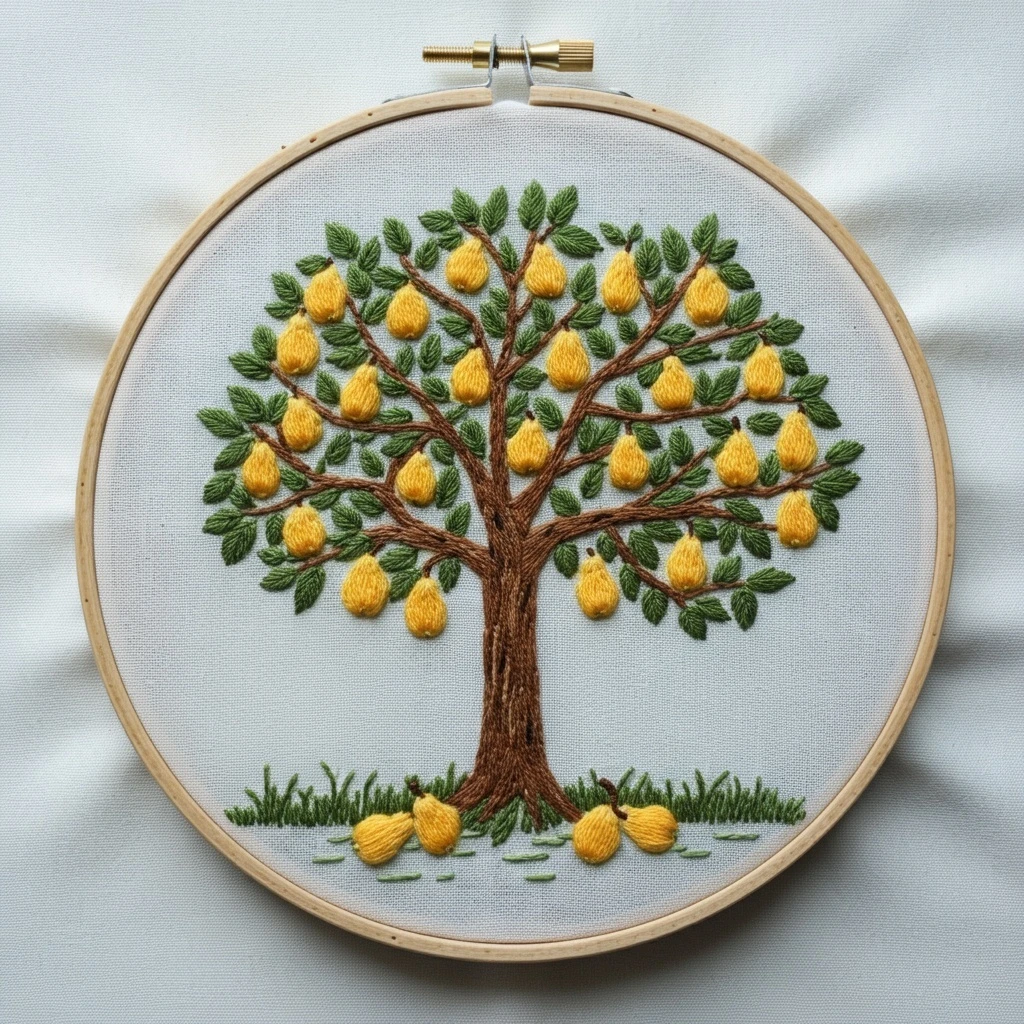
Preview image from the linked design reference. Colors are estimated visually from the stitched sample.
Design Read
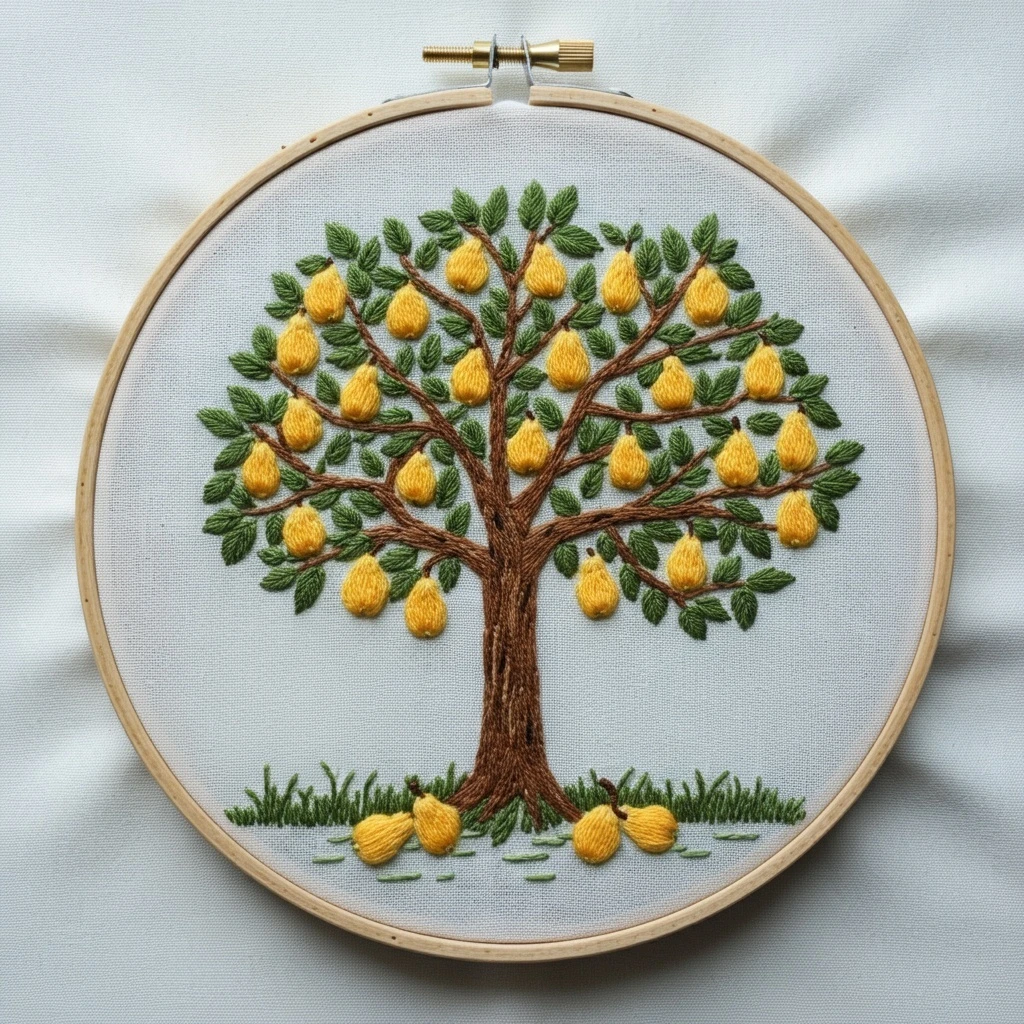
This hoop is built around a strong central trunk, curving brown branches, many raised pear shapes, and compact clusters of small directional leaves. The overall effect is sunny, rustic, and abundant, with the warm yellow pears acting as the focal points against deep foliage and textured bark.
The most important visual decisions are contrast and texture: keep the pears plump and luminous, the trunk visibly ridged, and the leaves crisp enough to separate from the branches.
Likely DMC Color Palette
Palette based on the visible pear fruit, dark and medium leaves, reddish-brown branches, textured trunk, small ground grasses, and pale neutral fabric background. Coverage percentages are practical visual estimates, not exact thread usage.
Stitching Suggestions
| Element | Recommended Stitch | Practical Notes |
|---|---|---|
| Central trunk | Split stitch base, stem stitch, long-and-short stitch | Work vertical rows in 801, then add 938 grooves and 975 highlight streaks. Keep lines slightly uneven to mimic bark. |
| Main branches | Stem stitch or whipped backstitch | Use 2 strands on major branches and 1 strand as branches taper. Add darker brown underneath for depth. |
| Pears on branches | Padded satin stitch or long-and-short stitch | Outline the pear, add a few padding stitches inside, then cover with vertical satin stitches. Shade lower edges with 782 and crown with 725. |
| Fallen pears | Padded satin stitch with directional straight stitches | Angle stitches following the fruit curve so the fallen pears look dimensional rather than oval and flat. |
| Leaf clusters | Fishbone stitch, lazy daisy, or detached chain | Fishbone gives the cleanest leaf texture. Alternate 3345, 3363, and 3052 from leaf to leaf for a lively canopy. |
| Small leaf veins | Single straight stitch or fine backstitch | Use 1 strand of 3051 or 3052 only on larger leaves; too many veins can make the canopy feel crowded. |
| Grass at base | Straight stitch, seed stitch, and fly stitch | Vary blade height. Mix dark green near the trunk with lighter green at the outer edges for a soft ground line. |
| Pear stems and dimples | Tiny straight stitch or couching | Use 938 or 801. Add after the pear fill is complete so stems sit cleanly on top. |
| Outlining | Backstitch or split backstitch | Outline pears only where needed: a partial dark line on the shadow side is more natural than a full cartoon outline. |
Thread Count & Blending
Blending ideas
For pears, try a three-step blend: 782 at the lower left, 783 through the main body, and 725 at the upper center. For bark, alternate 801 and 975 in broken vertical lines, then place 938 only in the deepest grooves.
Texture & Shading Guidance
The sample relies on raised fruit and layered leaf stitches. Do not flatten every area with the same stitch direction. Pears should be plump, leaves should have a pointed directional grain, and bark should feel rough and striated.
Leave small slivers of fabric between some leaves and branches. This breathing room keeps the canopy readable and prevents green areas from merging into one dense mass.
Where to Start
Helpful Notes
- Use a sharp embroidery needle for dense pear satin stitches and a slightly larger eye needle when blending two colors.
- Keep satin stitches smooth by laying each strand flat and avoiding overly long stitches; split large pears into subtle vertical sections if needed.
- Do not pull leaf stitches too tightly, or the fabric may pucker around the canopy.
- Work darker accents last. A small amount of 938 adds dimension, but too much can make the tree look heavy.
- For a softer handmade look, allow the leaves to vary slightly in angle and length rather than making every pair identical.