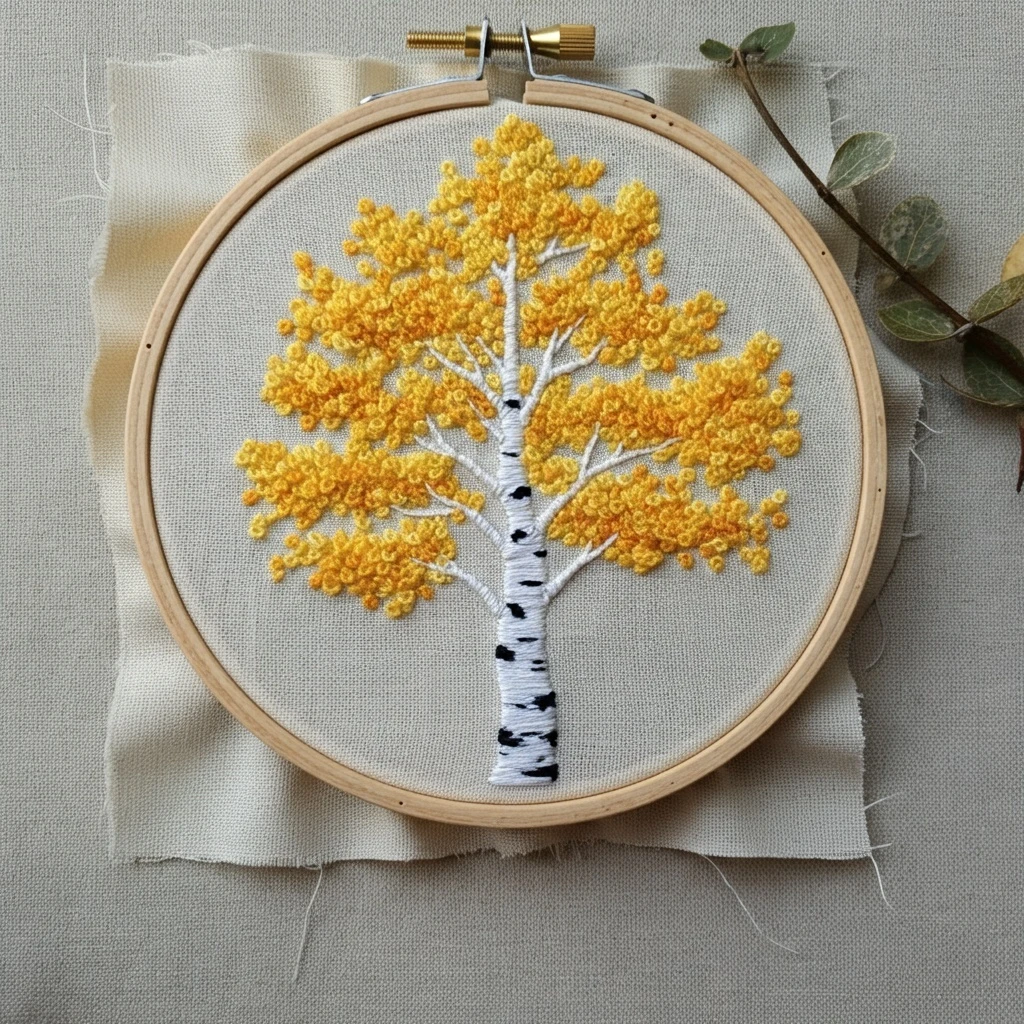

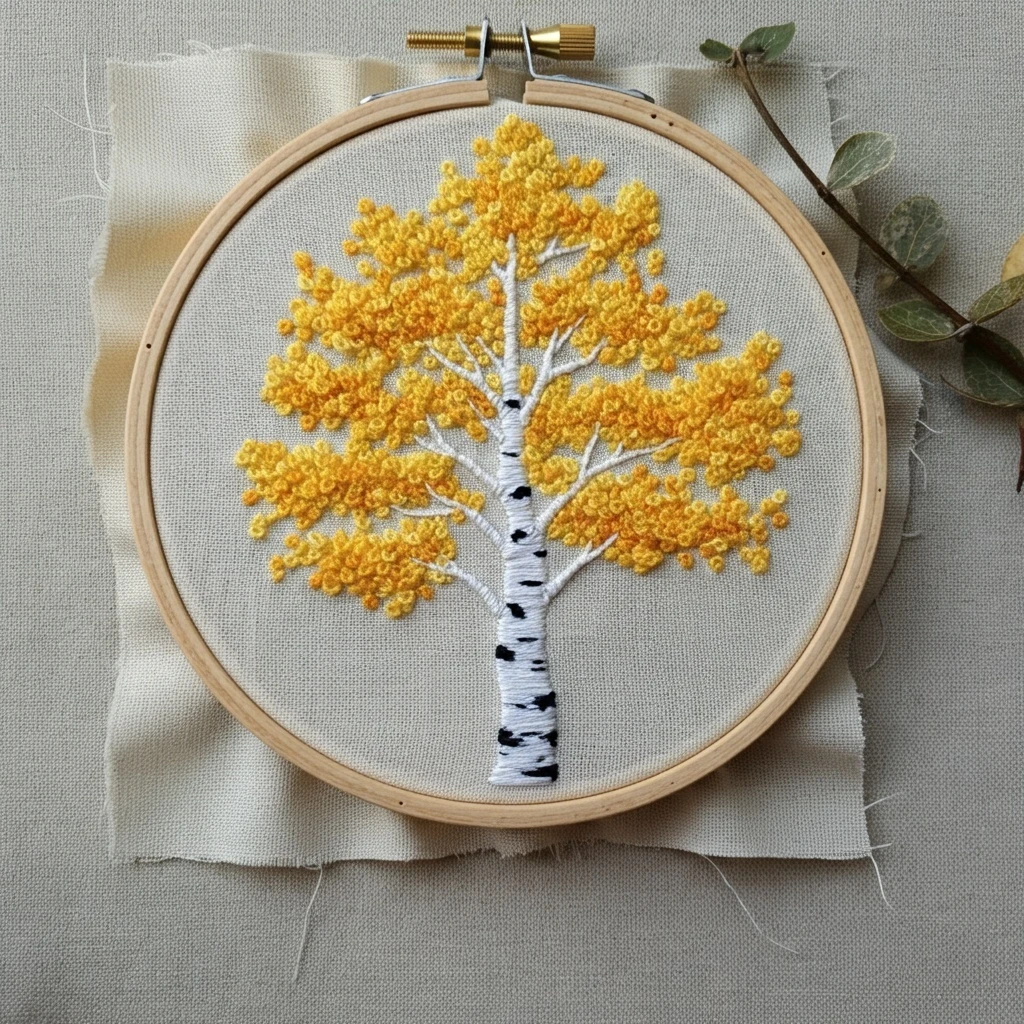
Autumn Aspen Birch Tree
A warm, textured woodland design built around pale birch trunks, dark bark markings, and a glowing canopy of French knots in gold, pumpkin, copper, rust, and amber.
Design read
Main color story
Use creamy linen as the negative space, then layer foliage from bright yellow through orange into rusty copper. The strongest contrast should come from black-brown birch markings against pale trunks.
Texture focus
The canopy should feel dotted, plush, and irregular. French knots are the star; vary wraps and strand count so the treetop has natural depth instead of a flat polka-dot look.
Composition focus
Keep trunks vertical and clean, then allow foliage clusters to spill outward in rounded crowns. A few fallen knots at the base help anchor the scene.
Suggested DMC palette
Stitch map by design area
Autumn canopy
- French knots: 2 strands, 1–2 wraps for small dots; 3 strands, 2 wraps for raised foreground leaves.
- Placement: cluster knots in loose bunches, leaving tiny fabric gaps so the canopy breathes.
- Color order: start with 742 and 970, add 743 highlights last, then tuck 921/920 into shadowed pockets.
Birch / aspen trunks
- Split stitch or stem stitch: 1–2 strands of B5200 or 822 for pale trunk edges.
- Backstitch: 1 strand 3371 for short horizontal bark marks.
- Shading: add 3864 or 822 on one side of each trunk to prevent a flat white column.
Branches
- Stem stitch: 2 strands 898 for visible limbs; 1 strand for thin twigs.
- Couching option: couch a twisted 898/975 strand for slightly raised branch texture.
- Direction: taper branch ends by switching from 2 strands to 1 strand.
Ground and fallen leaves
- Straight stitch: 1 strand 3864 for a simple ground suggestion.
- French knots: scatter 743, 970, 921, and 920 at the base.
- Balance: keep the ground sparse so it supports the trees without stealing attention.
Blending and shading plan
| Area | DMC blend | How to use it |
|---|---|---|
| Bright leaf tips | 1 strand 743 + 1 strand 742 | Make small 1-wrap knots around the outer top-left canopy to suggest sunlight. |
| Core autumn orange | 1 strand 742 + 1 strand 970 | Use as the main filler blend; it bridges yellow highlights and pumpkin orange. |
| Deep leaf pockets | 1 strand 970 + 1 strand 921 | Place beneath branch intersections and lower foliage masses for rounded depth. |
| Rusty shadow notes | 1 strand 921 + 1 strand 920 | Add sparingly along the right/lower canopy edge and behind trunks. |
| Branch warmth | 1 strand 898 + 1 strand 975 | Use stem stitch on thicker limbs; the mix reads woody without becoming too black. |
| Birch shadow | 1 strand 822 + 1 strand 3864 | Work tiny split stitches along one side of trunks to create roundness. |
Outlining details
Best thread counts
French knots: 2 strands for most leaves; 3 strands for foreground clusters; 1 strand for tiny distant dots.
Branches: 2 strands for main limbs, 1 strand for delicate twigs.
Birch bark: 1 strand only for crisp black-brown markings.
Ground line: 1 strand, light pressure, and broken strokes.
Practical embroidery tips
Keep knots consistent
Hold the working thread taut as the needle returns through the fabric. For this design, consistent tension matters more than identical knot size.
Use a shaded knot rhythm
Do not complete one color at a time in perfect rows. Instead, work in small color neighborhoods: yellow, yellow-orange, orange, copper, then rust.
Protect the white trunks
Stitch dark bark with a clean needle and short thread lengths. Dark fuzz dragged across pale trunks can dull the birch effect.
Check from a distance
Every few minutes, hold the hoop at arm’s length. Add knots where the canopy feels thin and stop before the treetop becomes a solid mass.
Finishing notes
For a soft autumn finish, mount on natural linen, oatmeal cotton, or light cream fabric. A 6–8 inch hoop suits the design well: small enough for dense French-knot texture, but large enough to keep the vertical trunks elegant. Press from the back on a towel so the knots stay raised, and avoid flattening the canopy after washing or blocking.
Palette suggestions are approximate DMC matches chosen for the visible autumn-birch design language: golden foliage, pumpkin-orange knots, rusty shadows, pale trunks, and high-contrast black-brown bark.