

DMC color palette · stitch planning · finishing notes
A Culinary Wheel
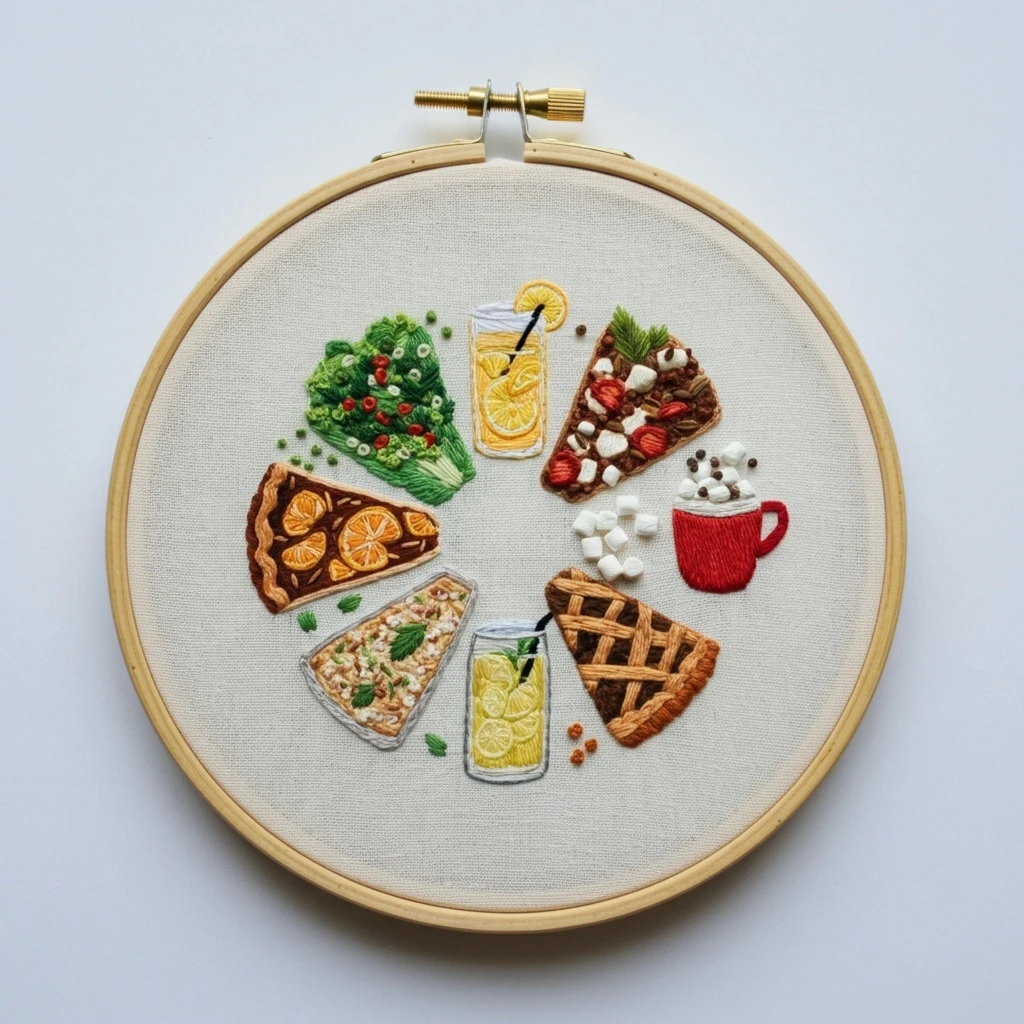
A cheerful food-themed embroidery guide inspired by the circular reference design: citrus drinks, leafy greens, tomato accents, lattice pie, chocolate dessert, coffee mug, marshmallows, mint leaves, and warm pastry browns arranged like a playful tasting wheel.
Design Read: What to Capture
Visual mood
The design is arranged as a loose culinary wreath with small stitched food vignettes around the hoop center. Its charm comes from contrast: bright lemon slices and red berries against creamy linen, leafy greens, rich chocolate browns, toasted pie crust, and a vivid red cup.
Embroidery priorities
Keep each food item readable at small scale. Use smooth satin for drinks and cups, textured knots for berries and cocoa bits, couching for lattice pastry, crisp backstitch for glass rims, and tiny detached stitches for herbs and garnishes.
Suggested DMC Palette
These colors are selected for the visible lemon yellows, leafy greens, tomato reds, pie-crust tans, chocolate browns, creamy marshmallows, clear-glass outlines, and dark finishing lines in the reference image.
Motif-by-Motif Stitch Suggestions
| Area | Recommended stitches | Threads | Color handling |
|---|---|---|---|
| Lemon drinks and citrus wheels | Satin stitch for liquid, backstitch for glass, straight stitches radiating from citrus centers. | 2 strands for glass and fruit lines; 3 strands for drink fill. | Fill with 3078, add 444 on rind and radial lines, use 742 for warm shadow wedges. |
| Leafy green wedge | Fishbone stitch, closed fly stitch, detached chain, and French knots for small peas or seeds. | 2–3 strands for leaves; 1–2 strands for detail dots. | Base with 701, highlight with 702, deepen folded areas with 700. Scatter red 321 knots sparingly. |
| Chocolate dessert slice | Long-and-short stitch, seed stitch crumbs, French knots, and tiny satin fruit pieces. | 2 strands for fill; 3 strands for raised toppings. | Use 801/898 for cake, Blanc/739 for marshmallow chunks, 321/816 for fruit pieces. |
| Fruit or citrus pie slice | Padded satin for crust, stem stitch border, tiny straight stitches for orange segments. | 3 strands for crust; 1–2 strands for fruit details. | Crust in 977 and 434; filling in 801/898; citrus slices in 742, 444 and 3078. |
| Lattice pie | Couched satin strips, woven lattice effect, split stitch outline. | 3–4 strands for raised strips; 1 strand for dark gaps. | Work strips in 977, shade lower edges with 434, place 898 in triangular filling gaps. |
| Red mug and whipped topping | Satin stitch for mug body, split stitch handle, French knots for cocoa bits, padded satin for cream. | 3 strands for mug fill; 1–2 strands for handle and rim. | Use 321 with 816 on the right/lower side. Whipped cream is Blanc with tiny 739 shadows. |
| Savory slice with herbs | Seed stitch, small satin patches, detached chain herb leaves, backstitch crust. | 2 strands for filling texture; 1 strand for herbs. | Use Blanc/739 for cheese, 977/434 for crust, 701/702 for herbs, tiny 321 accents if desired. |
| Loose garnishes and crumbs | French knots, colonial knots, single straight stitches and tiny lazy daisies. | 1–2 strands; vary wraps for scale. | Use greens for herbs, 434/898 for crumbs, 321 for berries, 444 for citrus specks. |
Blending & Shading Plan
Citrus sparkle
Blend 1 strand 444 + 1 strand 3078 for lemon pulp. Use pure 444 only for rind edges and the strongest segment lines so the lemon slices stay bright without becoming heavy.
Pastry warmth
For crust and lattice, combine 1 strand 977 + 1 strand 434 on lower strips, then switch to pure 977 on top strips. This makes the woven lattice look raised and toasted.
Chocolate depth
Use 801 as the main chocolate color and place 898 only in the deepest corners. Add a few 434 seed stitches to suggest crumb texture and keep dark food shapes from looking flat.
Thread Count & Texture Map
| Texture goal | Thread count | Where to use it |
|---|---|---|
| Smooth filled shapes | 3 strands | Red mug, drink liquid, large pastry pieces, leafy wedge base. |
| Fine readable details | 1 strand | Glass rims, citrus segment lines, small outlines, tiny herb veins. |
| Raised food texture | 3–4 strands | Lattice pie strips, crust edges, marshmallow cubes and whipped cream. |
| Tiny dots and toppings | 2 strands with 1–3 wraps | Cocoa bits, tomatoes, peas, crumbs, berries and garnish specks. |
| Natural leaf grain | 2 strands | Mint leaves, basil leaves, lettuce ribs and scattered green flecks. |
Outlining Details
Use soft outlines first
Outline glassware with 415 instead of dark brown, then add only one or two 3371 stitches where the straw, rim, or shadow needs crisp separation. This keeps the drinks transparent and light.
Match the outline to the food
Use 434 around crusts, 898 around chocolate, 700 around greens, 816 around the red mug, and 415 for neutral dish or glass edges. Reserve 3371 for the final smallest accents.
Practical Embroidery Tips
- Fabric: Natural linen, cotton-linen or evenweave in oatmeal, flax or warm ivory will match the neutral hoop background.
- Needles: Use a size 7–8 embroidery needle for most areas and a slightly larger chenille needle when couching lattice strips or making padded toppings.
- Hoop tension: Keep the fabric drum-tight, especially for satin-filled drinks and the red mug, so the shapes do not pucker.
- Tiny motifs: Shorten satin stitches on small items. Long satin stitches can snag and make the food shapes lose their edges.
- Knots: Vary French-knot wraps to suggest different toppings: one wrap for pepper-like dots, two wraps for berries, three wraps for round cocoa bits.
- Negative space: Leave breathing room between food items so the circular arrangement reads clearly as a wheel.
- Finishing: Press from the back on a towel. Avoid flattening lattice, knots, marshmallows and whipped cream texture.
Quick Stitch Recipe
- Transfer the food wedge outlines lightly, marking glass rims, mug handle, citrus wheels and lattice strips.
- Work pale grey glass outlines and soft dish edges first with 415.
- Fill the largest shapes: leafy greens, red mug, drinks, pie fillings and chocolate dessert.
- Add raised crusts and lattice using 977 and 434, couching where needed for neat woven lines.
- Stitch citrus segments with radial straight stitches and tiny backstitch circles.
- Add garnishes, herb leaves, tomatoes, marshmallows, cocoa bits and crumbs as raised accents.
- Finish with selective 1-strand outlines and a few dark accents to sharpen the most important overlaps.