
DMC palette & hand embroidery guide
Vibrant Bouquet Basket With Butterflies Easy
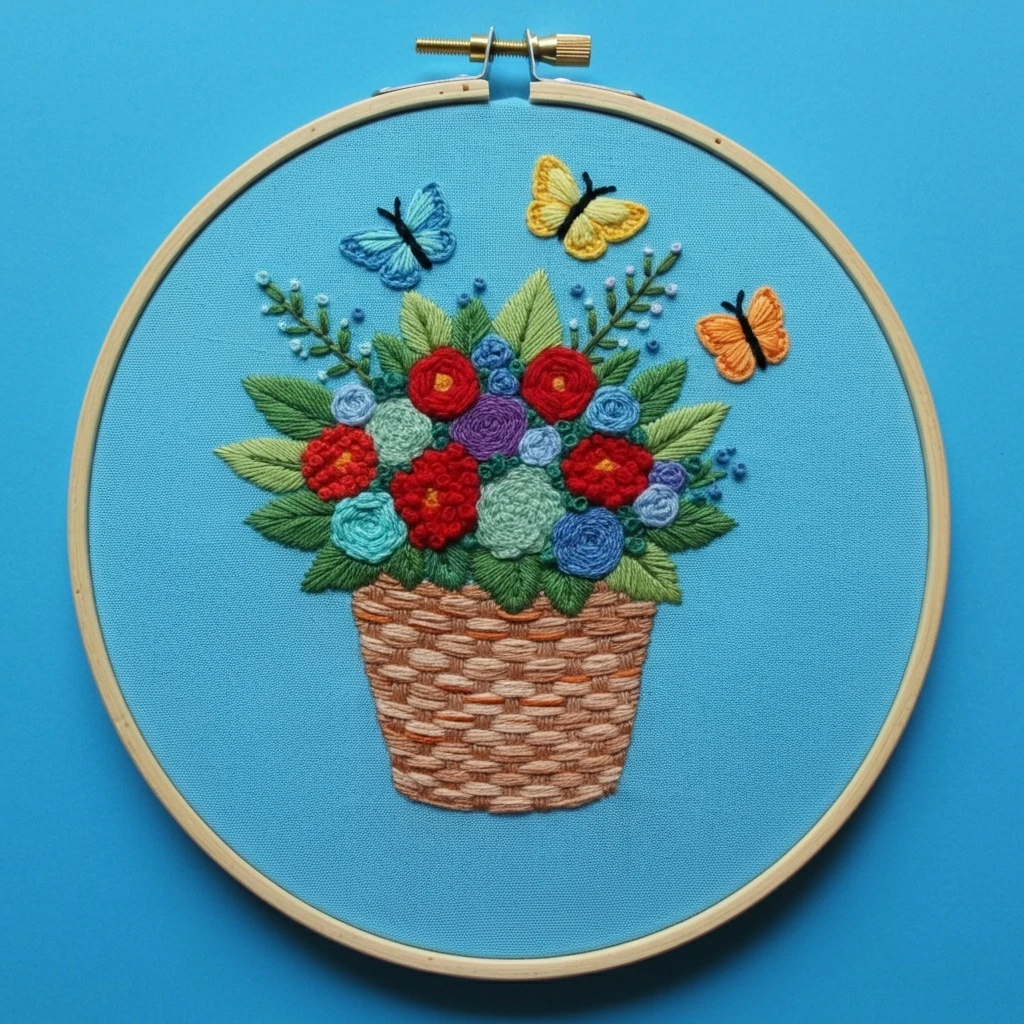
A cheerful beginner-friendly basket design with woven wicker texture, rounded spiral blooms, leafy greenery, tiny bead-like flower sprigs, and three airy butterflies. The color story is bright and garden-party fresh: turquoise fabric, warm basket browns, saturated reds, cool blue blossoms, minty filler flowers, clear greens, and sunny butterfly accents.

Likely DMC Color Palette
Colors are estimated from the visible hoop preview and matched to close DMC six-strand cotton shades. Use them as a practical stitching palette rather than exact thread-usage percentages.
Stitching Suggestions
Keep the design approachable: work the basket first, then leaves, then larger flowers, then butterflies and tiny knots last.
| Element | Suggested stitch | Thread count & practical notes |
|---|---|---|
| Wicker basket | Horizontal satin stitch, split stitch, couching | Use 3 strands for the base rows. Alternate 3859 and 975 in short broken bands, then couch a few lighter strands over the top to imitate woven wicker. |
| Basket outline | Backstitch or whipped backstitch | Use 2 strands of 975 around the sides and bottom. Whip with 3859 where you want the rim to look rounded. |
| Large leaves | Fishbone stitch | Use 2 strands. Start with 470 down the center and add 987 near the base or underside of leaves for natural depth. |
| Small stems and sprigs | Stem stitch and straight stitch | Use 1 strand for fine branching lines so the sprigs stay delicate and do not crowd the bouquet. |
| Round roses | Woven wheel or spiral satin | Use 3 strands for plush round blooms. Place 815 in the first shadow turns, then finish with 666 on the brighter outer rings. |
| Blue, aqua, and mint blooms | Woven wheel, satin stitch, or padded satin | Use 2-3 strands. Blend 3753 with 798 for blue rosettes, 3845 with a touch of 3813 for aqua flowers, and 3813 for soft filler blooms. |
| Red clustered flowers | French knots | Use 2 strands with one or two wraps. Mix 666 and 815 knots so clusters look bumpy and dimensional rather than flat. |
| Butterfly wings | Long and short stitch with backstitched veins | Use 1-2 strands. Fill wings lightly from body outward; outline wing edges with a matching darker shade or black only where the design needs definition. |
| Butterfly bodies | Satin stitch and straight stitch | Use 2 strands of 310 for the body and 1 strand for antennae. Keep the body slim so the wings remain airy. |
| Tiny berries/filler dots | French knots or colonial knots | Use 1-2 strands in violet, pale blue, or mint. Add these last, spacing them irregularly for a natural bouquet feel. |
Blending & Shading Plan
Outlining Details
This design can become busy, so outline selectively rather than tracing every shape.
- Use 1 strand of 987 to add short leaf veins after the leaf fills are complete.
- Use 2 strands of 975 only on the basket rim, side edges, and bottom curve.
- Use 310 sparingly: butterfly bodies, antennae, and a few wing vein marks only.
- Outline red flowers with 815 if they disappear into nearby red knot clusters.
- Leave some pale blue and mint flowers without dark outlines for a softer beginner-friendly finish.
Beginner-Friendly Working Order
Thread-count guide
Use 3 strands for the basket and plush woven flowers, 2 strands for leaves and most wing fills, and 1 strand for stems, antennae, veins, and delicate outlines.
Texture suggestion
Let the basket be ridged, the roses spiral, the red clusters knotted, and the butterflies smooth. The mix of textures makes this simple pattern look polished.
Tension tip
Because the fabric background is visually open, keep tension even and bury thread tails behind stitched areas rather than carrying dark threads across blank cloth.
Encouraging Finish
This piece works beautifully when it feels playful rather than perfectly symmetrical. Use the basket as the warm textured base, build the bouquet in rounded pops of color, and let the butterflies stay light and simple. Save the smallest knots and black details for the final pass so the finished hoop looks crisp, bright, and beginner-friendly.