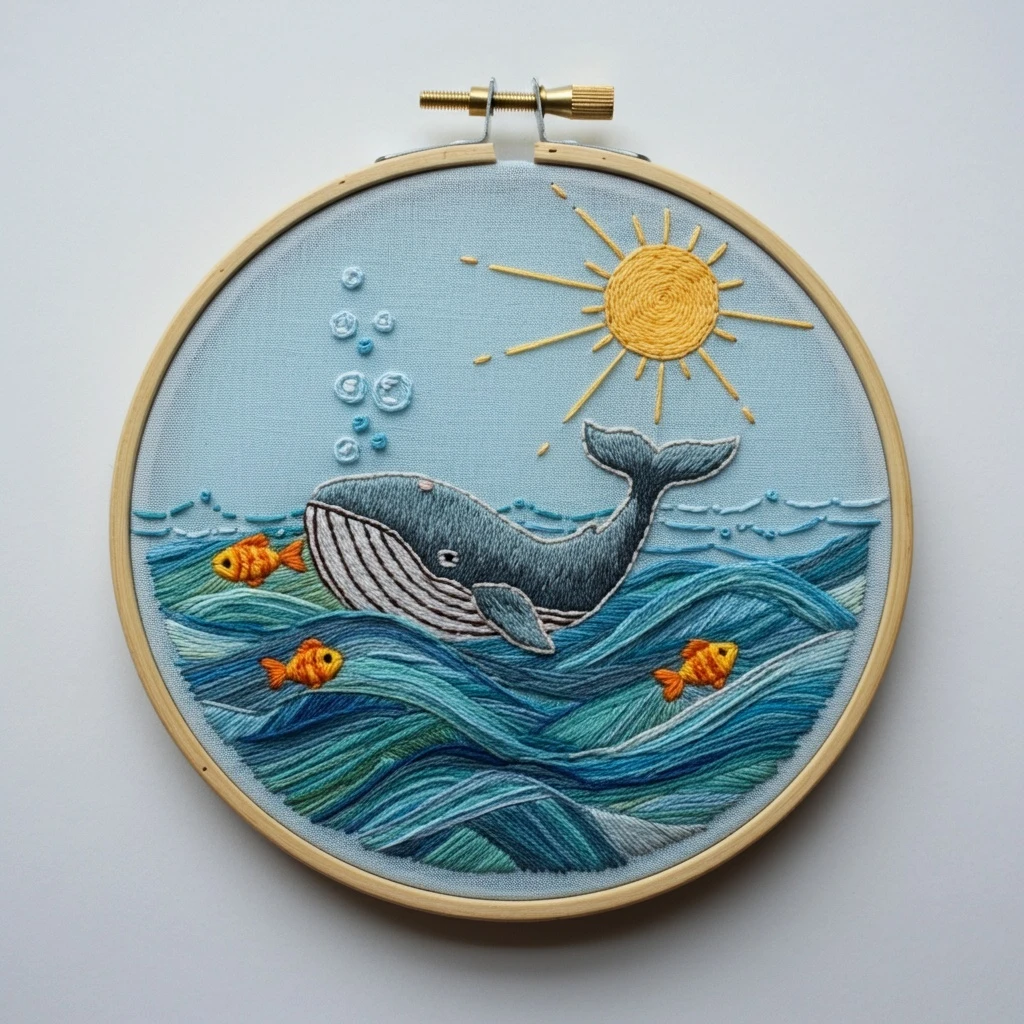

Sunlit Whale In The Waves
Design #809 · Ocean & Summer · DMC color palette and practical stitching guide
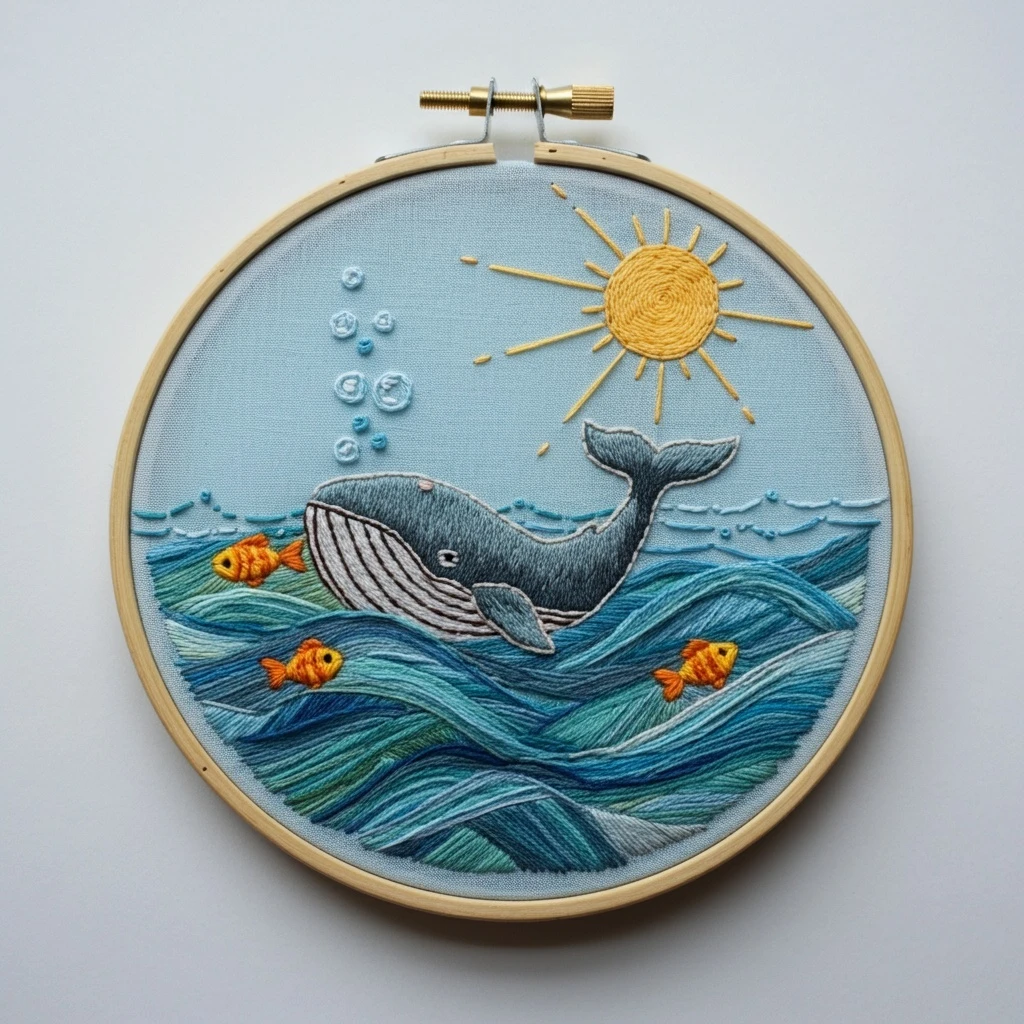
Colors are estimated from the visible hoop preview: a blue-gray whale rising through layered teal waves, golden sun rays, orange fish, pale foam, and airy blue bubbles on soft sky fabric.
Likely DMC Color Palette
Palette choices are matched to the main visual areas rather than exact dye sampling. Use the darker blues sparingly for definition and the pale aqua/gray tones generously for shimmer, foam, and water movement.
Main blue-gray shade for the whale’s upper back, tail base, and darker underside turns.
Blend through the whale body so the animal feels rounded rather than flat.
Use along the top ridge, fluke edges, and fin highlights touched by sunlight.
Fine details: whale mouth, eye, gill grooves, deepest wave creases, and small fish eyes.
Brighten whale belly ribs, tiny foam strokes, bubble rims, and water sparkle.
Place in wave troughs and below overlapping wave bands for strong ocean depth.
A rich blue for the bold rolling wave arcs and the horizon ripples.
Use for lively wave highlights, small dot accents, and crisp bubble centers.
Good for pale wave bands, crest lines, and transitions between dark teal sections.
Adds sea-green variety to the lower rolling waves so the water is not only blue.
Use in narrow strokes at the base and under wave overlaps for drama.
Primary golden sun fill and most rays; keep it warm and clean against the blue fabric.
Add on top of the sun spiral and outer ray tips for a sunlit glow.
Main orange for the fish bodies and fins, especially where they pop against the waves.
Use on fish bellies and stripe highlights to make the tiny fish readable.
Deepen fish stripes, tails, and the underside of each fish with short accent stitches.
Estimated coverage: waves 48%, whale 24%, sun 10%, fish 6%, foam/bubbles 6%, outlines and accent details 6%.
Stitching Suggestions
| Element | Best stitch types | Practical notes |
|---|---|---|
| Whale body | Long and short stitch, split stitch outline | Work directional stitches from the back ridge down toward the belly. Use 924 + 926 for the main body, then feather in 927 where the sun would catch the top curve and fluke. |
| Whale belly ribs | Backstitch, stem stitch, tiny satin areas | Outline each rib with one strand of 3799 or 924, then soften the spaces with 762 and a little 927. Keep the rib lines curved, not perfectly straight. |
| Tail fluke and fin | Fishbone stitch, long and short stitch | Stitch from the center vein outward so the fluke has natural direction. Add a darker lower edge and a thin pale upper edge. |
| Large rolling waves | Long and short stitch, satin stitch bands, couching | Follow each wave band like ribbons. Alternate 930, 3765, 3846, 598, 503, and 500 so overlapping water layers remain distinct. |
| Wave crests and foam | Whipped backstitch, split stitch, straight stitch | Use 762 and 598 for broken, irregular crest marks. Leave tiny gaps so the foam looks light rather than like a hard white outline. |
| Sun disk | Spiral stem stitch, chain stitch, padded satin stitch | For the textured sun, start at the center and coil outward with 725. Add 726 as small top stitches and 783 only if extra shadow is needed around the lower edge. |
| Sun rays | Straight stitch, whipped straight stitch | Use two strands for the main rays and one strand for shorter glints. Anchor each ray cleanly at the disk edge to avoid loose long threads. |
| Tiny orange fish | Satin stitch, straight stitch, backstitch | Use 741 as the base, 742 for highlights, and 946 for stripes and tails. One strand of 3799 is enough for eyes and mouth details. |
| Bubbles | French knots, detached chain, whipped backstitch circles | Use 762 and 3846. Make some bubbles as tiny knots and others as loose circles so the cluster looks varied and buoyant. |
| Horizon ripples | Running stitch, backstitch, stem stitch | Keep these thinner than the foreground waves. A single strand of 3765, 598, or 762 prevents the horizon from competing with the whale. |
Thread Count, Blending & Shading
Thread-count guidance
- 2 strands: whale fill, most wave bands, sun spiral, and fish bodies.
- 1 strand: whale face, belly ribs, foam breaks, bubble outlines, fish eyes, and horizon ripples.
- 3 strands: optional padded foreground wave ridges if you want a bolder raised ocean texture.
- 6 strands: avoid for this design except for practice knots; it can overpower the small details.
Blending ideas
- For the whale, try one strand 924 + one strand 926 in shadow sections, then one strand 926 + one strand 927 for highlights.
- For waves, combine one strand 3765 + one strand 3846 for a vivid blue ridge.
- For pale foam, blend one strand 762 + one strand 598 so the foam stays soft and ocean-colored.
- For fish glow, add a single 742 stitch over 741 after the orange base is complete.
Suggested Stitching Order
Beginner-Friendly Practical Tips
Keeping the waves clean
- Use shorter stitches on tight curves and longer stitches on broad sweeping wave bands.
- Do not fill every gap. Tiny slivers of fabric between wave bands help the water breathe.
- Angle stitches in the same direction as the wave, not straight up and down.
- When changing colors, overlap the new shade into the previous shade by two or three stitches.
Making the whale readable
- Use a slightly darker outline around the whale than the surrounding water so the silhouette stands out.
- Keep the belly ribs thin; thick black lines can make the whale look cartoonish.
- Add the eye only after the head shading is finished.
- For a soft realistic edge, use split stitch rather than a heavy backstitch around the full body.