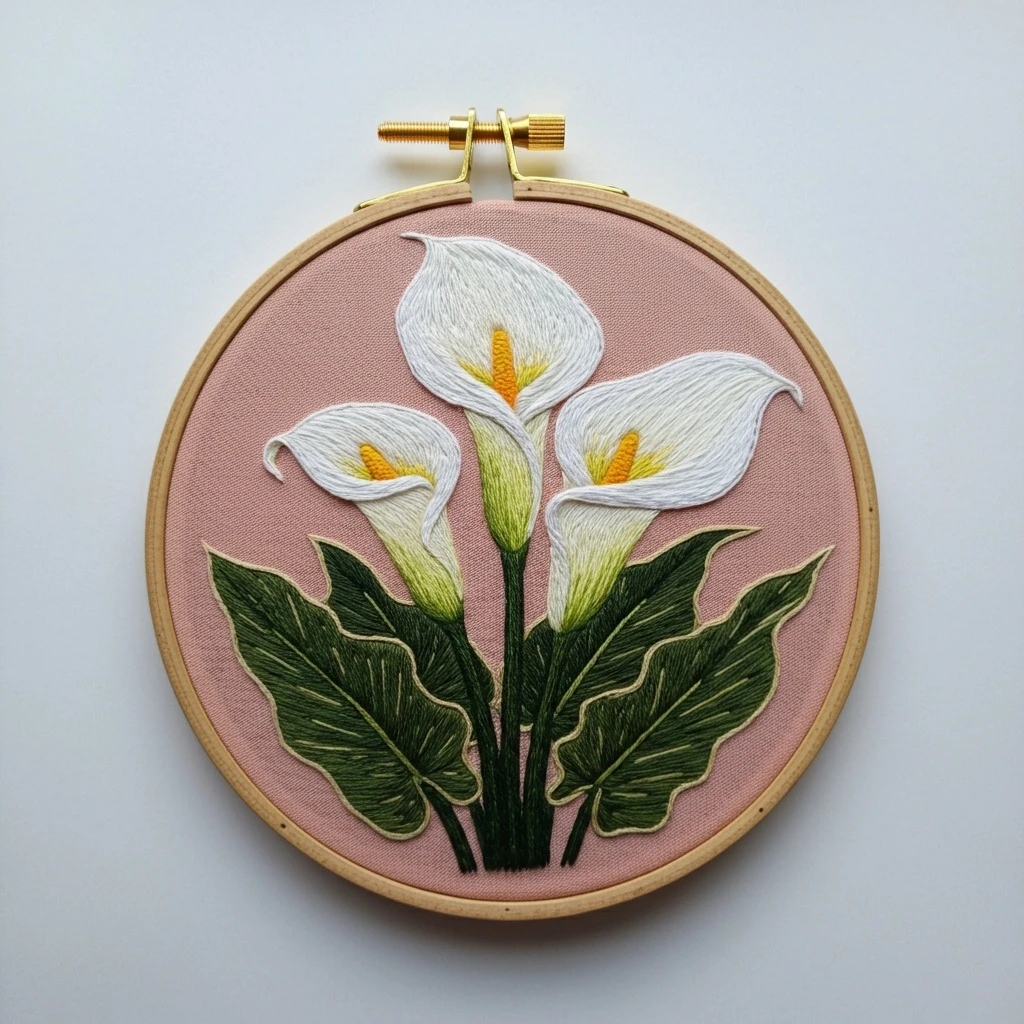

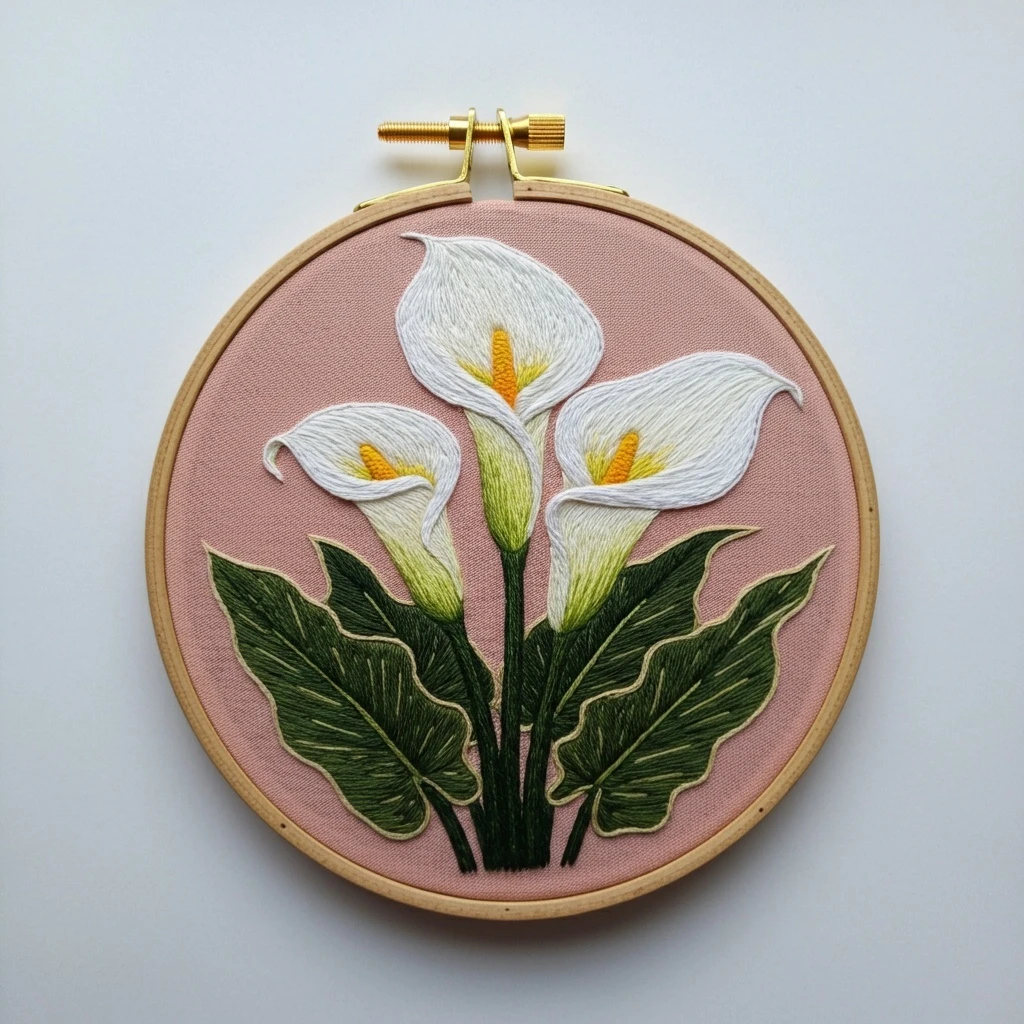
Elegant White Calla Lilies
A graceful hoop design with three sculptural white calla lilies, warm golden spadices, pale green flower throats, and large deep emerald leaves on a dusty rose fabric ground. This guide turns the visual reference into a practical DMC palette, stitch direction, thread-count plan, blending notes, and approachable hand-embroidery tips.
Design read
The calla lilies are the clear focal point: tall, clean white trumpets with softly curling rims and fine grey-white contour lines. Their centers glow yellow-orange, while the flower cups transition into light yellow-green at the base.
The lower half is visually heavier, with dark, glossy leaves and nearly black-green stems. Keep the lilies smooth and luminous, then make the leaves textured and directional so the bouquet feels elegant rather than flat.
Suggested DMC floss palette
Calla lily stitching plan
Calla lilies look best when the white petals are stitched smoothly with visible directional flow. Treat each flower as a folded cone: the stitches should curve from the outer rim toward the center throat, not run straight across the petal.
- Petal body: use 2 strands Blanc for long-and-short stitch. Work in narrow bands that follow the natural curve of the lily.
- Rim highlight: add B5200 with one strand along the top edge and curled tip. Keep these stitches light and intermittent.
- Fold shadows: place 1-strand 762 in fine split stitches inside petal folds; reserve 415 for only the deepest crease.
Centers and throats
The yellow spadix should sit raised against the flat white petal. The green throat should fade softly into the white cup without a hard outline.
- Spadix: use 2 strands DMC 728 for a padded base, then cover with tight French knots or seed stitches in 743 and 742.
- Green glow: blend 1 strand 3078 + 1 strand 3012 for the first throat layer, then add a few 3052 strokes at the lower base.
- Separation: avoid a heavy dark outline around the center; a few short 3363 stitches at the bottom are enough.
Element-by-element stitch guide
| Area | Best stitches | Thread count | Practical notes |
|---|---|---|---|
| White calla petals | Long-and-short stitch, satin stitch, split stitch contour | 2 strands for fill; 1 strand for fold lines | Keep stitches slightly arced. Switch to B5200 only at the brightest rim so the petals do not look flat. |
| Curled tips and rims | Short satin, stem stitch, tiny split stitch | 1 strand | Use fine grey at the underside of a curl and bright white on the edge to show the petal turning over. |
| Yellow spadices | Padded satin, French knots, seed stitch, colonial knots | 2 strands for padding and knots | Build a slim raised oval or column. Cluster knots tightly down the center, lighter on the top-facing side. |
| Lily bases | Long-and-short, fishbone, soft satin | 2 strands | Blend 3078 into 3012 and 3052. Let the green strokes tuck under the white petal edge. |
| Large leaves | Fishbone stitch, long-and-short, split stitch vein | 2 strands for fill; 1 strand for vein | Use 3362 as the body color, 895/500 at the base, and 3012/3052 for long highlight streaks. |
| Dark stems | Stem stitch, split stitch, whipped backstitch | 2 strands; 3 strands for thick lower stems | Keep stems strong and vertical in the center. Use DMC 500 in the deepest overlap where stems meet. |
Blending ideas
For luminous petals, use Blanc alone for most stitches, then mix 1 strand Blanc + 1 strand 3865 near the lower cup. For soft shadows, use 1 strand 762 with 1 strand Blanc instead of a solid grey line.
Outlining details
Outline only where a shape overlaps: the underside of a curled petal, the base of the cup, and the edges of large leaves. Heavy outlining around every white petal will reduce the elegant, airy effect.
Texture balance
Keep lily petals smooth, centers pebbled, and leaves streaked. That contrast makes the design read clearly even from a distance and gives beginners a simple texture map to follow.
Shading guidance
- Petal shadows: place grey stitches inside folds, never over the entire petal. White flowers need restraint to stay fresh.
- Light direction: keep the upper left and top rims brightest; deepen the lower cup and overlapping petal edges.
- Leaf dimension: start dark at the central vein and base, then pull mid green outward toward the edges. Add lighter vein strokes last.
- Fabric contrast: the dusty rose background warms the whites, so a small amount of grey and winter white will help the lilies stand out.
Beginner-friendly workflow
- Stitch the stems first so the flower bases can cover the stem ends neatly.
- Fill the large leaves next, working one leaf at a time to keep stitch direction consistent.
- Complete the pale green throats before filling the white petals; this prevents the green from sitting awkwardly on top.
- Add raised yellow centers after the petals are complete so the knots stay crisp and dimensional.
- Finish with one-strand highlights, crease lines, and tiny corrections around the petal rims.
Practical stitching tips
Use short lengths of white floss. Pale thread shows fuzz and handling quickly, so cut shorter working lengths and wash hands before stitching the calla petals.
Mind the stitch direction. The most important visual detail in this design is the flowing linework in the lilies and leaves. Even simple long-and-short stitches will look polished if they follow the flower's curve.
Test the white on your fabric. If Blanc disappears, add a few 3865 and 762 contour stitches. If the fabric is very dark, use B5200 for more of the upper petal surface.
Needle and hoop
Use a size 7 or 8 embroidery needle for two-strand areas, and switch to size 9 for single-strand contouring. Keep the hoop drum-tight so satin stitches stay smooth.
Thread-count rhythm
Use 2 strands for most fills, 1 strand for petal creases and leaf veins, and 3 strands only at the thick lower stems if your pattern is large enough.
Finishing touch
After stitching, gently steam from the back on a towel. Avoid pressing directly on the yellow knots so the spadices remain raised.