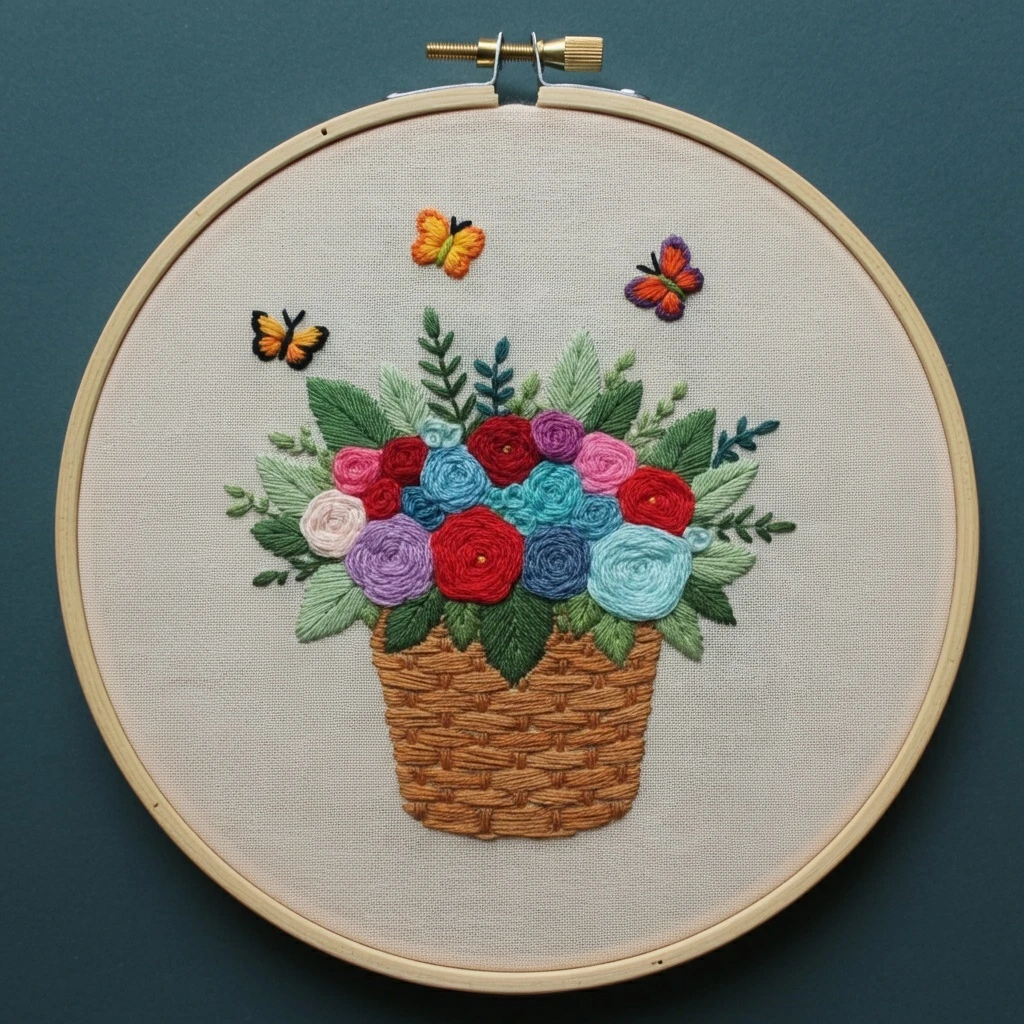

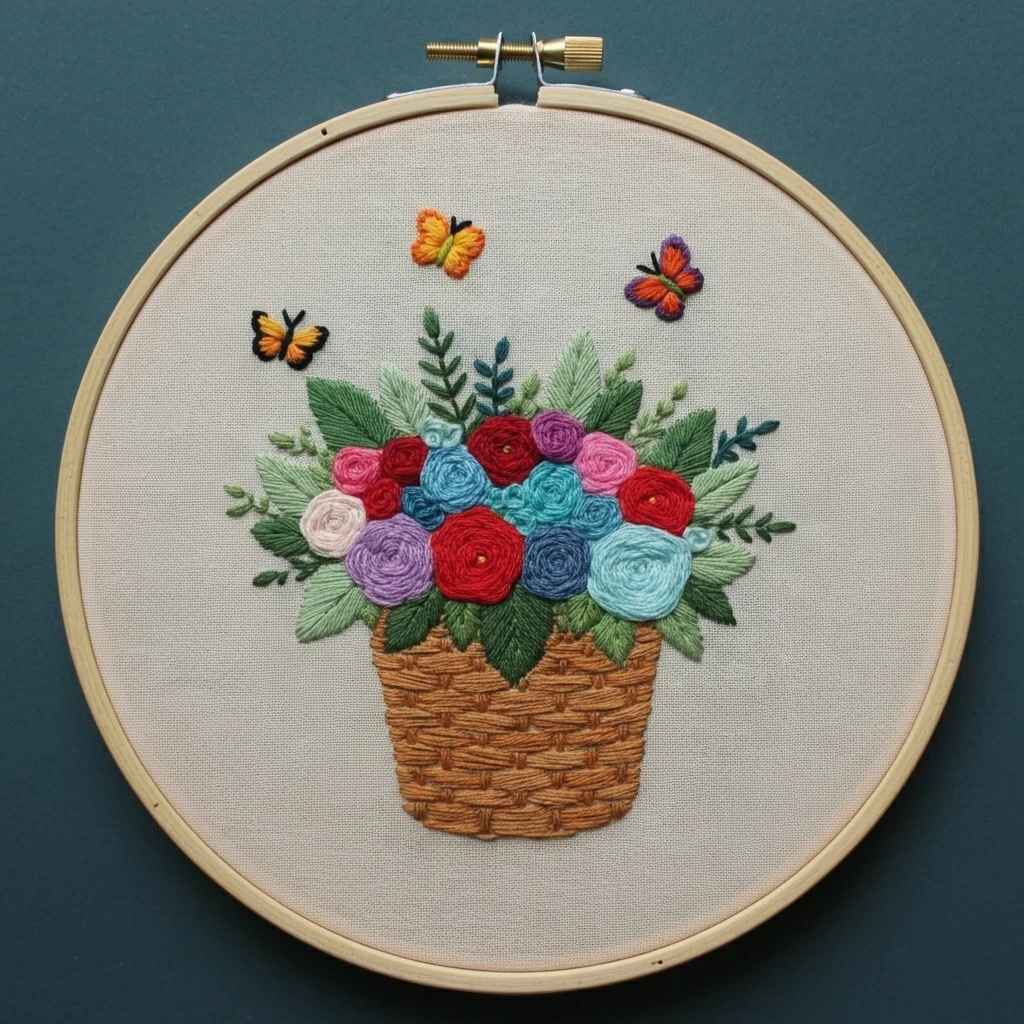
Colorful Flower Basket and Butterflies
This cheerful garden-basket design features a woven basket packed with bright flowers, layered leaves, tiny buds, and butterflies floating around the bouquet. The embroidery should feel joyful and dimensional: a warm wicker base, dense but readable flower clusters, fresh greenery, small accent blossoms, and light butterfly wings that appear to hover above the basket.
Polished DMC Color Palette
This palette keeps the design bright while still organized: warm browns for wicker, pink and coral focal flowers, yellow centers, lavender and blue filler blossoms, natural greens, and sunny butterfly tones.
Stitch Map by Design Element
Thread Count & Blending Guide
Fine details
Use 1 strand for butterfly antennae, wing outlines, tiny stems, petal veins, basket weave accents, and final correction stitches. Fine thread keeps the butterflies delicate.
Main fills
Use 2 strands for basket fills, large petals, leaves, butterfly wings, and stems. Two strands gives strong color while keeping the bouquet readable.
Raised accents
Use 2–3 strands for flower centers, dotted filler blossoms, and selected basket texture. Use three strands sparingly so the basket and blooms do not become bulky.
Shading, Outlining & Texture Suggestions
Basket dimension
- Stitch the basket before lower flowers so stems and blooms can tuck behind the rim.
- Alternate stitch direction in the weave to suggest woven wicker.
- Keep darkest browns at the lower edge and inside handle or rim overlaps.
- Add short light stitches on raised wicker strands instead of long continuous highlights.
Colorful bloom balance
- Place the largest flowers first, then fill with small blossoms and leaves.
- Repeat each strong color at least twice so the bouquet feels intentional.
- Use yellow centers to visually connect pink, coral, lavender, and blue flowers.
- Leave small open spaces around butterfly wings so they remain visible.
Butterfly lightness
- Use smooth satin stitches for wings and very fine stitches for bodies and antennae.
- Keep wing markings small; too many dark spots can make the butterflies heavy.
- Shade the lower wing edge slightly darker to create lift.
- Add wing glints after flowers are complete so butterflies look airy and bright.
Outlining approach
- Use brown outlines for the basket, matching darker shades for petals, and pewter or brown for butterfly bodies.
- Avoid black outlines around every flower; reserve the darkest thread for tiny butterfly details.
- Use split stitch for curved petals and back stitch for basket edges.
- Add outlines after base fills but before final knots and white highlights.
Beginner-Friendly Stitching Order
- Transfer the layout: mark the basket, handle or rim, largest flower heads, butterfly wing shapes, main stems, and leaf groups. Save tiny filler dots for later.
- Stitch the basket: complete the base fill, rim, and woven texture first so flowers can overlap it naturally.
- Add stems and back leaves: work the greenery that sits behind the flowers and inside the basket opening.
- Stitch focal flowers: add large blooms from darker centers to lighter petal tips.
- Add small flowers and buds: fill gaps with lavender, blue, yellow, white, and pink filler details.
- Stitch butterflies last: fill wings, add bodies, antennae, markings, glints, and final outline corrections so the butterflies stay crisp on top.
Practical Tips for a Clean Finish
Fabric & hoop
Warm cream, natural linen, pale blue, or soft oatmeal cotton-linen suits the bright garden palette. Keep the hoop drum-tight so basket weave, French knots, and butterfly wings stay neat.
Needle choice
Use a sharp embroidery needle size 7–9 for one- and two-strand stitching. Use a slightly larger needle only for three-strand knots or dense basket texture.
Keeping butterflies visible
Do not surround the butterfly wings with too many filler flowers. A small halo of open fabric makes the butterflies look like they are hovering above the basket.
Avoiding color overload
Group bright colors into zones: warm flowers, cool flowers, greenery, and butterflies. Repeating colors around the basket keeps the cheerful design from feeling chaotic.