
DMC palette & stitching guide
Hand Embroidered Lavender Bundle
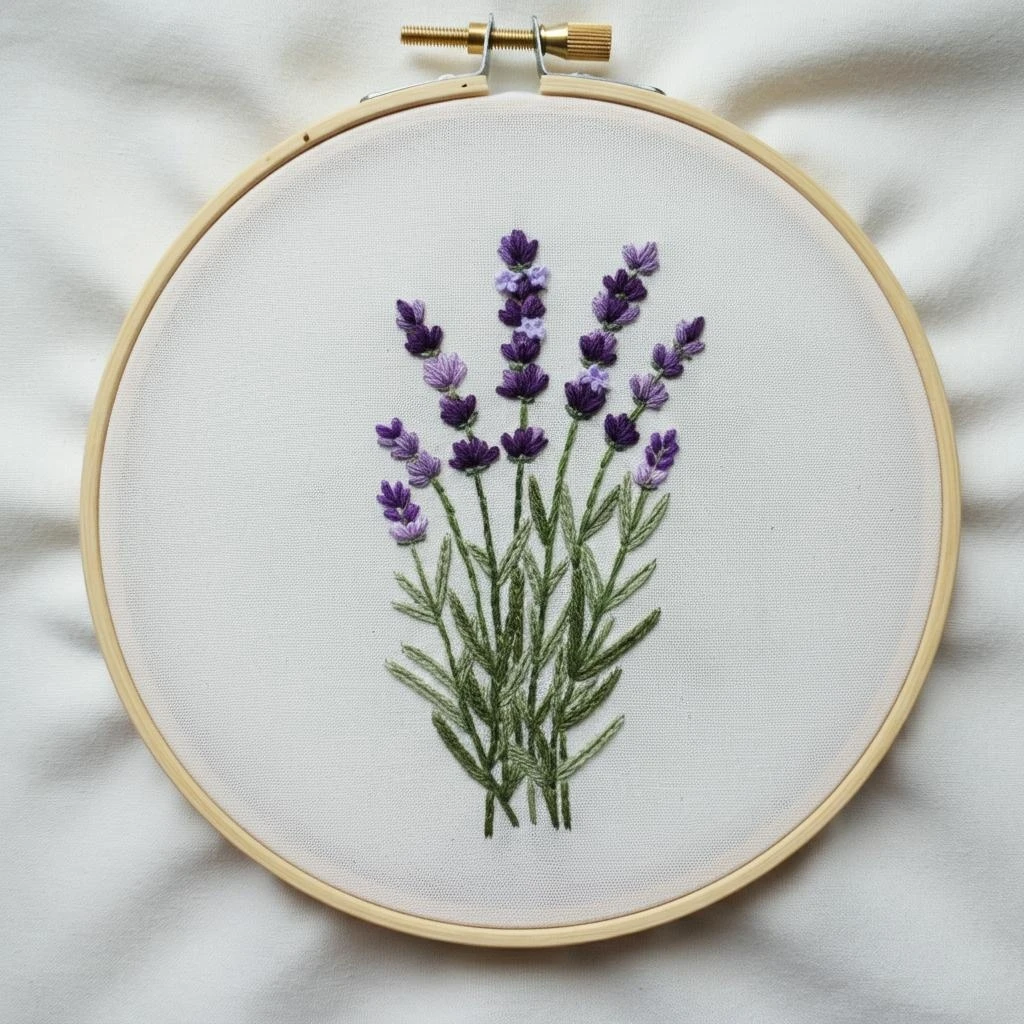
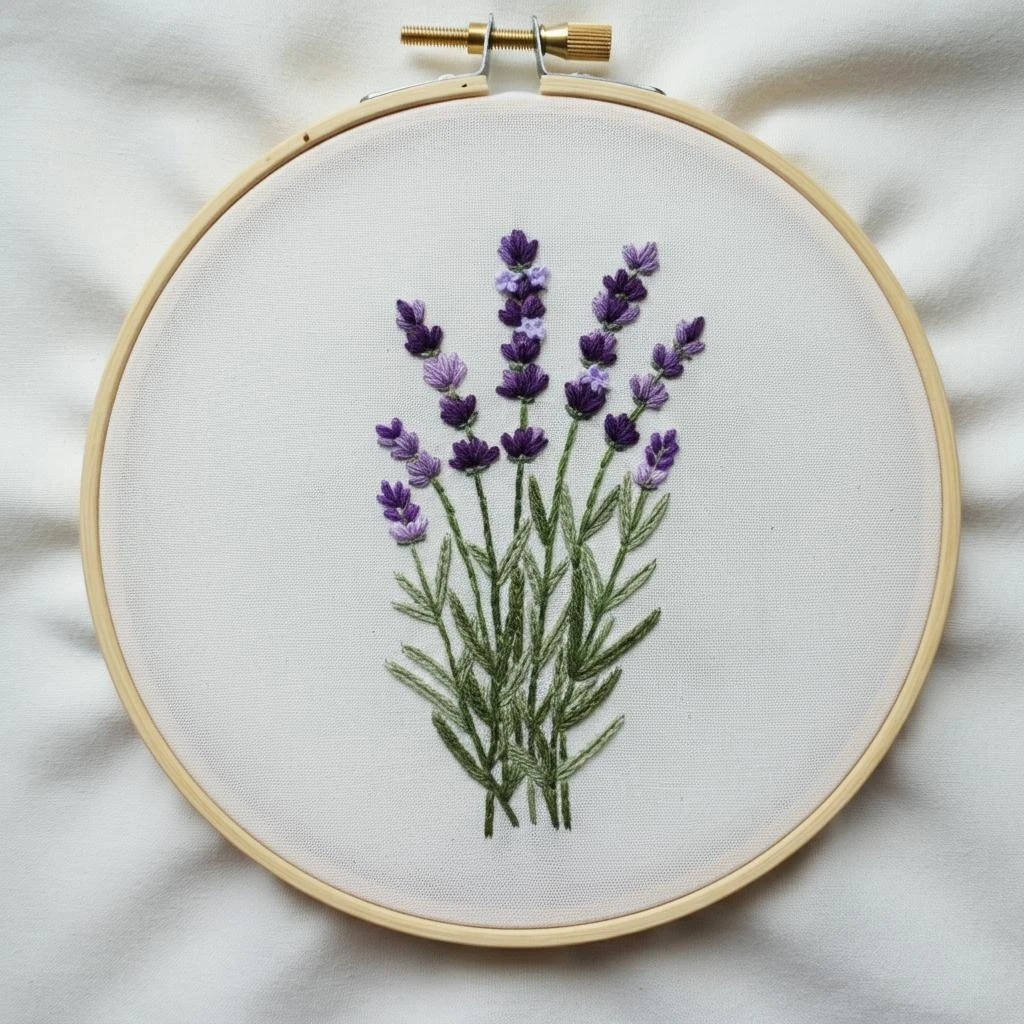
A calm botanical hoop with upright lavender spikes, soft purple flower clusters, long narrow leaves, and fine green stems on natural light fabric. The design works best with airy stitching, visible stem direction, and layered purples that keep the blossoms dimensional without becoming bulky.
Design focus: feathery stems, slim leaves, and clustered lavender buds with dark-to-light purple shading.
Suggested DMC Color Palette
Use the deep violets sparingly in the centers and shadow sides of each blossom, then lift the bud tips with pale lavender. Greens should stay slightly muted so the purple flowers remain the focal point.
Thread Count & Blending
- Stems: work with 1 strand for the thinnest side stems and 2 strands for the central upright stems.
- Leaves: use 1 strand for fly stitches and long straight stitches so the foliage stays light and grassy.
- Lavender buds: use 2 strands for satin, fishbone, or lazy daisy petals; add 1-strand dark accents after the main shape is in place.
- Blended petals: combine one strand DMC 552 with one strand DMC 209 for a middle purple that bridges dark centers and pale tips.
- Fine highlights: reserve DMC 210 or 211 for the top third of the flower spikes and small front-facing blossoms.
Shading Strategy
Build each lavender spike from the stem outward. Place darker purple nearest the stem and beneath overlapping blossoms, then add mid lavender on top and a few pale stitches at the outer tips.
- Alternate DMC 550 and 552 on lower buds for depth.
- Use DMC 553 and 209 for buds that face forward or catch light.
- Scatter small DMC 210 knots rather than filling whole buds with pale color.
- Let tiny gaps of fabric show between flowers; this keeps the spikes delicate.
- Shade leaves by placing DMC 3362 on the underside and DMC 3012 on the top edge.
Stitch Plan by Design Area
| Area | Recommended stitches | Practical notes |
|---|---|---|
| Main stems | Stem stitch, split stitch, back stitch | Follow the natural lean of each stalk. Use 1 strand for distant side stems and 2 strands for the central bundle. |
| Long leaves | Straight stitch, fly stitch, detached chain | Make leaves narrow and pointed. Vary length and direction so the base does not look like a flat fan. |
| Lavender buds | Lazy daisy, satin stitch, fishbone stitch | Work small petal clusters in groups of three to five stitches. Start dark near the stem, then cap with mid or pale lavender. |
| Flower texture | French knots, colonial knots, seed stitch | Add knots only after the petal stitches are finished. Keep them uneven and organic for a real lavender texture. |
| Fine outlines | 1-strand back stitch or couching | Outline only the darkest overlaps and a few leaf veins. Too much outlining will make the bundle look stiff. |
| Base of bundle | Layered straight stitch, whipped back stitch | Use deeper greens at the crossed stems, then add lighter strokes over the top to suggest loose gathered stems. |
Texture Tips
- Use short, raised satin stitches for plump buds.
- Angle petals upward along each spike.
- Add a few loose green stitches over stems for a wild herb look.
- Keep the top buds smaller than the lower flowers.
Beginner Notes
- Stitch stems first, then leaves, then flowers.
- Do not carry dark purple behind pale fabric between separated buds.
- Trim thread tails often so the back stays neat.
- Use a smaller needle for single-strand leaf details.
Finishing Details
- Press face down on a towel to protect raised knots.
- Mount in a clean wooden hoop to echo the natural herb theme.
- Add a tiny stitched ribbon tie in muted green or brown if desired.
- Leave generous blank space around the bundle for an elegant botanical finish.
Suggested Stitching Order
- Transfer the design lightly; mark only the main stems and bud placement so the finished embroidery stays clean.
- Stitch the central stems with DMC 3363, then add darker DMC 3362 to the crossing areas and base shadows.
- Add long leaves with single strands, alternating DMC 3363, 3012, and occasional 3013 highlights.
- Build the lavender heads from bottom to top using DMC 550 and 552 first, then layer DMC 553 and 209 above.
- Finish with tiny DMC 210 or 211 highlights and a few knots for texture; stop before the flower spikes feel crowded.
For a softer heirloom effect, stitch a few blossoms with a mixed needle of one strand DMC 552 plus one strand DMC 209. For a stronger, more graphic look, keep the dark DMC 550 shadows crisp and use fewer pale highlights.