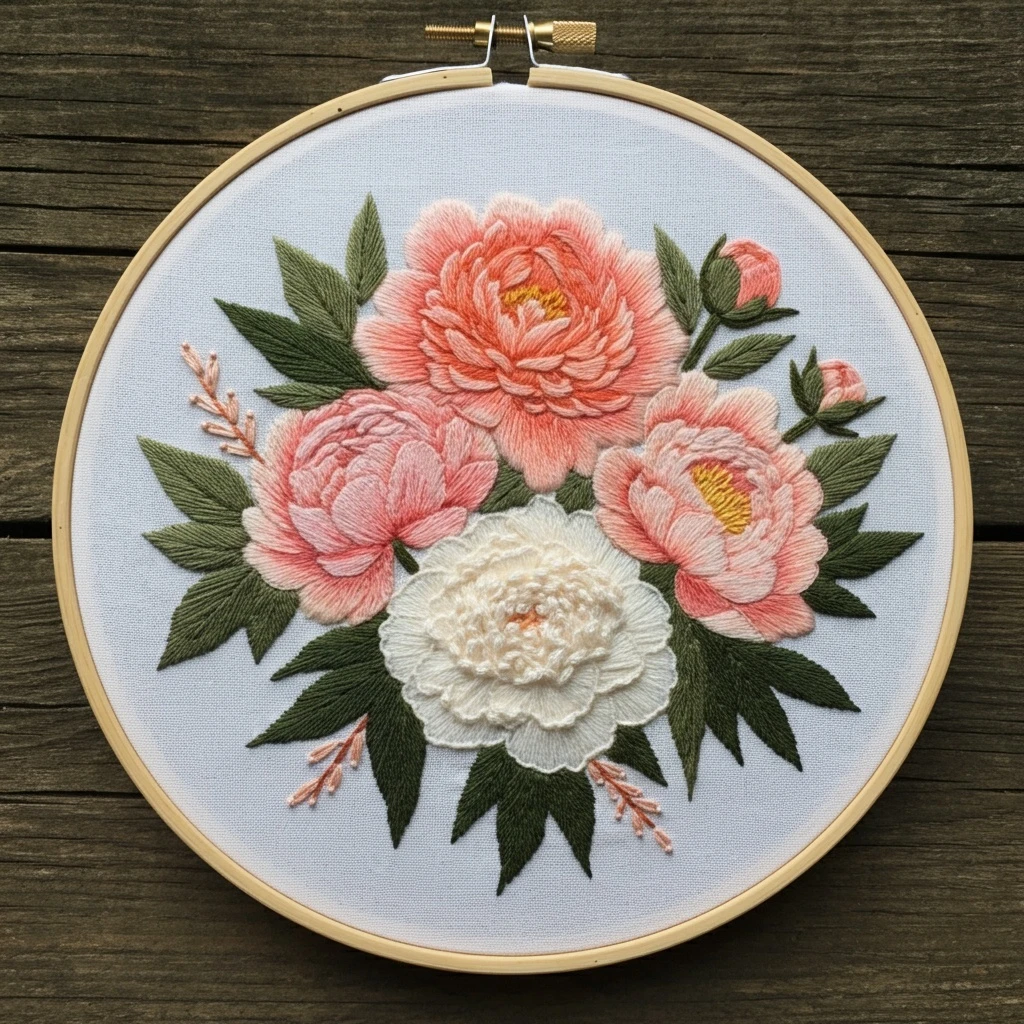


Textured Peonies 3D Floral
Colors are estimated from the visible hoop preview and matched to close DMC embroidery floss shades. The design features coral-pink peonies, a raised ivory bloom, dark layered foliage, warm yellow stamens, and small peach twig accents on pale linen.
Preview
Preview image from the linked design reference. The floss suggestions below are practical visual matches rather than exact kit quantities.
Design Notes
This piece is all about layered petal volume: soft coral shading around the upper peony, rosette-like pink petals on the left, a lighter open bloom on the right, and a dimensional ivory flower in front. The dark green leaves frame the flowers and make the pale petal edges look brighter.
Work from background leaves to foreground petals, saving the raised center knots and bold outlines for the end so the surface stays clean.
Likely DMC Color Palette
Palette based on the coral peonies, cream 3D flower, golden stamens, deep greenery, peach branches, pale fabric, and warm hoop tones.
| DMC | Thread Name | Coverage | Where It Appears / Practical Use |
|---|---|---|---|
| 761 | Salmon Light | 14% | Soft petal tips, pale highlights on the upper and right peonies, and feathered transitions into cream-pink areas. |
| 352 | Coral Light | 13% | Main coral-pink body color for the top peony and outer left peony petals. |
| 351 | Coral | 9% | Mid shadows inside folded petals; use in short directional strokes to shape the peony cup. |
| 350 | Coral Medium | 5% | Deepest pink-red petal creases, underside shadows, and tiny accents near flower centers. |
| 819 | Baby Pink Light | 8% | Very pale pink petals and blended highlights, especially on the left rosette and right open bloom. |
| 3865 | Winter White | 12% | Ivory flower petals, petal-edge highlights, and the brightest raised center texture. |
| 822 | Beige Gray Light | 5% | Warm shadows in the cream flower and subtle separation between pale petals. |
| 725 | Topaz Medium Light | 4% | Golden stamens and warm flower centers; combine with darker yellow for depth. |
| 782 | Topaz Dark | 2% | Stamen shadows, small center dots, and darker texture within yellow centers. |
| 3362 | Pine Green Dark | 12% | Deep leaf masses behind the flowers, leaf bases, and shadowed stems. |
| 3011 | Khaki Green Dark | 9% | Mid-green leaf veins, alternating leaf halves, and softer foreground foliage. |
| 3052 | Green Gray Medium | 4% | Leaf highlights and lifted tips where the leaves catch light. |
| 3778 | Terra Cotta Light | 3% | Peach twig accents, bud shadows, and warm outline details on small stems. |
Coverage percentages are visual estimates from the preview, not exact thread usage.
Stitching Suggestions
| Element | Stitch Type | Notes |
|---|---|---|
| Large coral peony | Long and short stitch | Fan stitches outward from the center. Blend 350 at the deepest folds, 351 through the petal bodies, 352 toward the middle, and 761 at the tips. |
| Left rosette peony | Padded satin stitch plus split stitch | Use a thin split-stitch outline first, then fill petal segments with curved satin stitches to create a layered, curled look. |
| Right open bloom | Long and short stitch with backstitch accents | Keep the lower petals pale and place coral shadow lines only where petals overlap, so the bloom stays airy. |
| Raised ivory flower | Detached buttonhole, woven picot, or padded satin | For a 3D effect, work outer petals flat, then add raised or padded central petals in 3865 with 822 tucked into the shadows. |
| Fluffy white center | French knots, colonial knots, or turkey work | Cluster 1- and 2-wrap knots tightly. Trim turkey work lightly if you want a soft tufted center. |
| Yellow stamens | Straight stitch and French knots | Use 725 for the bright strokes and 782 at the base or between knots for a golden textured center. |
| Leaves | Fishbone stitch | Angle stitches toward the central vein. Alternate 3362 and 3011 within each leaf, then add a few 3052 stitches near the tips. |
| Stems and peach sprigs | Stem stitch, backstitch, and tiny lazy daisies | Use 1 strand for fine twigs. Add small straight stitches or detached chain stitches as buds along the branches. |
| Petal outlines | Split stitch or fine backstitch | Outline only selected edges with one strand of 351, 761, or 822. Too much outlining can flatten the flowers. |
- Use 2 strands for most petals and leaves.
- Use 1 strand for petal veins, twig details, and delicate outlines.
- Use 3 strands or perle cotton only for intentional raised 3D centers.
- Blend 1 strand 352 with 1 strand 761 for soft salmon transitions.
- Blend 1 strand 3865 with 1 strand 822 for creamy petal shadows.
- Blend 3362 and 3011 in leaf rows for natural variegation.
- Keep darkest coral closest to petal overlaps and flower centers.
- Let pale pink and ivory sit on outer petal rims to mimic light.
- Place darkest green behind blooms to increase foreground dimension.
- Pad the cream flower with a base layer before satin or buttonhole stitches.
- Vary French-knot wraps so flower centers look organic.
- Use slightly uneven leaf stitch lengths to avoid a mechanical look.
Where to Start
Beginner-Friendly Practical Tips
- Use a sharp embroidery needle for dense petal areas and switch to a larger needle only for bulky 3D stitches.
- Keep floss lengths around 16–18 inches to reduce fraying, especially with pale pinks and whites.
- Do not pull raised stitches too tightly; dimensional flowers need a little loft.
- Test French knots on scrap fabric before stitching the flower centers so the knot size stays consistent.
- Step back often. Peony shading looks smoother from viewing distance than it does stitch-by-stitch.