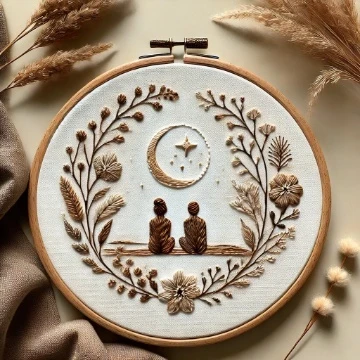

Design #850 · Neutral botanical wreath
Neutral Tones Botanical Wreath with Figures
Colors are estimated from the visible hoop preview and matched to close DMC embroidery floss shades. This guide focuses on warm beige linen, sepia botanical forms, small seated figures, a crescent moon, star detail, and softly textured dried-flower styling.

Likely DMC Color Palette
Palette based on the hoop fabric, warm wooden hoop, sepia branches, beige flowers, dark figure details, moon, star, and dried botanical accents. Coverage percentages are visual estimates, not exact thread usage.
Stitching Suggestions
Use small, controlled stitches and restrained contrast. The design depends on graceful outlines, raised seed textures, and gentle tonal shifts.
| Element | Stitch Type | Practical Notes |
|---|---|---|
| Outer wreath branches | Stem stitch or split backstitch | Use 1-2 strands of DMC 840 or 839. Follow the curve in short segments to keep the circle smooth and elegant. |
| Fine stems and twigs | Backstitch, single-strand stem stitch | Work with 1 strand for the thinnest botanical lines; switch to 2 strands only for the lower branches that need visual weight. |
| Leaves and grasses | Fishbone stitch, straight stitch, detached chain | Stitch leaves from base to tip, alternating 841, 840, and 839 so the neutral foliage has movement. |
| Dried seed pods | French knots, colonial knots, tiny satin ovals | Cluster 1-wrap knots for small beads and 2-wrap knots for prominent pod heads. Add 938 only as a tiny shadow dot. |
| Bottom flowers | Lazy daisy, woven wheel, satin stitch | Use 842 and 841 for petals; place 436 or 435 French knots in centers for warm raised texture. |
| Seated figures | Long and short stitch, satin stitch, split-stitch outline | Fill garments with 840/839, shade folds with 938, and keep facial or hair details minimal so the figures remain symbolic. |
| Crescent moon | Satin stitch with split-stitch edge | Outline first with 842, fill with 3865 blended with 739, then add a very fine 840 shadow on the inner curve. |
| Star | Straight stitch, tiny satin points | Use 3865 for the brightest point and couch a single 842 strand through the center if you want a subtle raised sparkle. |
| Ground line | Stem stitch or whipped backstitch | Work a steady base line in 435/839; keep it low contrast so it anchors the figures without overpowering the wreath. |
Thread Count, Blending & Shading
Thread count guide
Use 2 strands for most wreath leaves, flower petals, and figure fills. Use 1 strand for thin stems, star points, tiny seed stems, and the moon's delicate inner contour.
Neutral blending
Blend one strand 842 with one strand 841 for soft beige botanicals; blend 840 with 839 for richer figure shadows and darker branch transitions.
Outlining details
Reserve DMC 938 for the smallest dark touches. Too much dark outline can flatten the antique, sepia look, so place it only at intersections and deep silhouette points.
Shading direction
Shade leaves from darker bases to lighter tips. On the moon, keep the outer edge pale and use just a hairline of 840 on the inner crescent for dimension.
Texture suggestions
Mix smooth satin stitches for the moon and figures with raised knots for seed pods. This contrast makes the quiet palette feel rich and tactile.
Beginner tip
Transfer the wreath circle cleanly and stitch the main curve before adding details. A neat circle makes the entire design look polished even if the tiny botanicals vary.
Where to Start
Helpful Notes
| Fabric choice | A natural linen, oatmeal cotton, or warm ivory fabric will support the muted palette beautifully. On bright white fabric, add more 842 and 739 to keep the design soft. |
| Hoop scale | For a 6-inch hoop, keep most stems at 1 strand and avoid bulky knots. For an 8-inch hoop, 2-strand leaves and larger knots will read better. |
| Needle choice | A size 7 or 8 embroidery needle works well for 2-strand stitches; use a size 9 or 10 for delicate 1-strand linework and small knots. |
| Managing neutrals | Label floss cards carefully because beige-brown shades look similar under warm light. Check contrast in daylight before committing to large filled areas. |
| Clean finish | Do not carry dark threads behind pale moon or star areas. Dark traveling threads may shadow through light fabric and soften the crisp celestial center. |
Encouraging Finish
This design will look best when the palette stays quiet but the stitches stay varied: smooth moonlight, softly shaded figures, crisp branch curves, raised seed pods, and airy beige florals. Build it in layers from the main wreath to the tiny accents and the neutral composition will feel calm, balanced, and beautifully dimensional.