
Overalls Bunny Duo
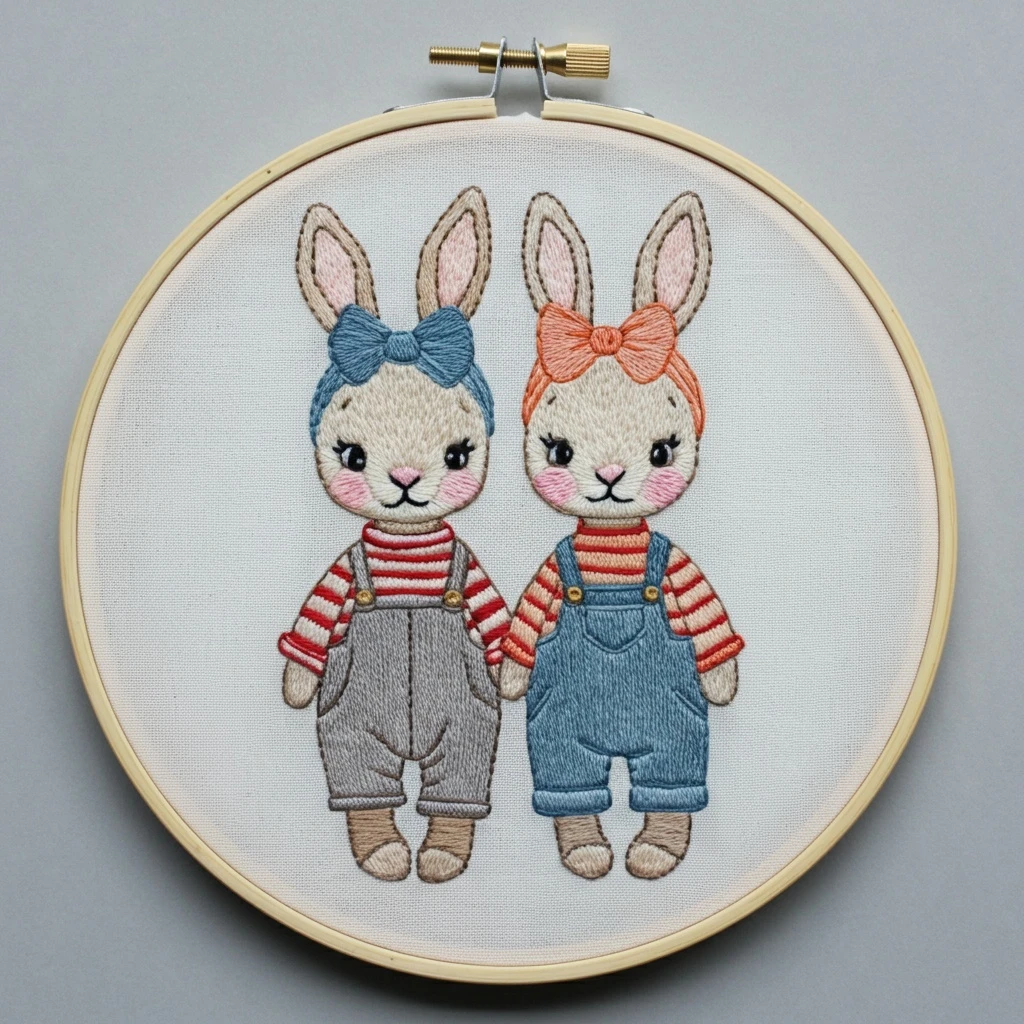
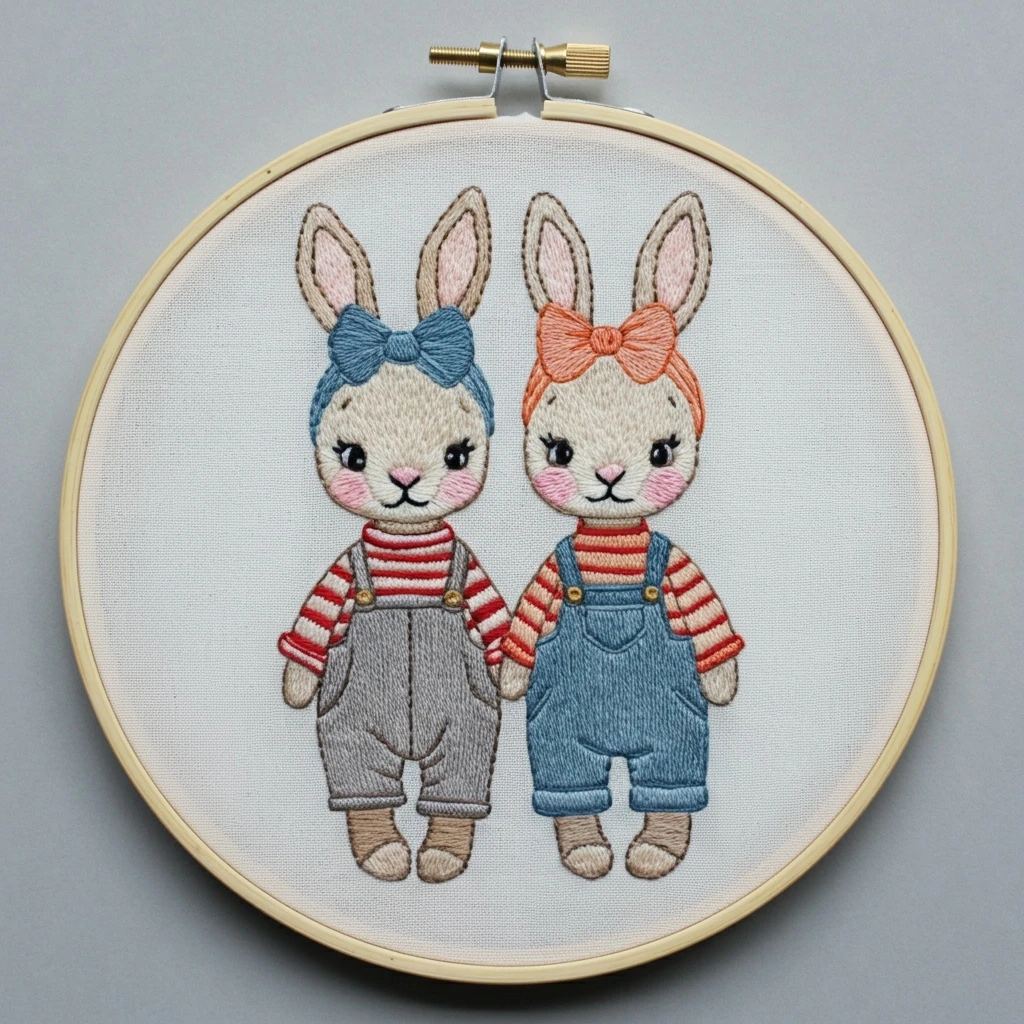
A cheerful hoop design with two cream bunnies holding hands, soft rosy cheeks, tall textured ears, striped shirts, denim overalls, warm gray overalls, and playful bow accents. The palette leans cozy and storybook: oat cream fur, dusty denim blue, coral-orange, red stripes, soft pink, taupe outlines, and tiny antique-gold buttons.
Color story observed from the artwork
The design is built around a gentle cream-and-taupe bunny base, with the clothing carrying most of the contrast. The left bunny uses slate blue for the bow and cap-like side detail, gray overalls, and red striped sleeves. The right bunny uses coral-orange for the bow and hair-tie detail, denim-blue overalls, and warm red-orange stripes.
Suggested DMC floss palette
DMC 3865 – Winter White
Main bunny face and body highlights. Use as the lightest fur layer and to soften transitions.
DMC 842 – Beige Brown Very Light
Gentle fur shading on cheeks, arms, legs, and the inner contour of the ears.
DMC 841 – Beige Brown Light
Mid-tone taupe for ear edges, paws, and places where the cream fur needs definition.
DMC 840 – Beige Brown Medium
Warm outline substitute for black on ears, bodies, hands, and clothing folds.
DMC 761 – Salmon Light
Soft blush cheeks, inner ears, and nose highlights. Keep it airy with 1–2 strands.
DMC 962 – Dusty Rose Medium
Deeper cheek arcs and the lower edge of the pink nose for dimension.
DMC 3760 – Wedgwood Medium
Blue bow, right overalls, and cool denim shadows. Excellent for long-and-short rows.
DMC 3761 – Sky Blue Light
Denim highlights on the bow ridges, overall cuffs, pocket, and strap tops.
DMC 351 – Coral
Orange bow and hair-tie shape on the right bunny; use directional stitches radiating from the knot.
DMC 352 – Coral Light
Highlight strands on the orange bow loops and warm shirt bands.
DMC 347 – Salmon Very Dark
Red shirt stripes, sleeve cuffs, and crisp accents around wrists and collars.
DMC 318 – Steel Gray Light
Left bunny overalls base; alternate with 414 for vertical woven texture.
DMC 414 – Steel Gray Dark
Gray overall seams, folds, cuffs, and the deeper side shadows.
DMC 729 – Old Gold Medium
Buttons and tiny metal accents. Add one small highlight with 3822 if desired.
DMC 310 – Black
Eyes, lashes, nostril dots, and mouth details. Use sparingly with a sharp needle.
DMC B5200 – Snow White
Eye sparkle and the lightest facial touches; one tiny stitch is enough.
Stitch plan by design area
Bunny fur and faces
- Use long-and-short stitch in 1–2 strands for cream fur, following the curve of the face.
- Add split stitch or tiny stem stitch outlines in 840, not black, for a soft illustrated edge.
- Keep cheeks as light satin arcs or small curved straight stitches so they remain fluffy.
Overalls and clothing
- Work overalls in vertical satin or long-and-short stitches to imitate woven fabric.
- Use stem stitch for straps, seams, cuffs, and pocket edges.
- For striped shirts, stitch the light shirt base first, then add red/coral bands on top.
Bows, ears, and accents
- Fill bow loops with satin stitches radiating from the center knot.
- Use detached chain or padded satin for button circles.
- Outline inner ears with split stitch, then lightly fill with pink using open spacing.
Thread-count and blending guidance
| Area | Recommended strands | Why it works |
|---|---|---|
| Face outlines, lashes, mouth | 1 strand | Small facial details need precision; too many strands can make the expression look heavy. |
| Fur fill and shading | 1–2 strands | Fine strand counts allow soft direction changes and subtle cream-to-taupe shading. |
| Overalls and bows | 2 strands | Gives enough coverage for saturated denim, coral, and gray areas without bulk. |
| Shirt stripes and cuffs | 2 strands for fill, 1 strand for edging | Keeps the stripes visible while preserving clean separation between bands. |
| Buttons and eye highlights | 1–2 strands or French knots | Small knots give raised texture; one white stitch makes the eyes lively. |
Texture, shading, and finishing details
Texture suggestions
- Use short directional stitches on the ears to suggest soft nap.
- Give the overalls visible vertical stitch direction; this makes the garments look like fabric instead of flat color blocks.
- Add tiny couching or stem-stitch seams down the legs and around pockets.
- French knots work beautifully for buttons, but keep them small so they do not overpower the faces.
Shading guidance
- Place darker taupe under the chin, around the arm edges, and near the lower paws.
- Shade bow loops darkest near the center knot and lighter toward the outer rounded edges.
- Keep inner ears paler at the center and slightly darker along the outer edge.
- Use the shirt stripes as crisp graphic accents; avoid over-shading them.
Beginner-friendly practical tips
Before stitching
- Use a 6–7 inch hoop and keep the fabric drum-tight, especially around the small face details.
- Transfer facial features lightly; heavy transfer lines can show through pale floss.
- Stitch large fills before the tiny eyelashes, mouth, buttons, and highlights.
- Separate floss strands fully, then recombine them for smoother satin stitches.
During stitching
- Work both bunny faces in the same session so their expressions and shading match.
- Use shorter satin stitches on curved shapes; long satin stitches may snag or loosen.
- Turn the hoop as you stitch bow loops and ears so stitches follow the form naturally.
- Finish with a clean press from the back on a towel to preserve raised knots and padded areas.