
-Hand-Embroidery-Hoop-Art-Hand-Embroidery-Pattern-PDF-sample.webp)
Love Bugs or Kissing Bunnies
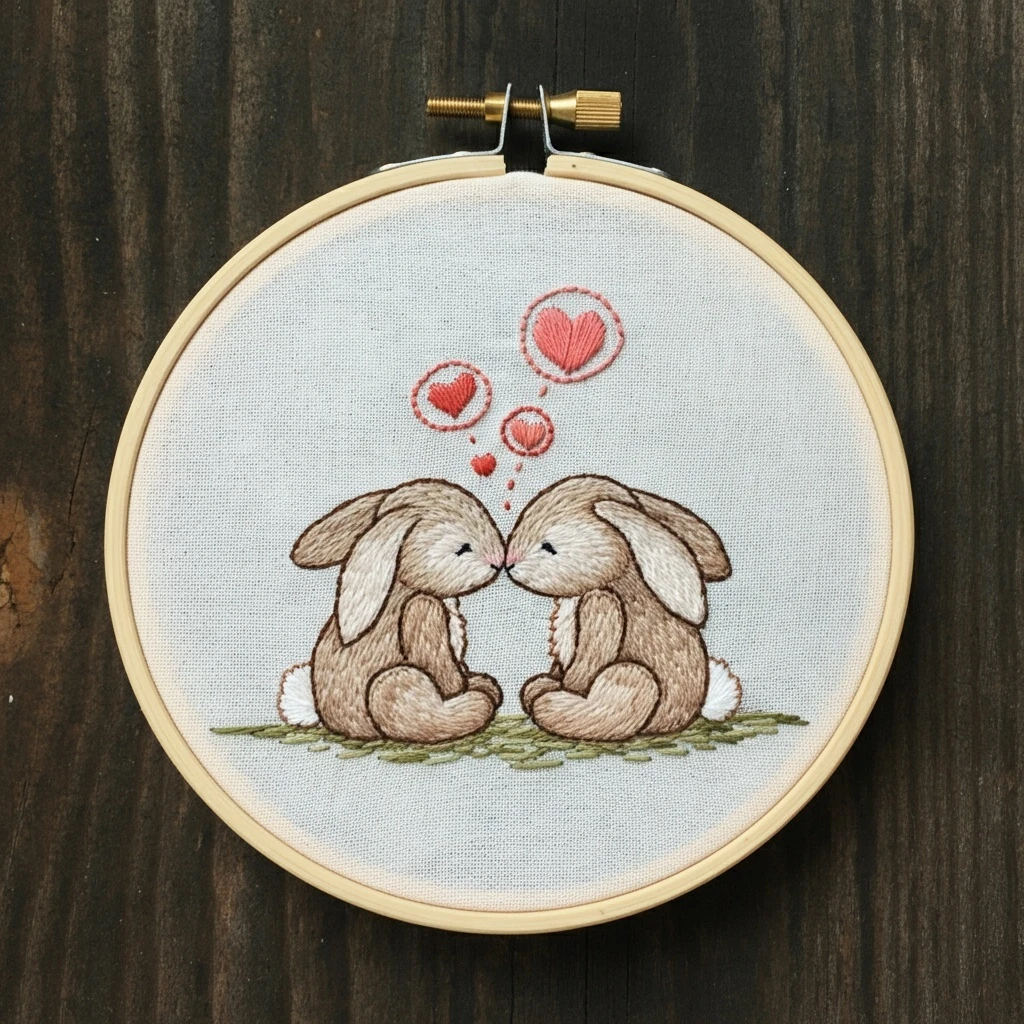
A tender hand-embroidery palette inspired by two soft brown bunnies touching noses, airy linen ground, pale tails and inner ears, mossy grass, and floating coral-pink hearts. The suggestions below translate the image into practical DMC floss choices, strand counts, blending ideas, stitch direction, and finishing details.
Color Story From the Reference
The design is gentle and storybook-like: warm taupe-brown rabbits sit on muted green grass, with creamy white accents on tails, cheeks, bellies, and inner ears. The romance comes from coral, blush, and soft rose hearts stitched above the pair. The palette should stay warm, low-contrast, and lightly shaded so the expression remains sweet rather than cartoon-bold.
Suggested DMC Floss Palette
| Design area | DMC colors | Use & notes |
|---|---|---|
| Bunny outlines & deepest fur | 3371 Black Brown 898 Very Dark Coffee Brown 839 Dark Beige Brown | Use sparingly for the stitched contour, facial crease, ear fold, feet, and shadow where the bodies touch the grass. Avoid heavy black outlines; brown keeps the design soft. |
| Main bunny fur | 840 Medium Beige Brown 841 Light Beige Brown 842 Very Light Beige Brown 3864 Light Mocha Beige | Build the rabbits with layered long-and-short stitches, moving from darker outer edges to lighter cheeks, bellies, and paws. |
| Tails, cheeks, bellies, ear interiors | Ecru 822 Light Beige Gray 3865 Winter White 543 Ultra Very Light Beige Brown | Keep these areas creamy, not stark white. Feather tiny tan stitches into the cream to make the bellies and tails feel fluffy. |
| Eyes, nose touch & tiny facial marks | 310 Black 3371 Black Brown B5200 Snow White | Use 1 strand only. Add a minute B5200 dot to each eye only if the scale allows; otherwise let the eye be a single dark seed stitch. |
| Hearts & love bubbles | 351 Coral 352 Light Coral 353 Peach 760 Salmon 761 Light Salmon | Use saturated coral for the small central heart and soft blush tones for the larger floating circles and filled hearts. |
| Heart outlines & dotted trail | 347 Very Dark Salmon 3705 Dark Melon 3712 Medium Salmon | Backstitch or stem stitch the bubble rings with broken, playful lines. Add small straight stitches or tiny knots for the dotted path. |
| Grass base | 3011 Dark Khaki Green 3012 Medium Khaki Green 3013 Light Khaki Green 469 Avocado Green | Muted khaki greens match the soft woodland mood. Layer short horizontal and diagonal stitches so the ground feels stitched, not filled solid. |
| Hoop warmth / optional border accents | 3828 Hazelnut Brown 3829 Very Dark Old Gold 677 Very Light Old Gold | Optional only: useful for a small date, initials, or a warm decorative frame if you want to echo the wooden hoop. |
| Optional linen shadow | 644 Medium Beige Gray 642 Dark Beige Gray 613 Very Light Drab Brown | Use very lightly under the bunnies to anchor them to the fabric. Skip this if your linen already has strong texture. |
Stitch Types by Design Element
Bunny Bodies
- Long-and-short stitch: main fur fill, following the curve of each body, head, thigh, and paw.
- Split stitch: soft contour lines around the ears, cheeks, backs, and feet.
- Seed stitch: tiny fur flecks in 841, 842, and Ecru to soften large filled areas.
- Satin stitch: small paws, nose area, and compact inner-ear shapes where you want smooth coverage.
Faces & Kissing Detail
- Single-strand backstitch: eyelids, tiny mouths, and the two touching noses.
- Seed stitch or colonial knot: eyes, using one strand of 310 or 3371.
- Tiny straight stitches: add a few short whisker or cheek marks, but keep them minimal.
- Couching: optional for an extra smooth nose-to-nose curve if stitching at a larger hoop size.
Hearts & Floating Bubbles
- Satin stitch: filled hearts, worked from top cleft to lower point for a plump shape.
- Stem stitch: circular bubble outlines; it curves more gracefully than standard backstitch.
- French knots: dotted love trail between hearts, using 1 or 2 wraps depending on scale.
- Split stitch: neat heart outlines before filling if you want crisp edges.
Grass & Ground
- Straight stitch: short blades under the bunnies, varied in length and angle.
- Stem stitch: longer moss lines and the horizontal base.
- Fly stitch: small leafy sprigs at the edges of the grass patch.
- Split stitch shadow: a fine 642 or 3011 line directly beneath each bunny helps them sit on the ground.
Thread Counts & Blending Ideas
1 strand Facial detail
Use for eyes, mouths, nose touch, tiny outlines, bubble trails, and individual fur lines. This prevents the faces from becoming heavy or overworked.
2 strands Main fills
Use for most fur, satin hearts, grass strokes, and cream tail fills. Two strands give soft coverage while leaving space for direction changes.
3 strands Plush accents
Use selectively for tails, lower paws, or the largest heart if you want a slightly raised, cuddly finish. Keep bulky stitches away from the tiny faces.
| Blend | Where to use it | Effect |
|---|---|---|
| 1 strand 840 + 1 strand 841 | Main bunny bodies | Soft mid-brown fur with natural tonal variation. |
| 1 strand 841 + 1 strand 842 | Cheeks, foreheads, paws | Gentle lightening without looking flat beige. |
| 1 strand 3865 + 1 strand 543 | Tails and belly tufts | Creamy plush highlights that are warmer than pure white. |
| 1 strand 898 + 1 strand 839 | Ear folds and underside shadows | Deep brown definition that stays softer than black. |
| 1 strand 351 + 1 strand 352 | Filled hearts | Romantic coral body color with slight brightness. |
| 1 strand 3011 + 1 strand 3012 | Grass beneath bunnies | Muted mossy base with woodland depth. |
Outlining, Shading & Direction
Outlining Details
- Outline the bunnies in 1 strand of 839 or 898 rather than black. Use broken split stitches so the edge reads furry, not graphic.
- Use 3371 only for the tiniest facial marks, the eye, and the point where the noses meet.
- Keep the heart rings playful: stitch them as slightly irregular circles in stem stitch with 347 or 3705.
- Outline the tails with 842 or 543, then add a few Ecru and 3865 tufts inside for fluffy texture.
Shading Guidance
- Place the darkest fur at the backs, ear tips, feet, and under each head where the face meets the body.
- Lighten the cheeks and muzzle area so the kissing pose remains visible. Blend into Ecru near the nose.
- Work ears from outer rim inward: darker brown around the fold, soft cream or light beige in the inner ear.
- Use grass colors in horizontal layers: 3011 deepest at the bottom, 3012 through the center, and 3013 on a few top blades.
Practical Embroidery Tips
Recommended Work Order
- Transfer the bunny outlines, face points, grass base, and heart bubbles with a fine washable pen or light pencil.
- Stitch the grass first so the feet and tails can overlap the ground naturally.
- Fill the bunnies from the outer backs toward the faces, leaving the nose and eye details until the end.
- Work tails and cream belly sections after the main fur, adding small tuft stitches over the brown edges.
- Stitch hearts and dotted bubbles last so the coral stays clean and bright.
- Add final single-strand facial marks only after all surrounding fur is complete.
Fabric & Finish Notes
- A natural cotton-linen blend or pale oatmeal linen will match the airy background and keep the bunnies warm.
- Use a 6-inch hoop for a cozy look; enlarge slightly if you prefer more room for fur shading.
- Keep strand lengths short for browns and creams so the fur remains smooth and does not pill.
- When satin stitching hearts, outline first with split stitch, then fill over the outline for rounded edges.
- Press from the back on a towel after stitching, avoiding pressure on French knots and raised tail texture.