
-Monochromatic-Floral-Crown-Hand-Embroidery-Pattern-PDF-sample.webp)
Heirloom Lace Garden or Monochromatic Floral Crown
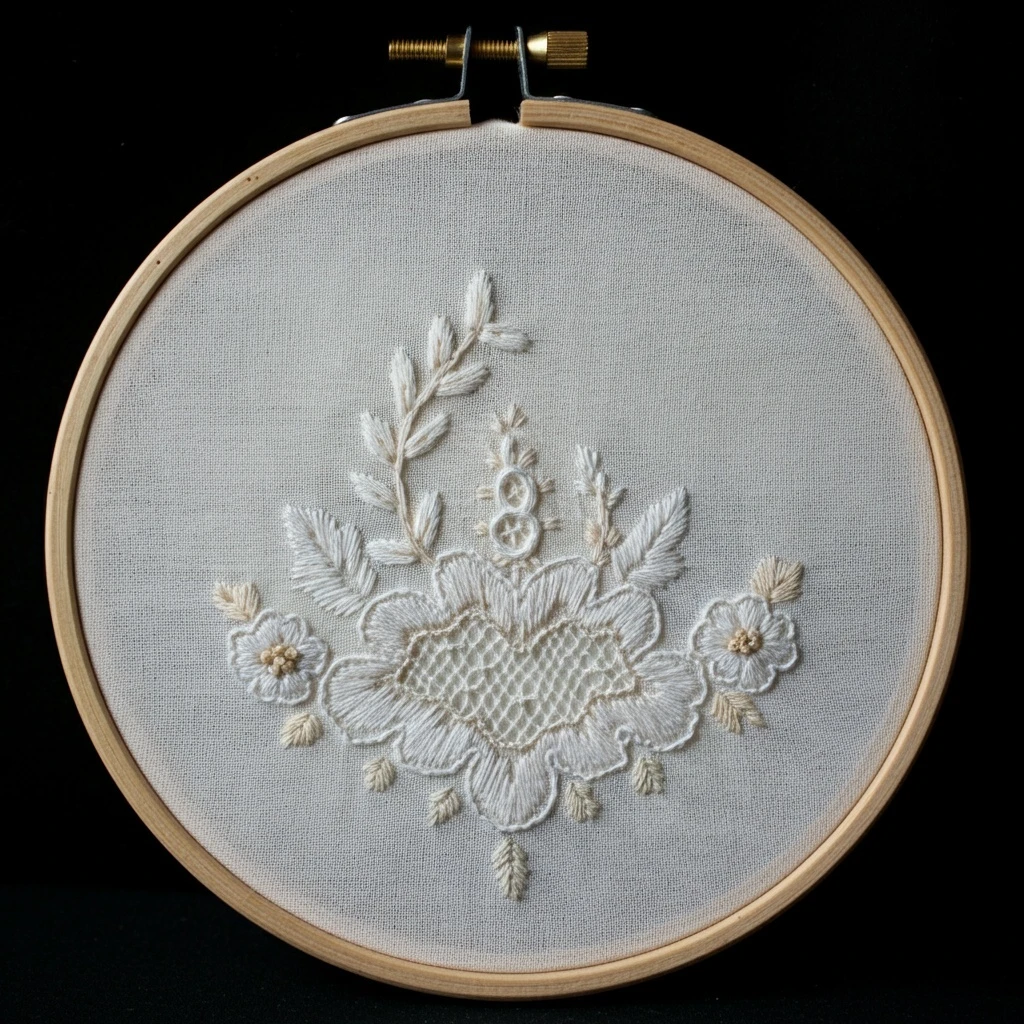
A soft whitework-style floral crown stitched on warm grey linen: layered petals, ferny sprigs, tiny buds, raised knot centers, and a lace-textured heart at the center. The design relies less on strong color contrast and more on cream, ivory, taupe, shadow, stitch direction, and dimensional texture.
Elegant, heirloom, and quietly dimensional. The reference reads as creamy white embroidery over natural linen, with subtle beige-gold touches in the small flowers and buds. Keep outlines crisp, highlights pale, and shadows warm rather than dark so the finished piece feels like lace instead of a colored floral bouquet.
Suggested DMC floss palette
The image is dominated by winter white and cream stitching on greige linen. The palette below gives enough steps for lace-like relief: very pale whites for lifted petals, creamy beige for floral body, taupe for shadows, and a few warm straw notes for tiny buds and flower centers.
Brightest lace highlights
Use sparingly on top ridges, petal tips, and the brightest raised stitches. It gives the whitework a clean highlight without making the whole design stark.
Main whitework shade
The best base for large petals, leaf highlights, and the central lace heart. It looks softer and more heirloom than pure white on natural linen.
Warm petal glow
Blend into lower petals and buds where the sample shifts toward creamy ivory. Useful for keeping the monochrome look warm and handmade.
Soft midtone cream
Use for petal bases, leaf undersides, and the small side flowers. It provides gentle definition without breaking the white-on-linen mood.
Bud and center warmth
Perfect for tiny bud caps, French knot centers, and the small beige strokes visible around the side blossoms.
Raised shadow tone
Work under petal rims, inside the lace-heart weave, and at the bases of leaves to make the ivory stitching stand forward.
Deepest antique shadow
Use with restraint for central veins, tucked stems, and the darkest overlaps. One strand is usually enough.
Natural linen bridge
Excellent for blending outlines back into the fabric and for tiny connecting stitches when you want a barely-there lace effect.
Stem and sprig definition
Use for fine stems and a few shadow-side leaf stitches. It echoes the linen ground and prevents the pale sprigs from disappearing.
Optional linen shading
Add a few single-strand couching or backstitch details around the central heart if you want the honeycomb texture more visible.
Stitch plan by design area
Couched lattice + tiny tacking
Lay a light grid with 1 strand of DMC 3865 or Ecru, then tack intersections with tiny stitches in 842. Keep the spacing even so it resembles drawn-thread lace or honeycomb filling.
Padded satin + long-and-short
Outline each petal with split stitch, add a small padding layer, then fill with 2 strands. Work from petal edge toward the center, using 3865 on raised areas and 712 or 842 at the base.
Split outline + satin petals
Use 1 strand for the scalloped outline and 2 strands for short satin fills. Add a few Blanc stitches only on the top edge for crisp whitework sparkle.
Fishbone stitch
Fishbone stitch gives the long leaves their ribbed botanical texture. Blend 3865 with 712 for pale leaves, then add one narrow vein in 613 or 841.
Stem stitch + lazy daisy
Use fine stem stitch for the vertical sprig lines and lazy daisy or straight stitches for small oval leaves. Vary the leaf angles to keep the crown natural.
French knots + granitos
Work 2-wrap French knots in 739 for warm centers. Use small granito stitches for beige buds and finish with one bright 3865 highlight stitch.
Thread-count guidance
- Lace heart lattice: 1 strand for laid threads and tacking stitches; 2 strands only if the design is enlarged beyond a 7-inch hoop.
- Petal outlines: 1 strand for split stitch. This keeps the scalloped edges delicate and prevents the monochrome design from looking heavy.
- Padded petals: 1 strand for padding, then 2 strands for the final satin or long-and-short layer.
- Leaves: 2 strands for fishbone stitch on larger leaves; 1 strand for the central vein and fine feathering.
- Stems and tiny sprigs: 1 strand of 613, Ecru, or 841 for a crisp line that does not overpower the white flowers.
- French knots: 2 strands with 2 wraps for small flowers; 2 strands with 3 wraps for the largest raised centers.
Blending ideas
- Soft whitework blend: 1 strand DMC 3865 + 1 strand DMC 712 for petals that need warmth but still read white.
- Raised highlight blend: 1 strand DMC Blanc + 1 strand DMC 3865 on only the topmost petal ridges.
- Antique shadow blend: 1 strand DMC 842 + 1 strand DMC Ecru for lace-heart shadows and petal bases.
- Natural stem blend: 1 strand DMC 613 + 1 strand DMC 3033 for subtle botanical structure on greige linen.
- Warm center blend: 1 strand DMC 739 + 1 strand DMC 712 for creamy, raised knots that do not look yellow.
Shading, outlining, and texture notes
| Element | Best stitch choice | Color handling | Practical note |
|---|---|---|---|
| Central lace heart | Couched lattice, woven filling, tiny seed stitches | 3865 or Ecru laid threads; 842 at intersections | Mark only the outer heart and a few guide lines. Too many transfer marks can show through pale floss. |
| Large scalloped petals | Split stitch outline, padded satin, long-and-short | Blanc/3865 highlights, 712 middle, 842 near the base | Curve the stitch direction with each petal so the flower looks rounded rather than flat. |
| Side flowers | Backstitch or split outline with satin fills | 3865 for edges, 712 for fill, 739 for knots | Keep the side blossoms slightly simpler than the central flower so the crown has a graceful hierarchy. |
| Leaf sprays | Fishbone, fly stitch, or feather stitch | 3865/712 for body; 613 or 841 for vein | Use alternating stitch lengths. The reference leaves have a combed, feathery quality rather than blocky fill. |
| Tall buds and sprigs | Stem stitch, lazy daisy, granitos | Ecru stems, 739 buds, Blanc tips | Leave tiny spaces between sprig elements. Negative space is part of the lace-garden look. |
| Raised centers | French knots, colonial knots, or seed stitch clusters | 739 plus 712, with optional 841 shadow knot | Cluster knots unevenly for a natural center, but keep the whole cluster compact and round. |
Beginner-friendly practical tips
- Choose the fabric carefully. A medium warm-grey linen or linen-cotton blend makes the ivory stitching visible without needing strong color contrast.
- Use a fine needle. A size 8 or 9 embroidery needle helps one-strand outlines and lace tacking stitches stay neat.
- Separate and recombine strands. Strip each strand before blending colors. This reduces twist and gives smoother satin petals.
- Pad only where needed. Add padding to the central flower and a few large leaves, but keep tiny sprigs flat so the composition does not become bulky.
- Mind pale transfer marks. Test your marking pen on the same fabric. Pale floss will not hide dark blue or heavy graphite lines.
- Use shadow sparingly. Monochrome embroidery works best when the darkest taupe appears only at overlaps, bases, and veins.
- Check from a distance. Step back after each section. If an area disappears into the linen, add one strand of 842 or 613 for gentle definition.