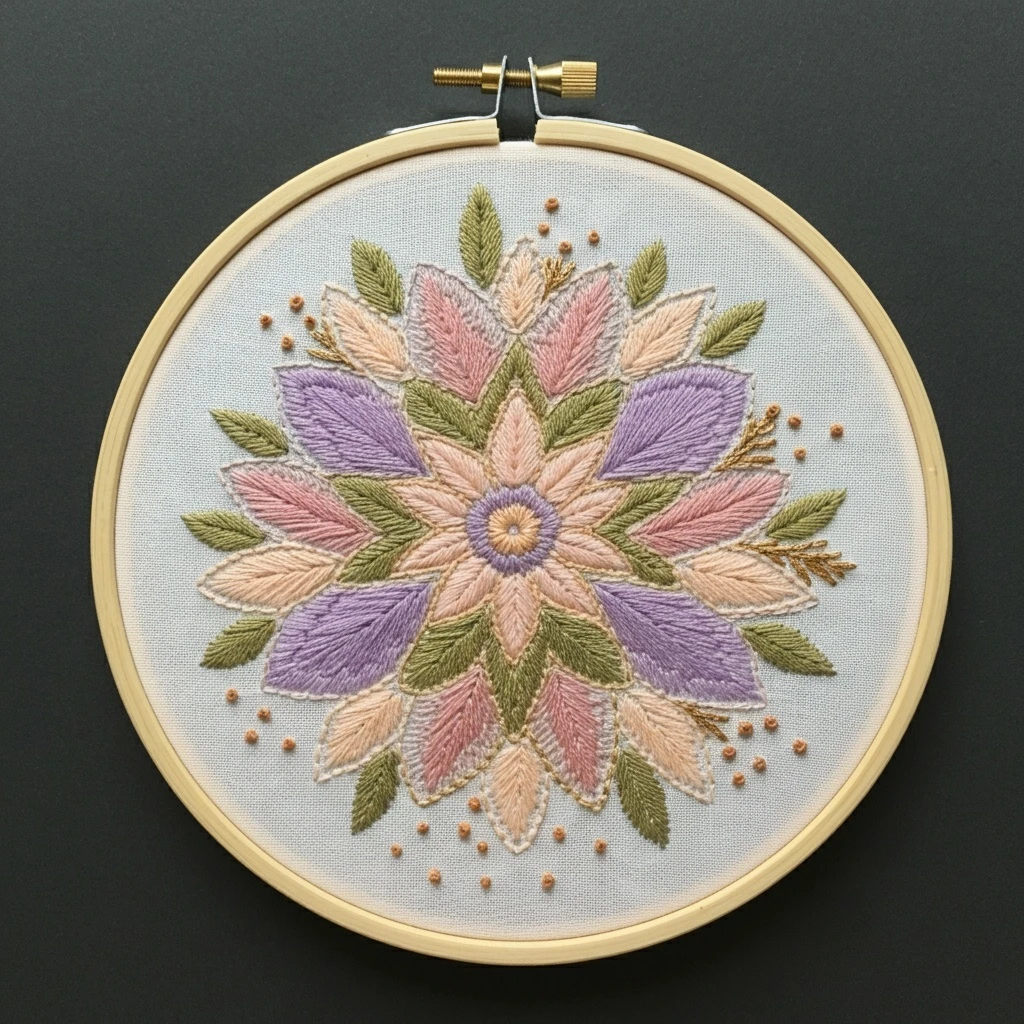

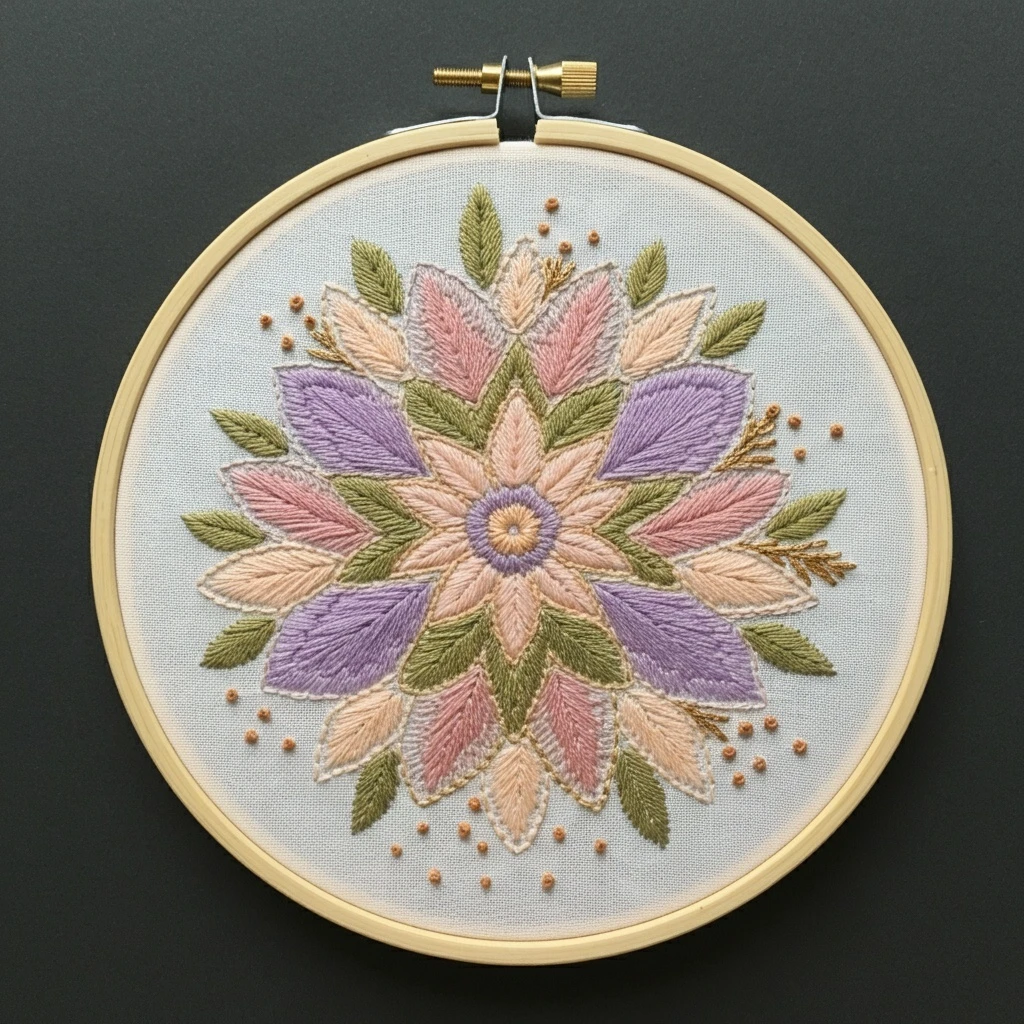
Mandala Flower
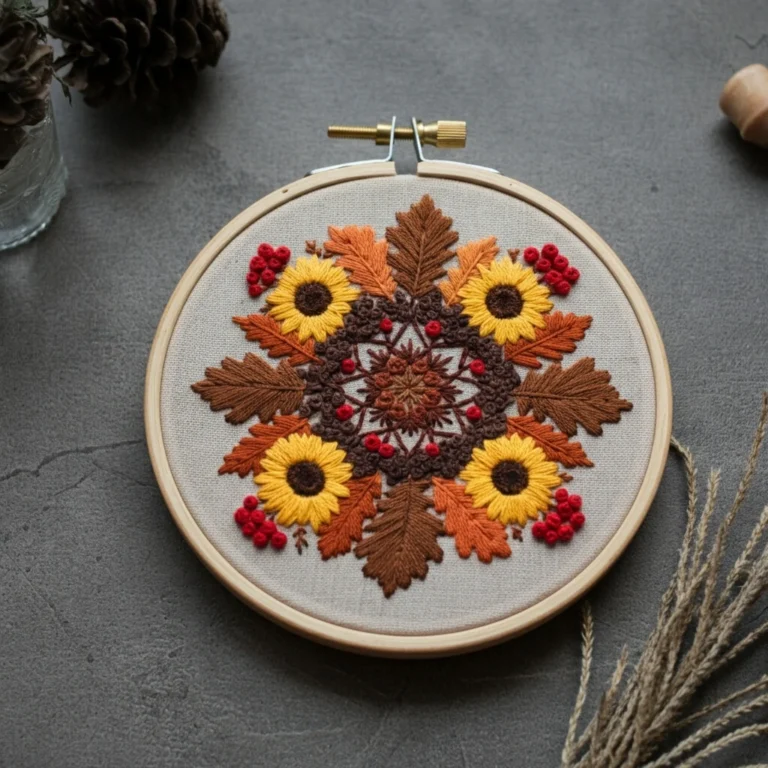
A balanced stitching plan for a symmetrical mandala bloom with layered petals, radiating leaf forms, tiny decorative dots, warm golden center work, and crisp ornamental outlines that keep the design calm, bright, and meditative.
Color story
This motif depends on rhythm and contrast. Use the richest color at the center and outer anchor points, mid-value corals and pinks across the main petals, golden thread for the tiny ornamental dots, and muted greens for the leafy shapes so the flower remains the focus.
Stitch map by design area
Because the pattern is symmetrical, the stitch direction should repeat as carefully as the color placement. Complete matching shapes opposite each other before moving to the next ring.
Central flower circle
Use satin stitch or woven wheel stitch with 680 and 3821. Add small French knots around the center to create a raised, beaded mandala point.
Main petals
Fill larger petals with long-and-short stitch in 335, 3733, and 761. Start at the tip and angle stitches toward the center so the flower appears to radiate outward.
Alternating warm petals
Use 350 and 351 in satin stitch for smaller teardrop and scallop forms. Stitch paired shapes in the same direction to preserve symmetry.
Decorative outlines
Use one strand of 550 for crisp back stitch or split stitch. For softer outlines, use 554 on inner arcs and reserve 550 for the outermost accents.
Leaf and vine shapes
Work leaves with fishbone stitch in 3812 and 954. Use darker green for the center vein and lighter green on the petal-facing side.
Dots and tiny flourishes
Use French knots, colonial knots, or single straight stitches in 680, 3821, and 3865. Keep knots consistent in size so the mandala does not look uneven.
Thread-count guidance
Fine outlines
Use 1 strand for back stitch, split stitch, tiny curves, and any inner line work. This keeps the mandala clean and prevents crowded intersections.
Petal fills
Use 2 strands for satin stitch and long-and-short petal fills. Two strands give enough color coverage without losing the printed shape edges.
Raised dots
Use 2 strands for French knots and 3 strands only for the largest center knots. Keep all repeated dots the same wrap count.
Blending & shading plan
Mandala shading should be controlled and repeatable. Instead of realistic random shading, use the same highlight placement on every matching petal.
| Area | Suggested blend | How to use it |
|---|---|---|
| Main rose petals | 335, 3733, 761 | Place 335 near the base or outline, 3733 through the midsection, and 761 only at petal tips or inner shine points. |
| Warm coral petals | 350 with 351 | Use 350 for shadowed sides and 351 on the petal edge closest to the gold center. |
| Center glow | 680 with 3821 | Work 680 first for depth, then add 3821 knots or short satin stitches on top-facing details. |
| Cool contrast lines | 550 with 554 | Use 550 for outer definition and 554 for repeated inner arcs where a heavy outline would feel too dark. |
| Green leaf balance | 3812 and 954 | Use fishbone stitch with 3812 along the center and 954 on alternating outer halves for a soft botanical contrast. |
Beginner-friendly stitching order
Mark the compass points
Before stitching, lightly mark top, bottom, left, and right on the fabric edge. This helps keep color placement balanced around the circle.
Start at the center
Complete the gold center first, then work outward ring by ring. A centered start makes it easier to keep later petals aligned.
Stitch opposite petals together
Work one petal, then stitch the petal directly opposite it with the same colors and stitch angle. Continue in pairs around the design.
Add outlines after fills
Fill petals first, then use one-strand back stitch or split stitch to sharpen the borders. This hides uneven fill edges beautifully.
Finish with dots and knots
Place French knots and tiny flourishes last so they sit cleanly on top and do not snag while you rotate the hoop.
Practical tips for a clean finish
Fabric & hoop
- Choose ivory cotton, linen, or cotton-linen so the pinks and golds stay warm.
- Keep the hoop drum-tight; symmetrical satin stitches show puckering quickly.
- A size 7 or 8 embroidery needle works well for most 1–2 strand details.
Symmetry control
- Thread all matching petals with the same strand count and stitch length.
- Rotate the hoop instead of bending your wrist; this keeps stitch direction smooth.
- Check the design from arm’s length after every ring to catch uneven color balance early.
Texture suggestions
- Use satin stitch for polished petals, fishbone stitch for leafy details, and French knots for raised ornamental dots.
- Keep knot wraps consistent: two wraps for small dots, three wraps only for the center.
- Leave tiny fabric spaces between some outline rows so the mandala looks airy.
Common fixes
- If the design feels too busy, reduce the number of dark violet outlines.
- If petals look flat, add one or two 761 highlight stitches at each matching petal tip.
- If knots vary in size, redo only the largest outliers; consistency matters more than perfection.