Rustic Wildflower Bouquet

Rustic Wildflower Bouquet - DMC Palette & Stitching Guide
DMC palette & hand embroidery notes

Rustic Wildflower Bouquet

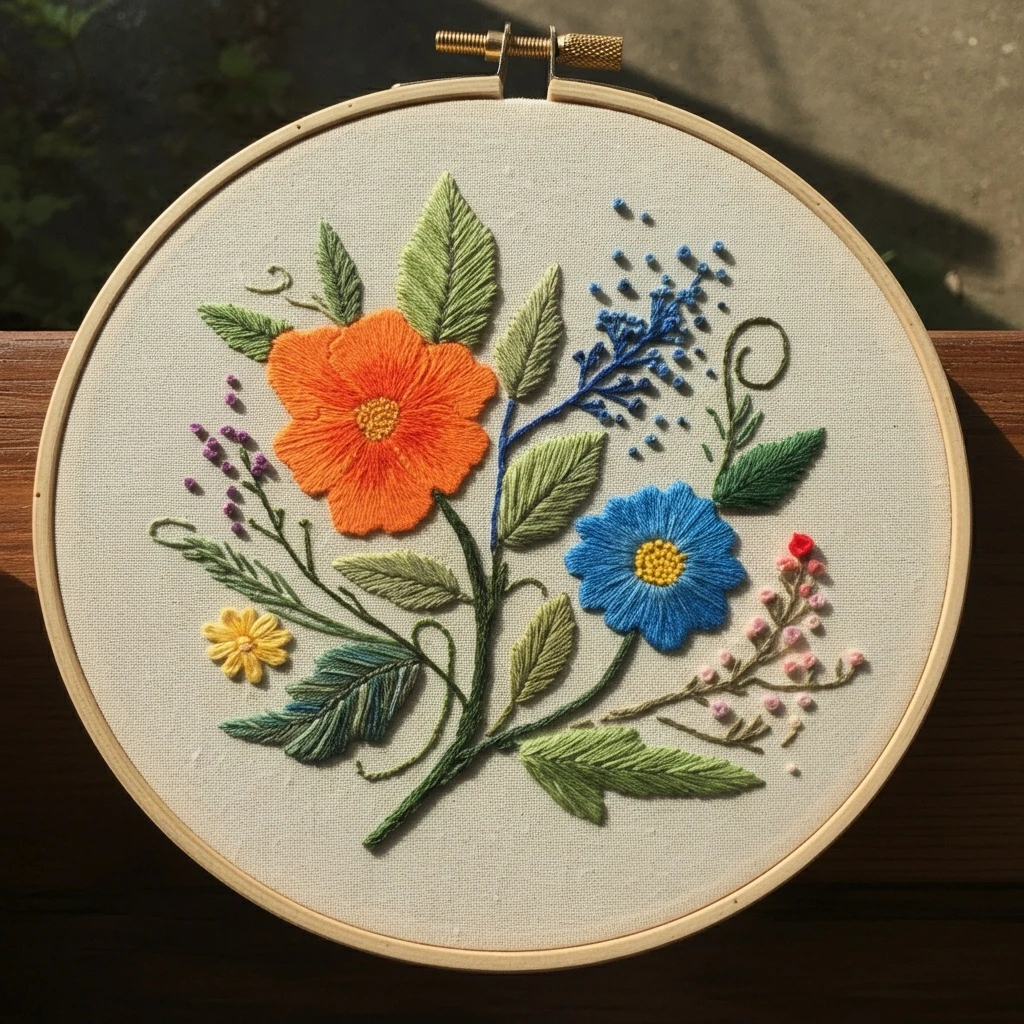
A cheerful natural-light hoop with an orange focal bloom, a bright blue daisy, golden centers, purple and pink berry sprigs, blue seed clusters, and layered sage-to-forest leaves on warm linen.

Best worked on natural linen or cotton in a 6–8 inch hoop
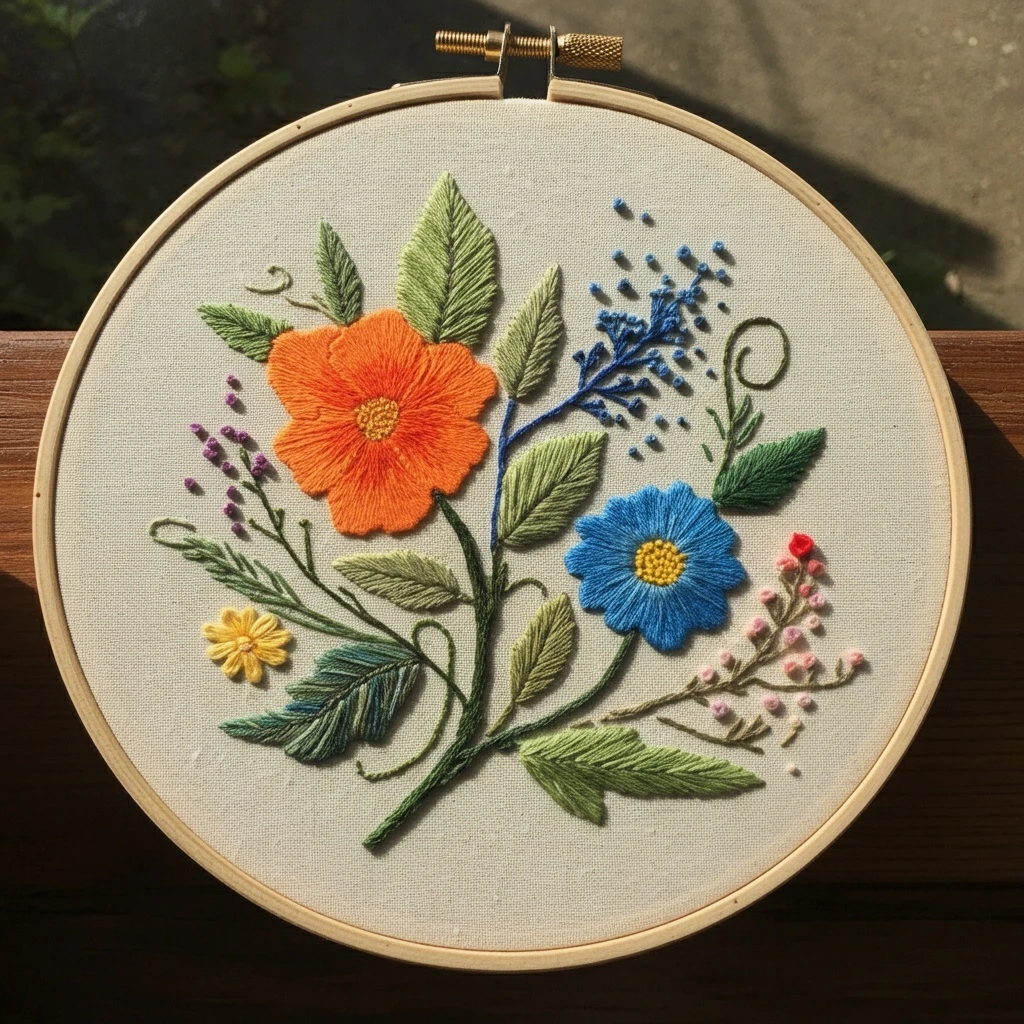
Rustic Wildflower Bouquet Hand Embroidery in Natural Light

Image-Inspired Color Story

The design reads as a rustic summer wildflower bouquet: vivid petals are balanced by olive leaves and dark, curling stems. Use strong color contrast for the two main flowers, then soften the surrounding foliage with blended greens and fine directional stitches.

DMC 721
Orange Spice
Main orange flower petals; place at outer petal edges and sunny ridges.
DMC 347
Salmon Very Dark
Warm petal shadows near the center and between overlapping orange petals.
DMC 740
Tangerine
Bright highlights on the orange bloom; add a few long-and-short accents.
DMC 995
Electric Blue Dark
Blue flower petals and vivid blue berry dots; strongest in the petal tips.
DMC 3843
Electric Blue
Mid-blue petal body, blue branch stems, and scattered seed sprigs.
DMC 742
Tangerine Light
Raised yellow flower centers and the small yellow daisy petals.
DMC 783
Topaz Medium
Knotted center shadows, seed depth, and darker gold at flower bases.
DMC 3012
Khaki Green Medium
Sage leaf fills; ideal for broad upper leaves and soft foliage.
DMC 3011
Khaki Green Dark
Leaf midribs, shaded veins, and the darker sides of folded leaves.
DMC 890
Pistachio Green Ultra Dark
Deep stems, tendrils, lower leaves, and anchoring outlines.
DMC 3727
Antique Mauve Light
Soft pink berry sprig; use as the highlight knot on each berry.
DMC 3834
Grape Dark
Purple buds on the left sprig and occasional berry shadow stitches.

Stitch Plan by Design Element

Orange focal flowerUse long-and-short stitch with 2 strands. Begin at the petal tips with DMC 721/740, angle stitches toward the center, and tuck DMC 347 into the petal bases for depth. Keep the outer scalloped edge clean with tiny split stitches if needed.
Blue daisy flowerWork each petal as satin stitch or long-and-short stitch using 995 and 3843. Fan the stitches from the yellow center outward so the thread direction creates the petal ribbing visible in the reference.
Flower centersBuild texture with French knots or colonial knots in DMC 742 and 783. Use 2 wraps for small knots and 3 wraps for a raised, seed-like center.
LeavesFill with fishbone stitch for the large leaves. Blend 3012 and 3011 in the same leaf by alternating single strands; add 890 along the midrib or shaded side.
Fine stems & tendrilsUse stem stitch, split stitch, or whipped backstitch in 890 and 3011. For curling tendrils, use 1 strand and keep stitches short so the curves stay smooth.
Berry & seed sprigsUse detached chain, French knots, or tiny satin dots. Purple buds work well in 3834 with a 3727 highlight; blue seed clusters can alternate 995 and 3843 for sparkle.

Thread Count, Blending & Shading

Thread count

Use 2 strands for most petals and leaves, 1 strand for delicate stems and curls, and 3 strands only for chunky knots or foreground berry dots.

Blending idea

For natural leaves, thread the needle with one strand DMC 3012 plus one strand DMC 3011. This creates a rustic variegated look without changing color every few stitches.

Shadow placement

Put darker tones at petal bases, behind overlaps, and along the lower-left side of leaves. Keep the upper petal tips and top-facing leaf ridges lighter.

Suggested working order

  • Transfer the stems and main flower outlines first, using a light removable marker or transfer paper.
  • Stitch stems and tendrils before large petals so the bouquet structure stays clear.
  • Complete large leaves next, then the orange and blue flowers, then finish with knots and tiny seed details.
  • Add final outlining sparingly: a split stitch edge in a matching darker tone is enough to define petals without making them cartoonish.

Texture & Beginner-Friendly Tips

Rustic textureNatural linenSoft shading

Choose a cream, oatmeal, or natural linen background to echo the photographed hoop. Do not pull satin stitches too tightly; a slightly raised surface gives the wildflowers their hand-stitched charm.

Clean curvesShort stitchesKnot control

For beginners, shorten the stitch length around curves and place French knots after the surrounding stitches are complete. Keep the fabric drum-tight in the hoop so long petals do not pucker.

Practical finishing notes

  • Use a sharp embroidery needle for dense petals and a crewel needle for knotted centers.
  • Separate all six strands, then recombine only the number needed; this keeps the floss smooth and less twisty.
  • For a softer botanical finish, avoid black outlines. Use DMC 890 or 3011 for definition around stems and leaf bases.
  • When mounting in a hoop, press from the back on a towel so the raised knots and petals are not flattened.
Leave a Reply

Your email address will not be published. Required fields are marked *