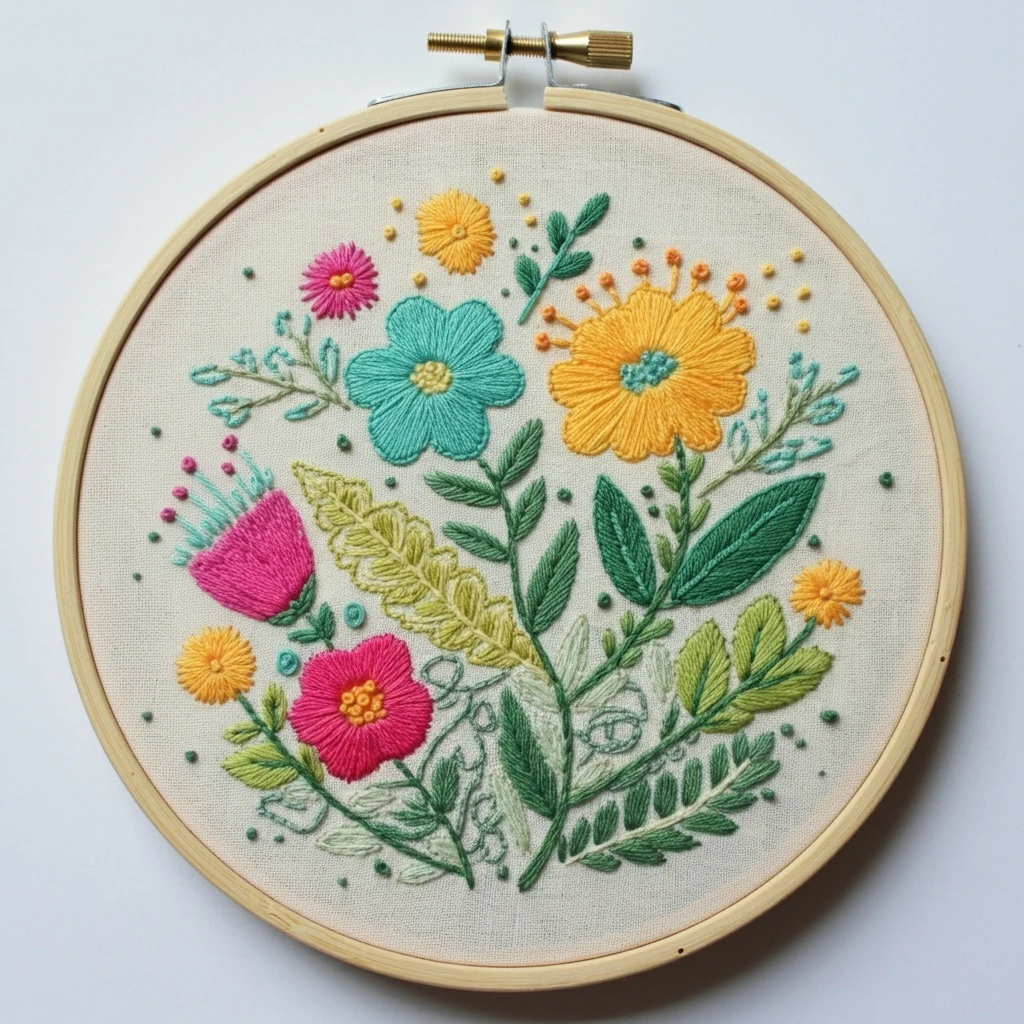

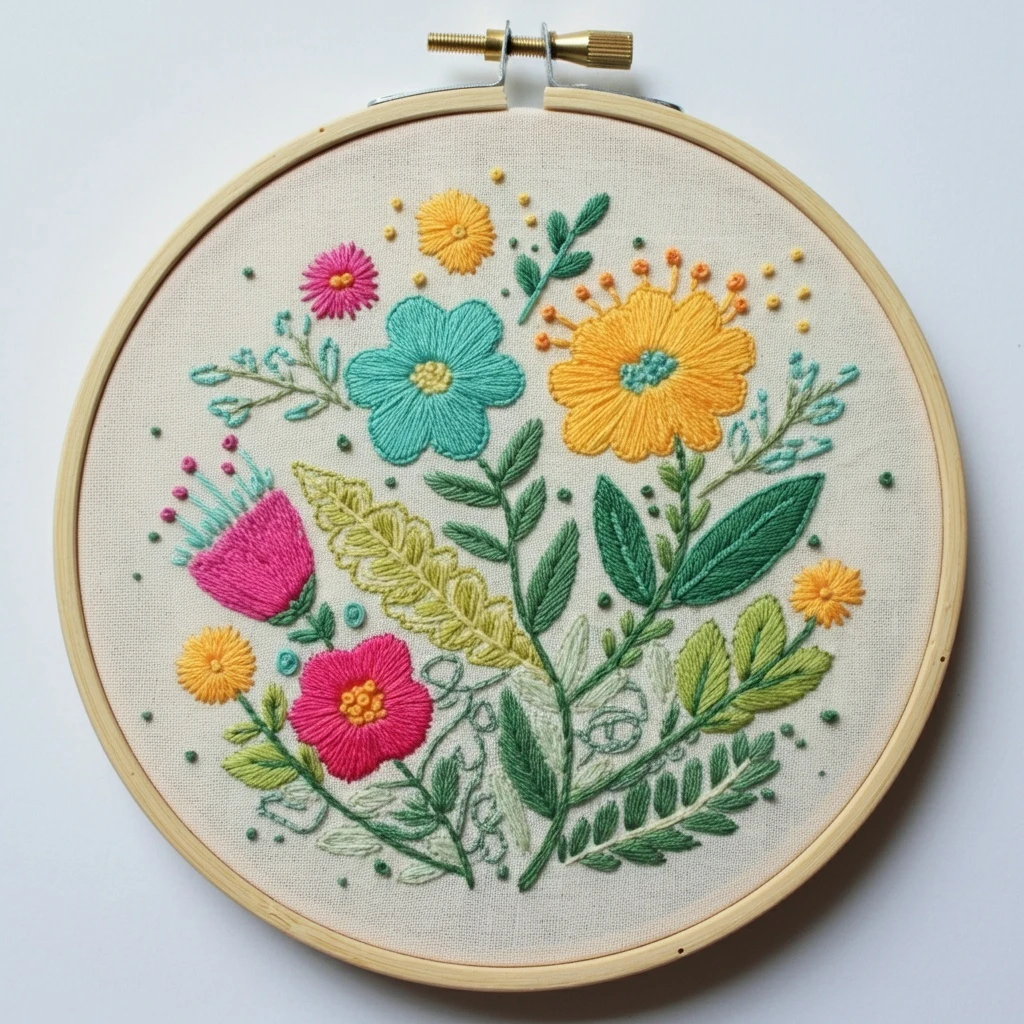
Radiant Mandala Bloom
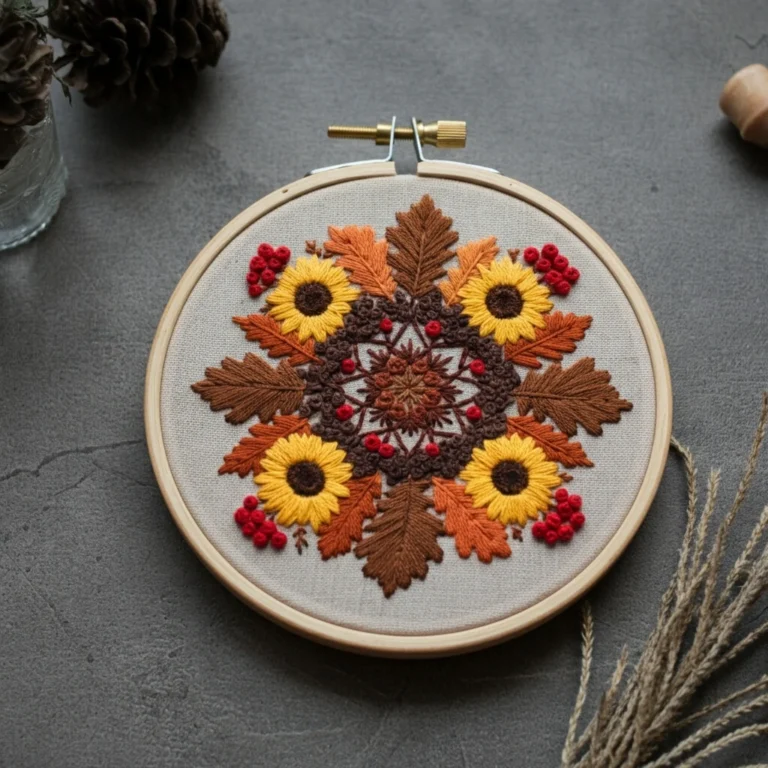
A bright floral mandala with a sunburst bloom feeling: layered petals, circular symmetry, warm rose-coral-gold accents, and cool teal or sage details for balance. The design should feel radiant and orderly, with crisp repeated motifs, clean petal shading, and raised center texture that catches the eye.
Design color read
The mandala reads as a floral bloom built in rings: a warm central cluster, petal bands in rose, coral, peach, and golden yellow, then cool green/teal accents and possibly lavender shadows for depth. Keep the palette cheerful but controlled—each repeated motif should use the same color placement so the mandala remains polished and symmetrical.
Suggested DMC floss palette
This palette gives the mandala a radiant floral look with warm central glow and cool botanical contrast. Use the richer shades for structure and the lighter shades for petal tips and highlight dots.
Deep rose petal bases, inner ring shadows, and strong floral definition.
Main rose petal fill and repeated bloom motifs in the warmer rings.
Coral transition petals and sunny warmth between rose and peach sections.
Soft petal highlights, small accent petals, and gentle outer-ring warmth.
Golden mandala center, warm knots, and sunburst details.
Bright center glints, tiny dot highlights, and luminous petal tips.
Cool teal details, ring separators, and contrast accents against warm petals.
Soft teal highlights, tiny dots, and airy outer-ring decorative stitches.
Sage leaf motifs and gentle botanical accents around the bloom.
Leaf bases, deeper green separators, and small stem-like details.
Optional cool lavender shadows, secondary petals, and subtle depth.
Pinpoint highlights, tiny negative-space accents, and crisp final glints.
Stitch map by design element
Central bloom
Use woven wheel, satin stitch, or clustered French knots in gold and pale yellow. Keep the exact center compact and raised.
Large petals
Use long-and-short stitch from petal base to tip. Repeat the same direction and color order on every matching petal.
Small petal rings
Use detached chain, lazy daisy, or short satin stitches for repeated small petals. Keep stitch counts consistent.
Teal separators
Use stem stitch arcs, backstitch, or small straight stitches to divide warm petal rings with crisp cool contrast.
Leaf motifs
Use fishbone stitch or detached chain in sage greens. Place darker green at the base and light green at the tips.
Dot texture
Use French knots or colonial knots in gold, white, teal, and rose. Make knots consistent so the mandala looks tidy.
Thread-count and blending guidance
| Area | Strands | Blending idea | Practical note |
|---|---|---|---|
| Warm petals | 2 strands for filled petals; 1 strand for final highlights | Use 3731 at bases, 3733 through the body, then 352/353 toward tips. | Work opposite petals in pairs so color balance stays even around the circle. |
| Center glow | 2 strands for knots or woven center; 1 strand for glints | Mix 3820 and 744, then add a few 3865 stitches only at the brightest points. | Keep center texture raised but compact so it does not distort surrounding petals. |
| Cool accents | 1 strand for linework, 2 strands for small filled details | Use 3810 for structure and 3811 for tiny highlight dots or lighter teal arcs. | Use teal sparingly; it should refresh the warm palette, not dominate it. |
| Leaves and outer motifs | 1–2 strands | Pair 3012 at bases with 3013 at tips; add 341 if the design needs a cooler shadow. | Repeat the same leaf stitch style around the whole mandala for a clean rhythm. |
Recommended stitching order
- Transfer the mandala carefully with a clear center point, ring guides, and motif spacing marks.
- Stitch the central bloom first to anchor the design visually.
- Work large petal motifs in opposite pairs, then fill the remaining repeated petals.
- Add teal separators, sage leaf motifs, and smaller decorative petal rings.
- Finish with knots, tiny highlights, and final tonal outlines after checking symmetry.
Beginner-friendly practical tips
- Use a printed transfer rather than freehanding the circle; mandalas rely on precise spacing.
- Keep thread tension gentle so the fabric does not pull toward the center.
- Use the same number of stitches in each repeated motif whenever possible.
- Shorten stitches near the center where petal bases are narrow.
- Press from the back on a towel to protect raised knots and center texture.
Texture, shading, and finishing notes
A radiant mandala looks polished when the color placement is lively but the repetition is disciplined. Let warm petal gradients create the bloom, and use cool teal/sage accents as quiet structure.
Radiant petal shading
Imagine light shining from the center outward. Put deeper rose near the base of each petal and lighter peach or yellow near the tips. Keep the same gradient direction on every repeated petal to preserve the sunburst feeling.
Clean mandala rhythm
Repeat stitch types consistently by ring: for example, satin for large petals, detached chain for smaller petals, stem stitch for arcs, and knots for dots. This planned texture makes the page feel intentional and refined.