
Mandala Style Spring Decor
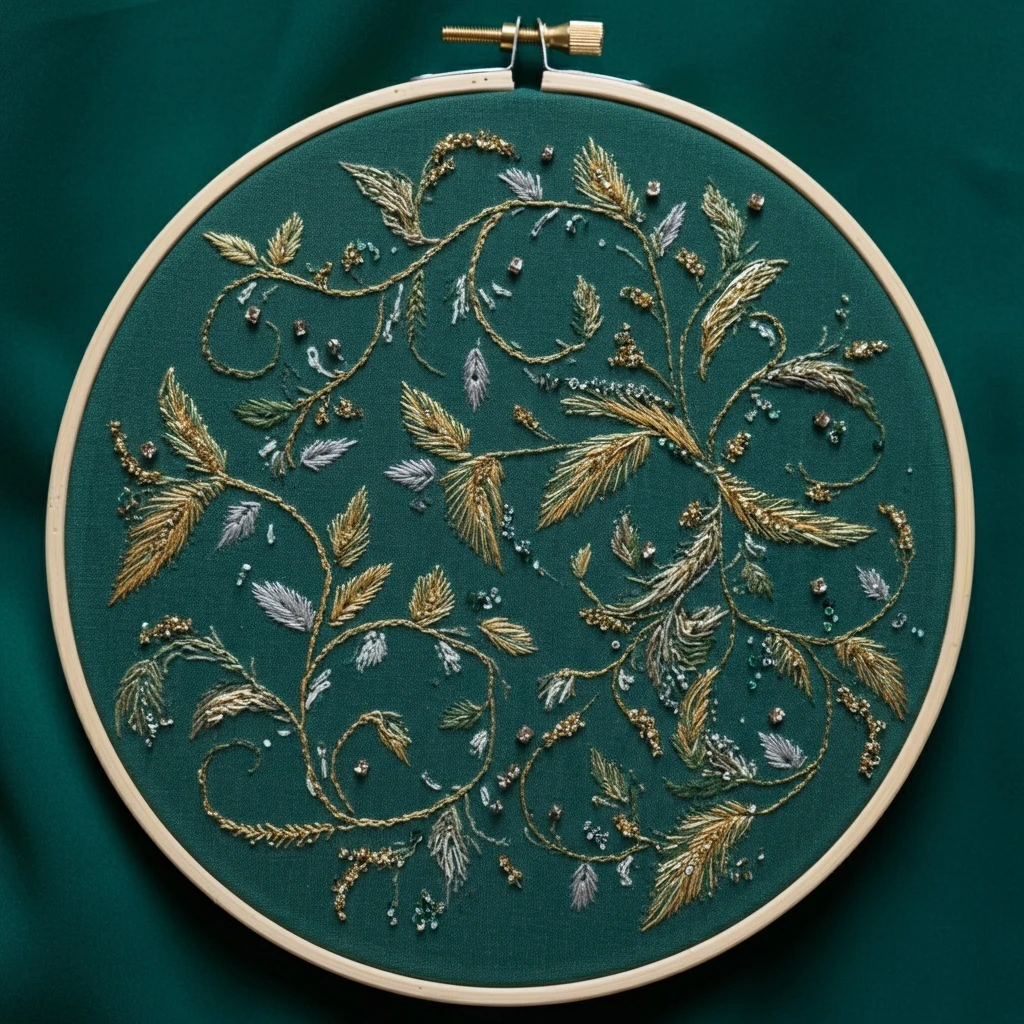
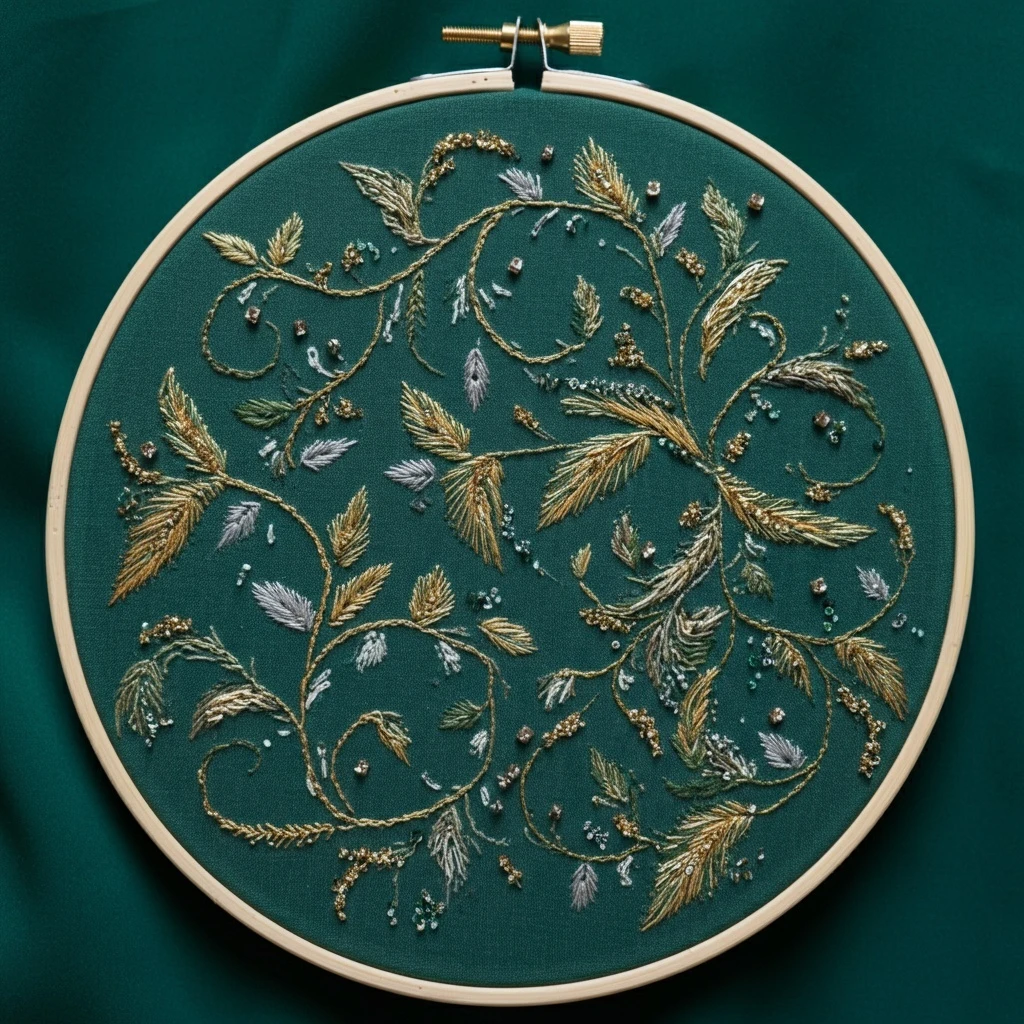
A polished stitching plan for an airy botanical mandala stitched on deep teal fabric: curling gold vines, feathered spring leaves, pale silver sprigs, bead-like dots, and softly raised accents arranged in a graceful circular flow.
Color story
The design reads as a spring mandala because the palette is restrained and luminous: dark teal fabric creates depth, olive stems establish movement, old-gold and straw tones make the leaves glow, while pale pewter, blue-green, and ivory details keep the fine sprigs light and fresh.
Stitch map by design area
This design is less about dense filling and more about graceful line quality. Keep stitches fine, directional, and slightly raised so the vines feel like they are floating over the dark ground.
Curling vine scrolls
Use stem stitch for the main scrolls in 3011 or 680. Add a second, occasional whipped strand of 729 on the outer curve for a subtle gold highlight.
Feathered gold leaves
Use fishbone stitch or closely spaced straight stitches in 729, 3821, and 3012. Angle every stitch toward the leaf base so each leaf looks like a fine frond.
Pale silver sprigs
Use one-strand straight stitches with 762 and 415. Keep them airy and slightly uneven in length to mimic delicate spring shoots.
Raised berry clusters
Use French knots or colonial knots in 680, 3821, 3813, and 3865. Group knots in odd numbers for natural clusters and reduce wraps near the edges.
Small olive leaves
Use detached chain, lazy daisy, or mini fishbone stitch in 3011, 3012, and 3053. Add one dark central vein only when the leaf is large enough.
Scattered bead-like dots
Use single seed stitches, French knots, or tiny beads. Keep dot spacing irregular but balanced across the circle so no section feels heavy.
Thread-count guidance
Fine linework
Use 1 strand for the thinnest curls, tendrils, and silver sprigs. One strand keeps the scrollwork elegant and prevents bulky intersections.
Leaves and fronds
Use 2 strands for fishbone and straight-stitch leaves. This gives enough color coverage on dark fabric while still preserving individual feather lines.
Knots and accents
Use 2 strands for French knots with one or two wraps. Use 3 strands only for the largest gold berry clusters or focal raised dots.
Blending & shading plan
The reference has a brushed, botanical shimmer rather than heavy realism. Use small directional shifts and controlled color changes to create movement around the circular composition.
| Area | Suggested blend | How to use it |
|---|---|---|
| Main vines | 3011 + 680 | Stem stitch the vine in 3011, then add short 680 stitches on the upper curves where light would catch the raised thread. |
| Golden leaves | 680, 729, 3821 | Place 680 near the base, 729 through the middle, and 3821 along the outer edge or tip for a soft antique-gold gradient. |
| Muted green leaves | 3011, 3012, 3053 | Use darker green for the central vein, medium green for the body, and 3053 as two or three highlight stitches on one side. |
| Silver-white sprigs | 415, 762, 3865 | Use 415 as the shadow line, 762 for the main pale sprig, and 3865 only as a final tiny highlight dot or tip stitch. |
| Cool berry accents | 3813 + 3865 | Work most blue-green dots in 3813 and add a single 3865 knot in selected clusters to keep the sparkle controlled. |
Texture suggestions
Make the vines feel raised
Use stem stitch with a consistent twist, then whip selected gold sections with one strand. Whipping is easier than couching and gives a polished cord-like effect.
Keep leaf strokes feathery
Do not overfill the leaves. Leave tiny slivers of teal fabric between straight stitches so each frond keeps the airy look seen in the reference image.
Use knots as sparkle, not clutter
Choose three knot sizes: tiny one-wrap dots, standard two-wrap berries, and a few larger three-wrap focal knots. Repeating sizes makes the scattered accents intentional.
Bead option
For a jewelry-like finish, substitute a few knots with size 11/0 seed beads in antique gold, champagne, or clear silver. Keep beads away from hoop edges to prevent snagging.
Beginner-friendly stitching order
Transfer lightly on dark fabric
Use a white water-soluble pencil, chalk pencil, or light transfer paper. Mark only essential vine lines and leaf positions so the finished piece stays clean.
Stitch the largest vine paths first
Work the main scrolls in 3011 or 680 before adding leaves. This establishes the circular movement and prevents floating leaves from drifting out of alignment.
Add leaves in color families
Complete all gold leaves, then all olive leaves, then pale silver sprigs. Repeating one family at a time helps maintain consistent stitch angle and tension.
Rotate the hoop often
Turn the hoop so each leaf points comfortably away from your hand. Consistent body posture creates smoother fishbone and straight-stitch leaves.
Save knots, beads, and metallics for last
Raised accents can snag while stitching nearby areas. Add them after all linework and leaves are complete, then gently steam from the back.
Practical finishing notes
Fabric choice
Deep teal cotton, linen, or cotton-linen blend suits the design best. A tight weave supports fine tendrils and small knots without distortion.
Needle choice
Use a size 7 or 8 embroidery needle for most stitching. Switch to a larger eye needle for metallic or blended threads to reduce fraying.
Tension check
Keep the fabric drum-tight but not stretched. Loose fabric makes long leaf stitches wobble, while over-stretching can distort the circular mandala.