
DMC palette & hand embroidery guide
Soft Lavender Bloom
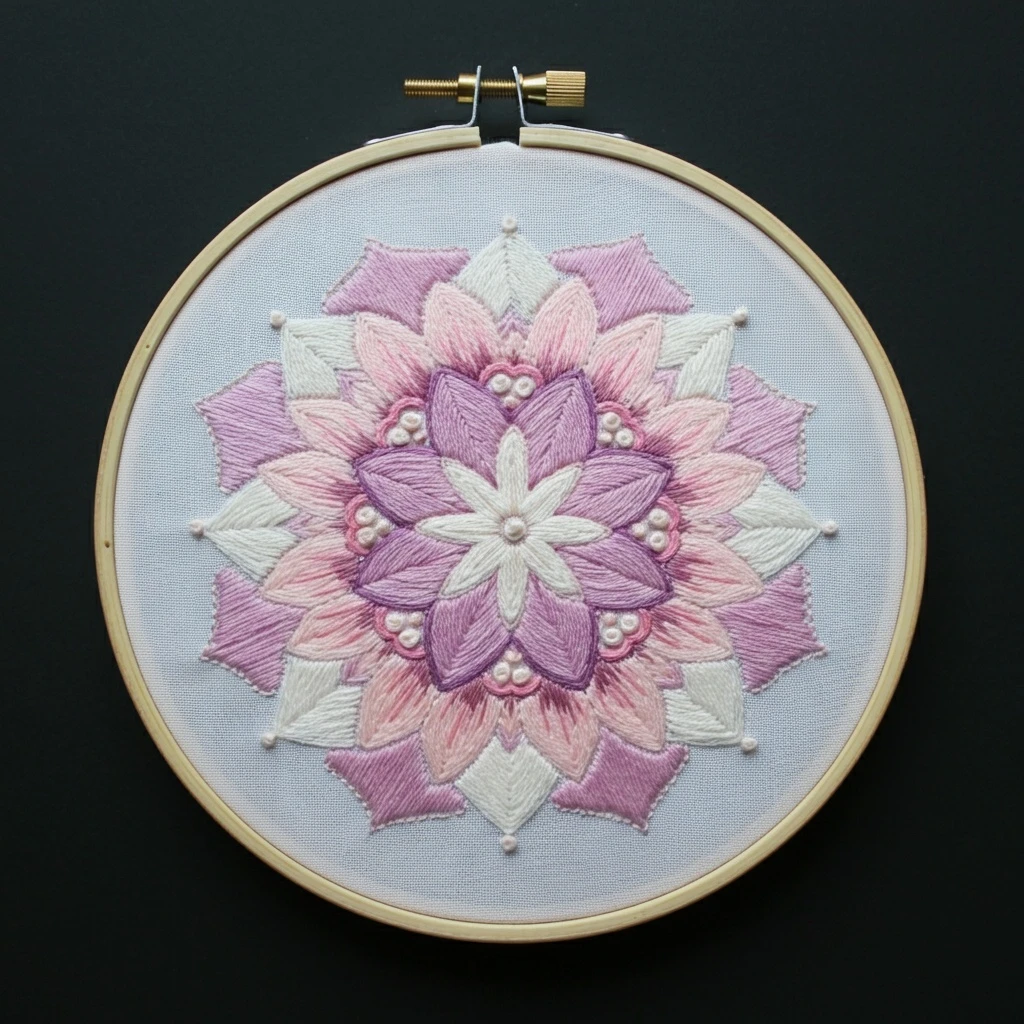
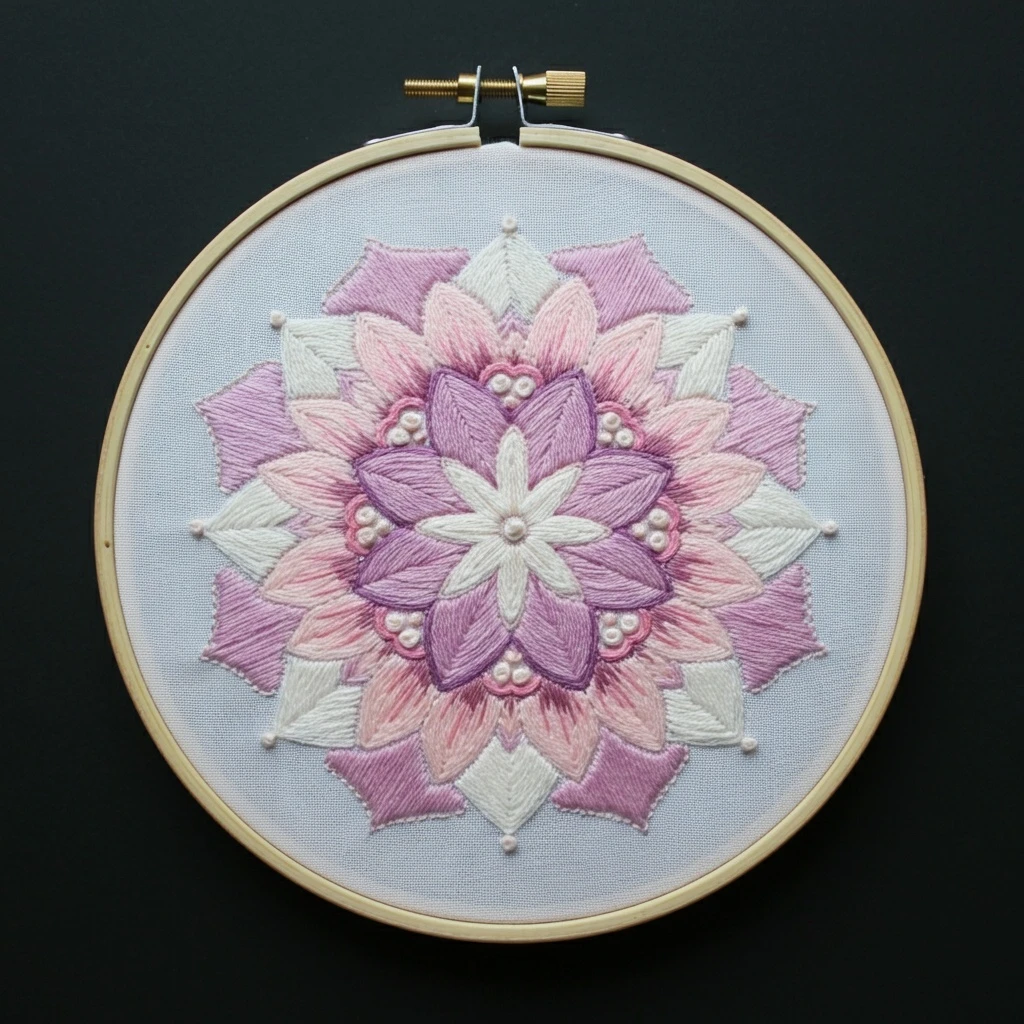
A gentle, symmetrical floral mandala with layered lavender petals, blush-pink accents, creamy white points, pearl-like knot details, and a pale blue-gray ground. The stitching should feel soft, padded, and petal-by-petal rather than flat: think satin-filled shapes, delicate directional shading, and clean outlines that keep the bloom crisp.
Observed colors and design elements
The reference design is built as a layered radial bloom: dark lavender-violet in the center petals, dusty mauve outer points, pale pink petal layers, ivory leaves/points, tiny cream pearl knots, and soft raspberry shadows tucked between petal bases. The hoop fabric reads as a cool, pale gray-blue, which helps the pastel stitching stay airy.
Layered petals
Use directional stitches that follow each petal from base to tip. Change stitch angle at every petal so the flower catches light like the sample.
Pearl accents
Small cream knots or beads sit around the inner ring and on outer points. They add the raised, decorative folk-floral finish.
Soft outlines
Outlines are present but not harsh. Choose mauve, plum, or pale gray instead of black so the piece remains delicate.
Suggested DMC floss palette
These colors are chosen to match the lavender, blush, ivory, cool background, and shaded mauve tones visible in the design. Use the darker shades sparingly in petal bases and outline folds; the lighter colors should dominate the bloom.
Main mid-tone for central lavender petals and soft outer flower sections.
Petal-base shadows, crease lines, and deeper central definition.
Blending layer between pale pink and purple petals; useful for long-and-short shading.
Highlights on petal tips and the softest lavender outer points.
Pale pink petals and gentle highlight strokes over blush areas.
Rosy petal bases and warm shadows around the inner flower ring.
Accent shading in the deepest pink creases; use one strand for subtle lines.
Creamy central star petals, ivory points, and bright pearl knots.
Subtle shade on ivory sections so white areas are not flat.
Optional fabric-toned outline or shadow under pale cream shapes.
Elegant outline for lavender petals without the heaviness of black.
Tiny highlight stitches on knots and the brightest tips of ivory petals.
Stitch plan by area
Central lavender petals
- Fill each petal with satin stitch or long-and-short stitch, working from the base toward the tip.
- Use 2 strands for smooth coverage; add 1-strand DMC 208 or 3042 along the base crease.
- Place the stitch direction like a fan so each petal has a natural central vein.
Pale pink petal ring
- Use DMC 819 as the main fill and blend in DMC 3688 toward the center.
- For a beginner shortcut, fill with split stitch rows instead of satin stitch; the ribbed texture still looks floral.
- Keep the outline pale mauve rather than dark purple for a soft blossom edge.
Ivory star and outer points
- Use DMC 746 for the main fill with DMC 822 on one side of each point for soft dimension.
- Short satin stitches work best on narrow leaf-like points; avoid carrying long floats over the back.
- Add a single straight stitch vein through the center if the shape needs definition.
Pearls, dots, and raised details
- Use French knots, colonial knots, or small pearl beads in DMC 746/3865.
- Wrap French knots twice with 2 strands for small dots; wrap three times for larger outer pearls.
- Anchor knots firmly and avoid pulling too tight, especially on loosely woven linen.
Thread-count, blending, and texture guidance
| Element | Recommended strands | Technique notes |
|---|---|---|
| Fine outlines | 1 strand | Use split stitch, back stitch, or stem stitch in DMC 3042, 208, or 3687. Keep outlines fine so the pastel design stays refined. |
| Main petal fills | 2 strands | Satin stitch gives a polished look; long-and-short stitch is better for shaded petals and larger shapes. |
| Deep shaded creases | 1 strand | Add after the fill with short straight stitches. Concentrate darkness at the petal bases, not the tips. |
| Cream points and center star | 2 strands | Use DMC 746 as the base and add a few DMC 3865 highlight stitches only where the light would catch. |
| French knots / pearl dots | 2 strands | For consistent dots, keep the same wrap count throughout one ring. Test knots on scrap fabric first. |
| Optional background accents | 1 strand | A few pale gray stitches in DMC 762 can suggest shadow under raised petals, but leave most of the background open. |
Beginner-friendly stitching order
Transfer and stabilize the design
Use a fine water-soluble pen on pale fabric. Tighten the hoop firmly; smooth tension is especially important for satin stitch petals.
Outline the main shapes lightly
Back stitch the petal boundaries with 1 strand of lavender or mauve. Keep stitches short around curves to maintain the mandala symmetry.
Fill from the center outward
Complete the center star and central purple petals first, then work the pink ring, ivory points, and outer lavender petals. This keeps overlaps tidy.
Add shadows and highlights last
Use short 1-strand strokes in DMC 208, 3687, 822, and 3865 after the main fills are complete. This gives control and prevents over-darkening.
Finish with knots
Stitch the pearl dots at the end so they remain raised and clean. If using beads, secure each bead individually with two passes.
Practical tips for a polished result
Control satin stitch
For large petals, split the shape visually into two or three smaller stitch-direction zones. This prevents loose, snag-prone satin stitches.
Preserve symmetry
Stitch matching petals opposite each other with the same colors and strand count. It is easier to keep a radial design balanced this way.
Keep pastels clean
Wash hands before working with ivory and pale pink floss. Park darker purples away from cream areas to avoid lint transfer.
Use a sharp needle
A size 7 or 8 embroidery needle works well for 1–2 strands. A sharp point helps place shading stitches precisely between existing threads.
Don’t overfill
The sample has light, airy negative space around the bloom. Avoid background fills unless you want a denser hoop-art finish.
Press from the back
After stitching, place the work face-down on a towel and press gently from the back so knots and satin texture stay raised.