
-Woven-Rose-and-Bud-Arrangement-Hand-Embroidery-Pattern-PDF-sample.webp)
Timeless Classic Rose Bouquet
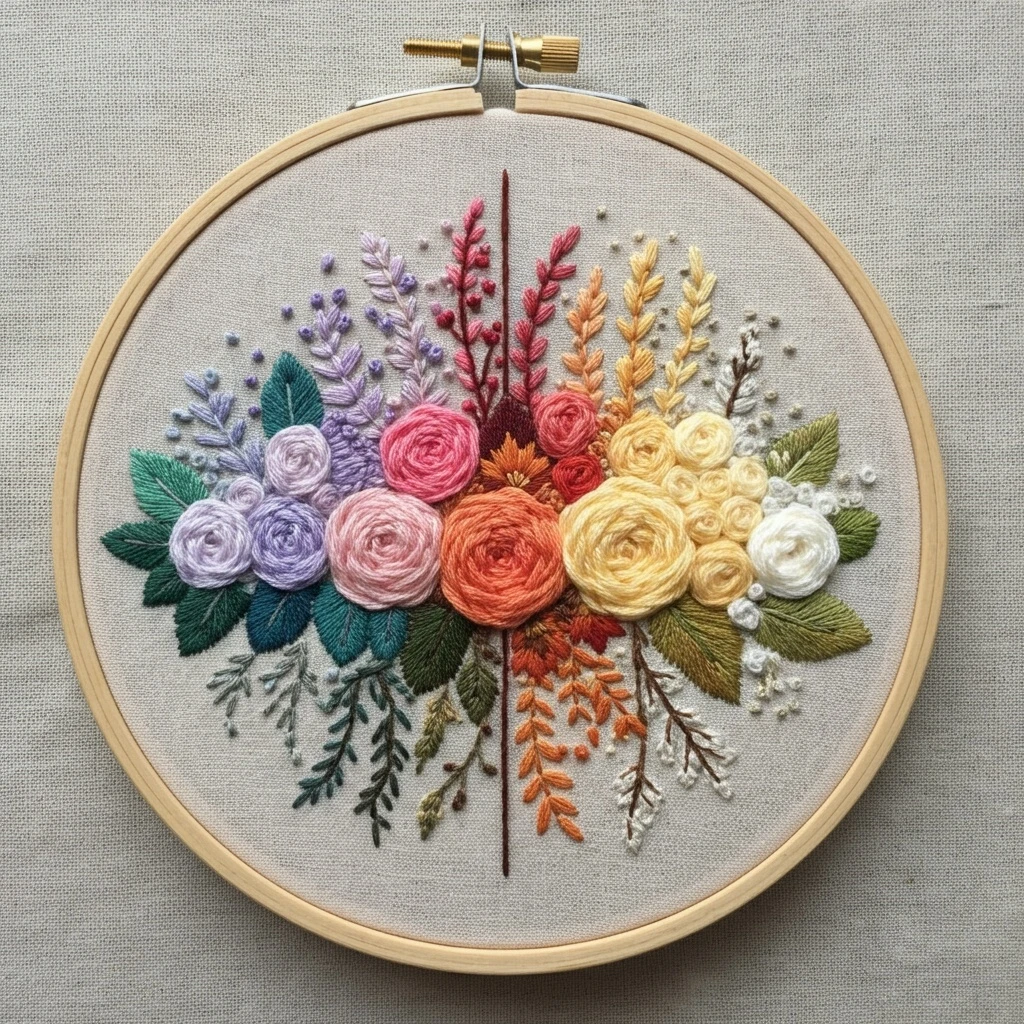
A polished DMC palette and practical stitch plan for a woven rose and bud arrangement with lavender, blush, coral, golden cream, ivory, teal leaves, olive foliage, and delicate twig details. Colors are estimated from the visible hoop preview and matched to close DMC embroidery floss shades.
Coverage percentages are visual estimates for planning thread purchases, not exact yardage.
Likely DMC Color Palette
The design reads as a broad horizontal bouquet: cool lavender roses on the left, pink and coral roses through the center, creamy yellow and ivory blooms on the right, with teal-green leaves, olive fronds, brown stems, and tiny knot accents.
Soft blush rose petals, pale bud spirals, and smooth transitions between pink and ivory areas.
Classic medium pink for the large central rose, petal ridges, and warm rosebud highlights.
Deeper pink shadows tucked inside woven rose spirals and under overlapping petals.
Small red rose, vertical berry sprays, and dramatic accents near the center line.
Coral-orange rose, lower fern sprigs, and autumn-toned petal shadows.
Peachy leaf sprays and warm bridges between coral flowers and the yellow side of the bouquet.
Cream-yellow roses, petal tips, and luminous highlights on the right-hand blooms.
Golden shading inside yellow roses and wheat-like sprigs behind the bouquet.
Ivory rose, white knots, tiny blossoms, and final sparkle on pale flower edges.
Left-side lavender roses, soft stems, and pale cool filler flowers.
Purple rose shadows, small lavender knots, and contrast in the left floral cluster.
Teal leaves beneath the lavender roses and cool dark foliage accents.
Deep leaf shadows, lower greenery, and the base layer that makes the roses stand forward.
Olive leaves on the right, fern tips, and mid-tone foliage transitions.
Branching stems, center divider stem, twig outlines, and grounding details behind the blooms.
Neutral seed knots, airy dot texture, and subtle shading against the linen background.
Stitching Suggestions
Work the bouquet in layers: stems and background sprays first, leaves next, then the large woven roses and final knots. This keeps raised flowers clean and prevents snagging them while adding smaller details.
| Element | Best Stitch Type | Practical Notes |
|---|---|---|
| Large woven roses | Woven wheel rose over straight spokes | Use 6 or 7 spokes for round roses. Lay a darker shade near the center, then weave medium and light shades outward for a natural spiral. |
| Small rosebuds | Woven wheel, bullion rose, or whipped spider wheel | Use fewer spokes and 2 strands so buds stay compact. Place the darkest stitch at the base to imply depth. |
| Lavender filler sprays | Lazy daisy, detached chain, and French knots | Angle stitches upward on a central stem. Mix DMC 211 and 340 so the left side feels cool and airy. |
| Golden wheat-like sprigs | Fishbone stitch or paired straight stitches | Use DMC 3822 and 744, alternating sides of the stem to create a soft feathery plume. |
| Teal and olive leaves | Fishbone stitch, satin stitch, or long and short stitch | Start with the center vein, then stitch diagonally to each edge. Use darker green at the base and lighter olive near the tips. |
| Thin brown branches | Stem stitch, split stitch, or backstitch | Keep branches fine with 1 strand. Whip a few main stems for a rounded twig effect. |
| White blossom clusters | French knots and colonial knots | Use 1 to 2 wraps for small blossoms. Scatter them irregularly so they look botanical rather than dotted in rows. |
| Central vertical stem | Stem stitch or couched straight line | Use dark garnet-brown or coffee brown. Keep the line smooth; it helps organize the symmetrical bouquet. |
Thread Count, Blending & Shading
Thread-count guidance
- Use 2 strands for most woven roses, medium leaves, and filler petals.
- Use 1 strand for fine stems, twig outlines, tiny veins, and delicate lavender sprays.
- Use 3 strands only for the largest rose spokes or where you want a plush, raised woven texture.
- For French knots, 1 strand with 2 wraps gives delicate seed texture; 2 strands with 1 wrap makes rounder berry dots.
Blending ideas
- Blend one strand DMC 3713 with one strand DMC 335 for soft pink rose transitions.
- Blend DMC 921 with DMC 3824 for the coral rose outer petals and warm lower sprigs.
- Blend DMC 744 with DMC 3865 for creamy highlight passes on the yellow and ivory roses.
- Blend DMC 3011 with DMC 3810 for deep teal-green leaves under the left roses.
Outlining details
- Outline only selected leaf edges with 1 strand in the darker green; too much outlining can flatten the soft bouquet.
- Add a short darker crescent inside rose centers to suggest depth without drawing hard circles.
- Use brown backstitch sparingly on branch forks, then soften with tiny gray-beige knots around them.
Texture suggestions
- Keep rose weaving slightly loose so the floss has a rounded, ribbon-like lift.
- Vary knot sizes around the right side to mimic tiny white blossoms and seed heads.
- Let filler sprays overlap behind the roses; the raised woven flowers should be the final focal layer.
Beginner-Friendly Working Order
- Transfer the main rose circles, vertical center stem, leaf shapes, and filler spray stems lightly onto fabric.
- Stitch the brown branches and green leaf bases first so they sit visually behind the bouquet.
- Add lavender, golden, and coral filler sprigs with 1 to 2 strands, keeping them light and directional.
- Work the large woven roses from the center outward, changing shades gradually as you reach the petal edges.
- Finish with white French knots, lavender dots, tiny berries, and any final highlight stitches.