
Design #897 · Florals & Botanical Texture
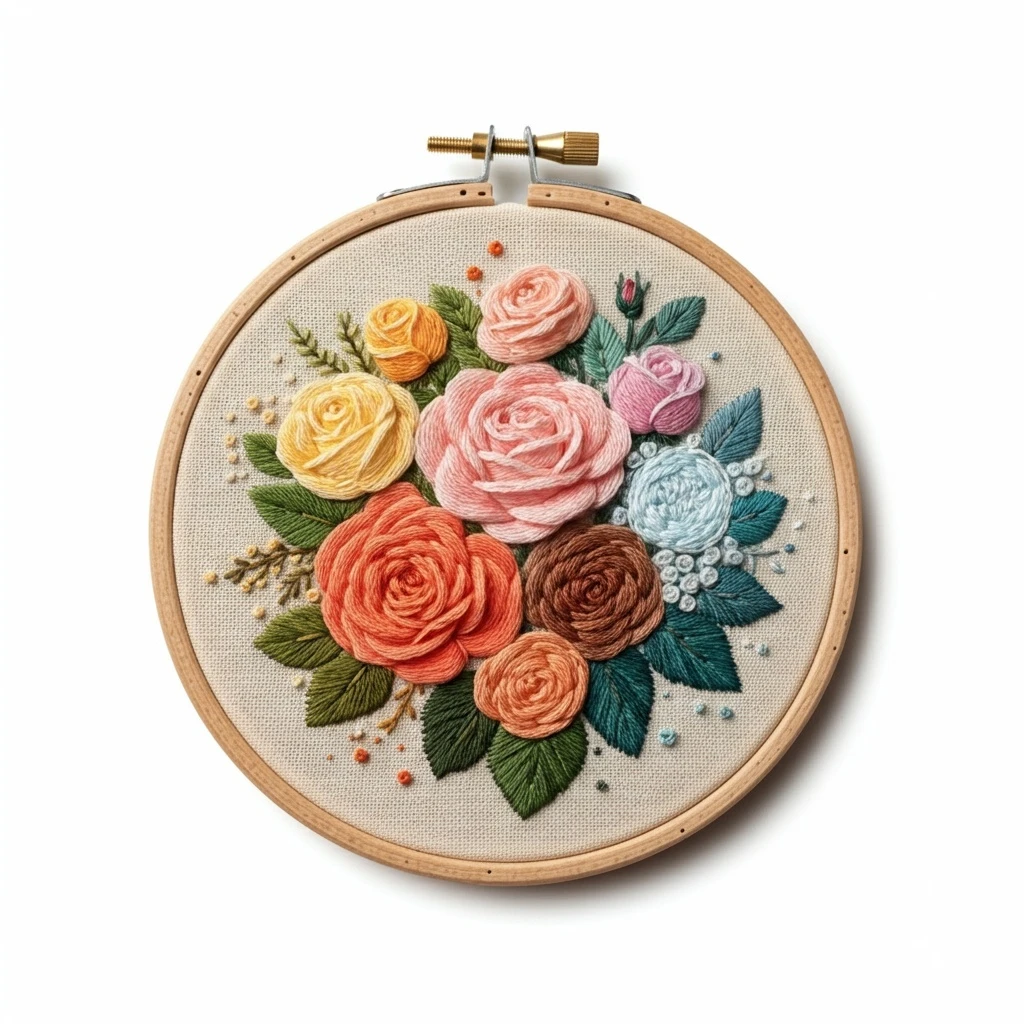
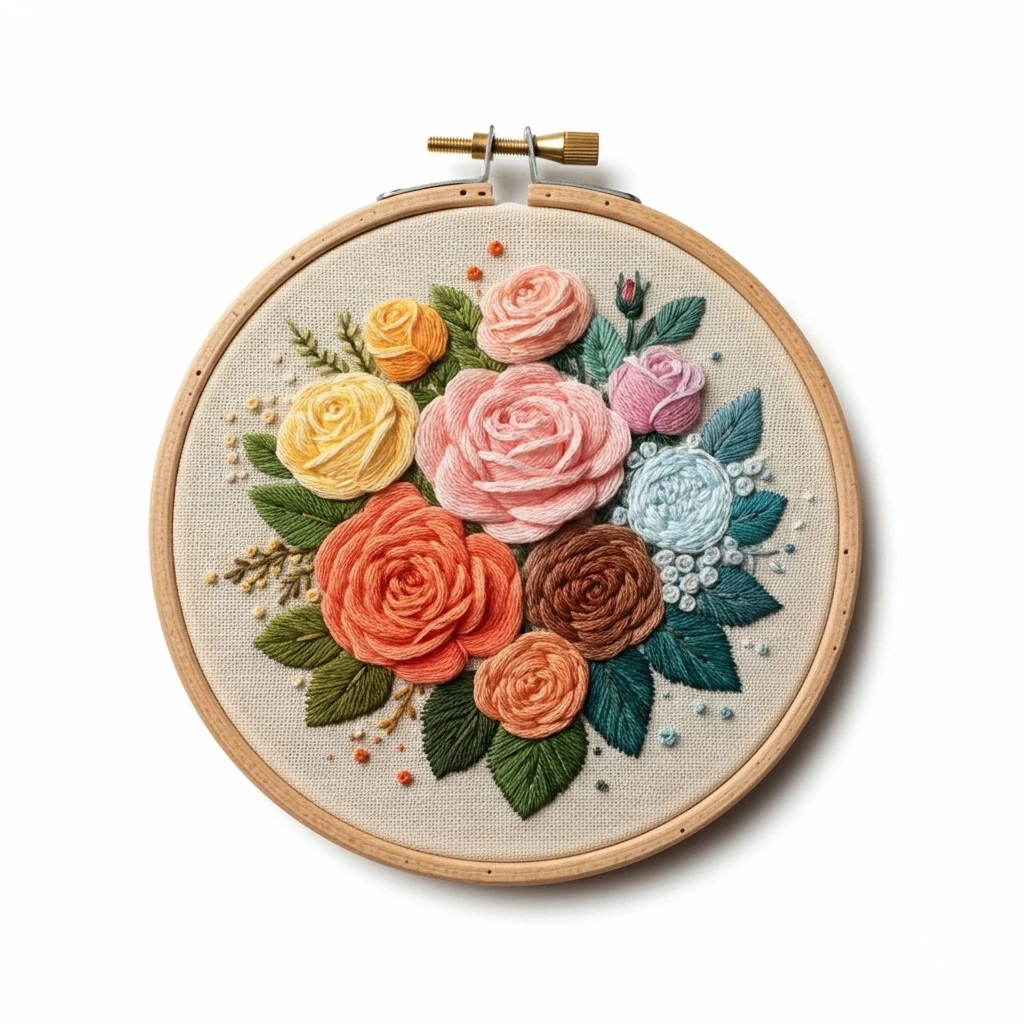
Textured Rose Bouquet
A warm, dimensional rose cluster stitched in coral, peach, butter yellow, blush pink, dusty mauve, chocolate brown, icy blue, deep fern green, and blue-green foliage. Colors are estimated from the visible hoop preview and matched to close DMC embroidery floss shades.
Likely DMC Color Palette
Palette based on the large coral rose, pale pink rose, yellow roses, small peach rose, brown rose, cool blue flower, mauve bud, dark leaves, teal foliage, berries, and natural linen ground. Coverage percentages are visual estimates from the preview, not exact thread usage.
Main blush-pink rose highlights; use for petal tips and soft curved strokes.
Middle tones in the large central rose and warm pink petal turns.
Deep coral shadows inside rose spirals and under overlapping petals.
Small peach rose, warm transitions between coral and golden flowers.
Bright yellow rose highlights and lifted petal ridges.
Golden rose middles, shadowed folds, and sunny accent knots.
Purple-pink rosebud and mauve petal shadows.
Soft rosebud highlights and pale pink blending with blush petals.
Icy blue flower, pale berry knots, and cool sparkle around the bouquet.
Cool blue shadows and deeper teal leaf transitions.
Deep fern leaves, lower foliage, and strong leaf vein shadows.
Medium leaf bodies and base greenery behind the roses.
Olive sprigs, sepals, and warm leaf shading near yellow flowers.
Blue-green leaves on the right side and cool outline accents.
Chocolate rose center, deepest petal grooves, and occasional twig shadows.
Warm brown rose highlights, twig accents, and natural hoop-toned details.
Bright petal glints, pale berry tops, and tiny highlights on rolled roses.
Subtle background-friendly accents and softened linen-colored details.
Stitching Suggestions
The design reads best when the roses are visibly raised and directional, while the leaves stay crisp and supportive. Work from background foliage to large flowers, then finish with knots and high-lighting stitches.
| Element | Recommended Stitch | Practical Notes |
|---|---|---|
| Large central pink rose | Layered long and short stitch, woven rose stitch, or padded satin arcs | Follow the spiral direction. Use 351 in the inner folds, 352 for the middle petals, and 353 or 3865 sparingly on the highest ridges. |
| Large coral-orange rose | Woven wheel rose with extra couching, or curved satin stitch rows | Build the flower from the center outward. Blend 351 with 3824 where the coral warms toward peach. |
| Yellow roses | Woven wheel, fishbone petal arcs, or long and short stitch | Use 743 in the center and underside folds, then bring 726 to the outer ridges for a buttery highlight. |
| Brown rose | Whipped backstitch spiral over padded base | Start with 435 as a soft base, then whip or couch 938 into the inner spiral to keep the chocolate rose dimensional. |
| Blue flower | Loose woven rose or circular long and short stitch | Keep the blue flower cooler and slightly quieter than the coral roses. Blend 3811 with a little 3810 near the lower folds. |
| Mauve bud | Satin stitch petals with split-stitch outline | Use 3688 in shaded areas and 3689 or 3865 for small curved highlight lines along the petal edges. |
| Dark green leaves | Fishbone stitch, raised fishbone stitch, or closed fly stitch | Stitch each leaf from the center vein outward. Alternate 3345 and 895 to avoid flat blocks of green. |
| Blue-green leaves | Fishbone stitch with backstitched veins | Use 924 for the darkest right-side leaves and touch in 3810 for cooler reflective highlights. |
| Small berries and filler dots | French knots, colonial knots, or seed stitch | Use 3811 for pale blue dots, 726/743 for golden dots, and coral scraps for warm berry accents. Vary one-wrap and two-wrap knots. |
| Fine twigs and stems | Stem stitch, split stitch, or couching | Use one strand of 3011, 435, or 938. Keep stems thin so they do not compete with the raised roses. |
Thread Count, Blending & Texture
- Use 2 strands for most rose petals and leaf fills.
- Use 3 strands only for the raised woven rose centers or extra-puffy petal ridges.
- Use 1 strand for outlines, veins, tiny stems, and delicate final highlights.
- For blush roses, thread one strand 353 with one strand 352 for soft middle petals.
- For coral shadows, blend 351 with 3824 where the orange rose turns warm.
- For cool foliage, combine 924 with 3810 in a few leaves to echo the blue flower.
- Outline only the deepest petal breaks; too much outlining can flatten the roses.
- Use split stitch under petal edges before satin filling for a clean raised rim.
- Backstitch leaf center veins with one darker strand after the leaf fill is complete.
- Place darkest color in the rose center and beneath petal overlaps.
- Let highlight stitches curve in the same direction as the petal roll.
- Keep the background dots scattered and uneven for a natural bouquet finish.
Where to Start
Mark the main flower circles, leaf directions, and berry clusters. Avoid heavy marks inside pale petals.
Add leaves behind the bouquet with 3345, 895, 3011, and 924 so the flowers can sit on top.
Work the large coral and pink roses from center to outer petals, padding or weaving as needed for height.
Add buds, knots, tiny fillers, and one-strand highlights last so the surface stays clean and lively.
Beginner-Friendly Practical Tips
Raised roses need firm fabric tension. Tighten the hoop before starting each flower so woven and padded stitches do not pucker the linen.
Cut floss around 14–16 inches for textured areas. The repeated pulling in woven roses can roughen long thread quickly.
Practice the center spiral on scrap fabric before stitching the main bouquet. The design is forgiving, but rose direction matters.
French knots are easiest after the surrounding petals and leaves are complete. They also hide small gaps and make the bouquet feel full.