
DMC color palette · stitch planning · finishing notes
A Dozen Delicate Butterflies
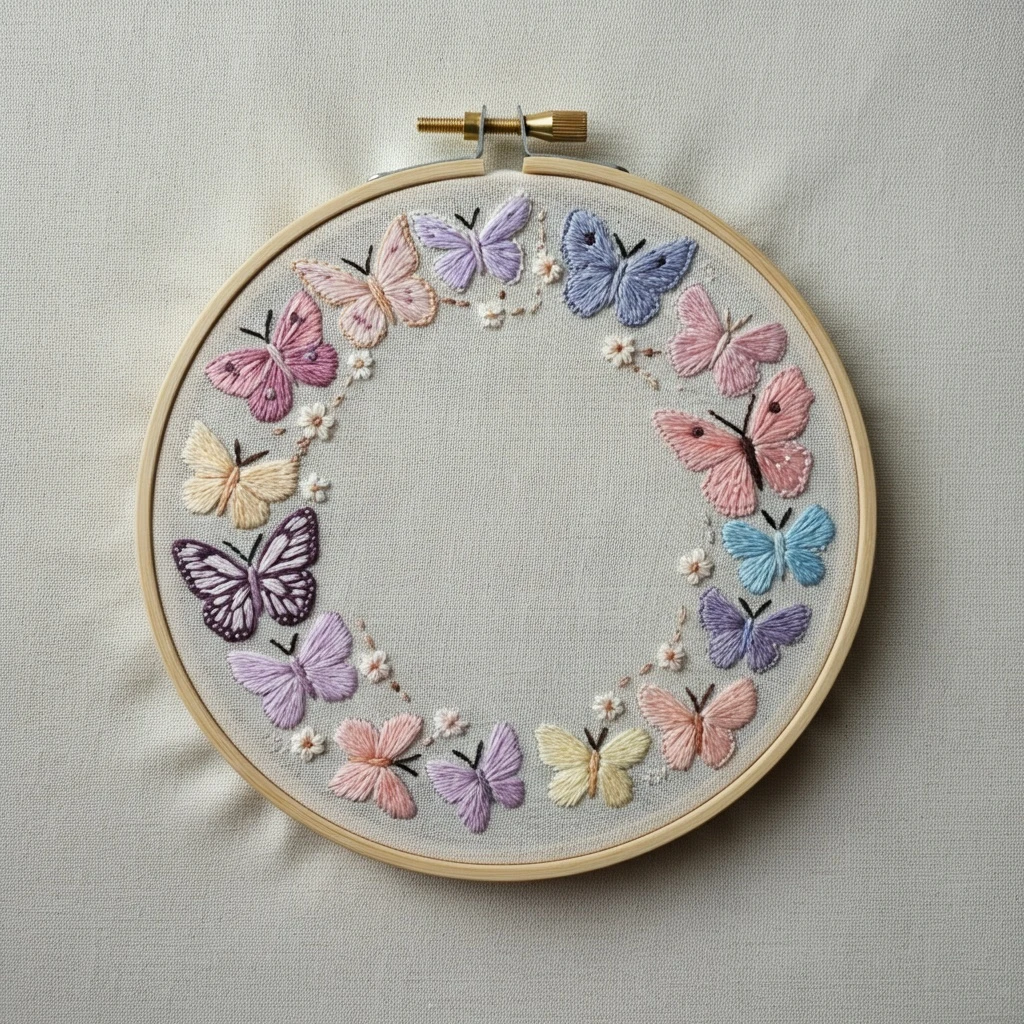
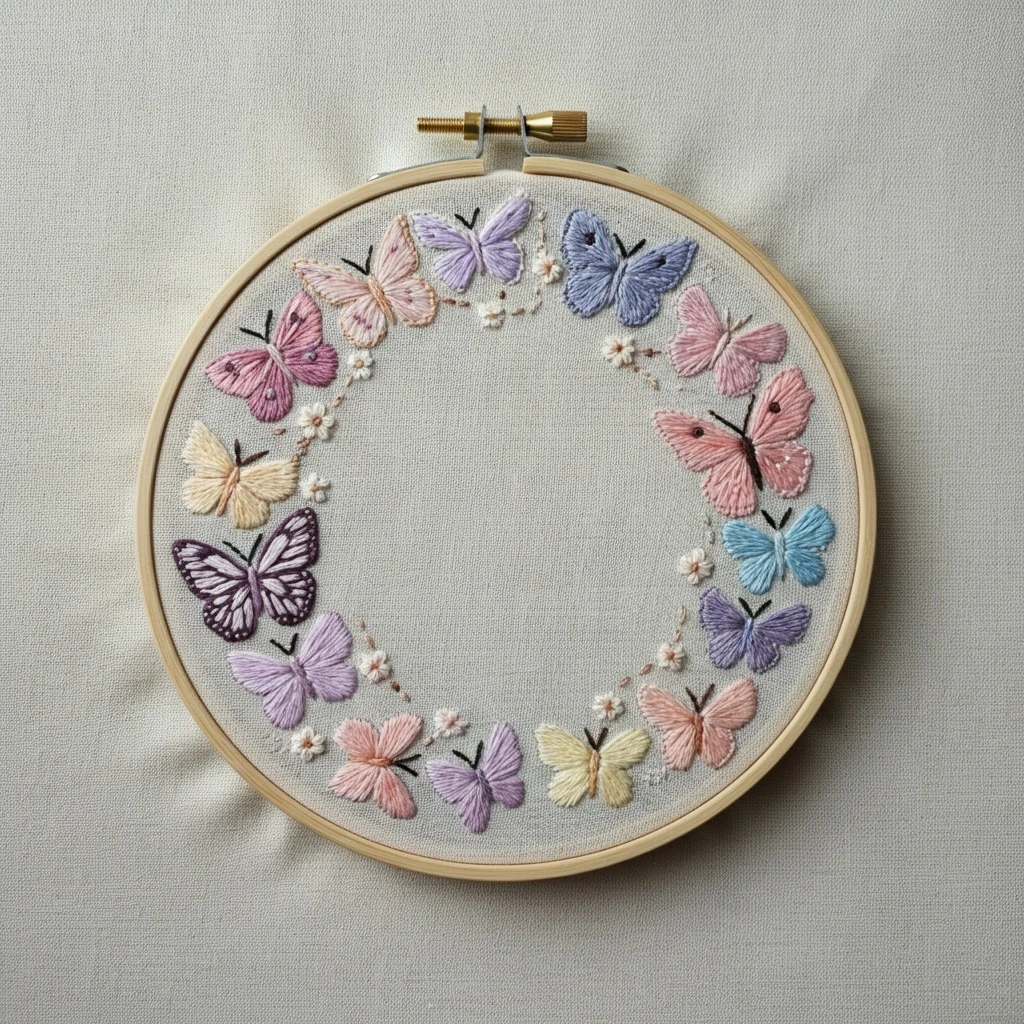
A soft hoop-art guide inspired by the reference design: twelve airy butterflies arranged as an open wreath, with pastel pink, lavender, blue, cream, peach, and plum wings floating around tiny white blossoms and dotted flight trails.
Design Read: What to Capture
Visual mood
The composition is light, circular, and romantic. Butterflies sit at varied angles around the hoop, leaving a calm open center. The palette is mostly powdered pinks, mauves, lavender, pale blue, warm cream, and one deep plum butterfly for contrast.
Embroidery priorities
Keep wings soft but defined. Use directional stitches radiating from each body toward the wing edge, then add darker veins and tiny body marks. The small white flowers and dotted trails should feel delicate, not heavy.
Suggested DMC Palette
These colors are chosen to match the visible pastel butterfly wings, linen background, cream blossoms, brown dotted trails, dark bodies, and the dramatic plum-and-white butterfly on the lower left.
Motif-by-Motif Stitch Map
| Area | Suggested stitches | Thread count | Notes |
|---|---|---|---|
| Pastel butterfly wings | Long-and-short stitch or directional satin stitch | 1–2 strands | Angle stitches from the body outward. Keep each wing half stitched in a fan direction so the butterflies look airy rather than block-filled. |
| Wing veins | Split stitch, backstitch, or very fine stem stitch | 1 strand | Use a darker shade from the same family. Let veins taper by shortening the final stitches near the wing edge. |
| Plum-and-white butterfly | Backstitch outline, satin fill, small straight stitches | 1 strand for white marks, 2 strands for plum outline | Stitch the deep plum outline first, fill the pale inner marks last, and leave small linen gaps if the shape gets crowded. |
| Butterfly bodies | Satin stitch or wrapped backstitch | 1–2 strands | A tiny tapered satin body gives a raised center. Use one strand for antennae so the V shapes stay elegant. |
| White flowers | Lazy daisy petals with French knot centers | 1 strand petals, 1–2 wraps for knots | Use B5200 for petals and 745 or 841 for centers. Keep petals small and irregular for a hand-stitched meadow feel. |
| Dotted flight trails | Seed stitch, tiny straight stitch, or colonial knots | 1 strand | Alternate dot size and spacing. Do not make a continuous line; the charm comes from a broken, floating path. |
| Outer wreath balance | Minimal couching or scattered detached stitches | 1 strand | Use only where needed to connect clusters visually. Avoid adding heavy vines that would compete with the butterflies. |
Blending & Shading Ideas
Pink butterflies
Blend 818 + 776 in the needle for a soft rose wing. Add a few single-strand 3688 stitches at the wing base and along lower edges.
Lavender butterflies
Use 211 for the outer wing, 210 through the middle, and 209 nearest the body. Feather the shades with alternating stitch lengths.
Blue butterflies
Lay 3841 as the main fill, then place short 3760 vein stitches over the top. A few 3865 highlights make the wings look luminous.
Cream butterflies
Shade 745 with a touch of 841 near the body. Keep the outer tips pale so they remain visible against linen without looking yellow-heavy.
Peach butterflies
Work 353 as a warm base and mix with 818 for softer upper wings. Add one or two 776 stitches at the body for dimension.
Deep plum contrast
The dark butterfly anchors the wreath. Use 550 sparingly but confidently, then brighten it with B5200 straight stitches inside each wing cell.
Outlining & Fine Details
Butterfly outlines
Use one strand for most outlines. Backstitch the body-side edges and the upper wing veins, but leave some pastel outer edges unoutlined to keep the design soft. The darker plum butterfly can take a stronger two-strand border.
Antennae and wing spots
Use DMC 3371 with one strand. Make antennae as two tiny straight stitches or a narrow V. For spots, use single seed stitches or one-wrap French knots rather than large knots.
Flight trails
Mark the curve lightly with removable pencil, then stitch staggered dots in 841. Vary the direction of the tiny stitches so the path looks hand-drawn and fluttery.
Flower clusters
Scatter the white blossoms between butterflies to guide the eye around the wreath. Use five lazy-daisy petals and a small knot center, or simplify to three petals where space is tight.
Practical Embroidery Tips
- Use a firm neutral fabric. The pale wings need contrast, so natural linen or cotton-linen in oatmeal, warm grey, or flax is ideal.
- Keep the hoop tension even. Long satin stitches on butterfly wings can pucker if the fabric relaxes while stitching.
- Shorten satin stitches on larger wings. Split big wing areas into narrow fan sections so the floss lies smoothly and does not snag.
- Stitch mirrored wings separately. Complete one wing half, then rotate the hoop and match the stitch angle on the opposite side.
- Do the darkest details last. Brown bodies and antennae are tiny but visually strong; adding them last prevents smudgy-looking corrections.
- Press from the back. Place the finished work face-down on a towel and steam gently from the reverse to preserve raised knots and wing texture.
Quick Starter Plan
For a softer beginner version
Use two strands for all wing fills, one strand for outlines, and skip complex shading. Choose one pink, one lavender, one blue, one cream, one peach, white, trail brown, and body brown.
For a more dimensional version
Use long-and-short shading on each butterfly, add single-strand vein overlays, couch a few wing edges with matching thread, and place tiny B5200 highlights where wings catch the light.