
Victorian Steampunk Roses and Cogs
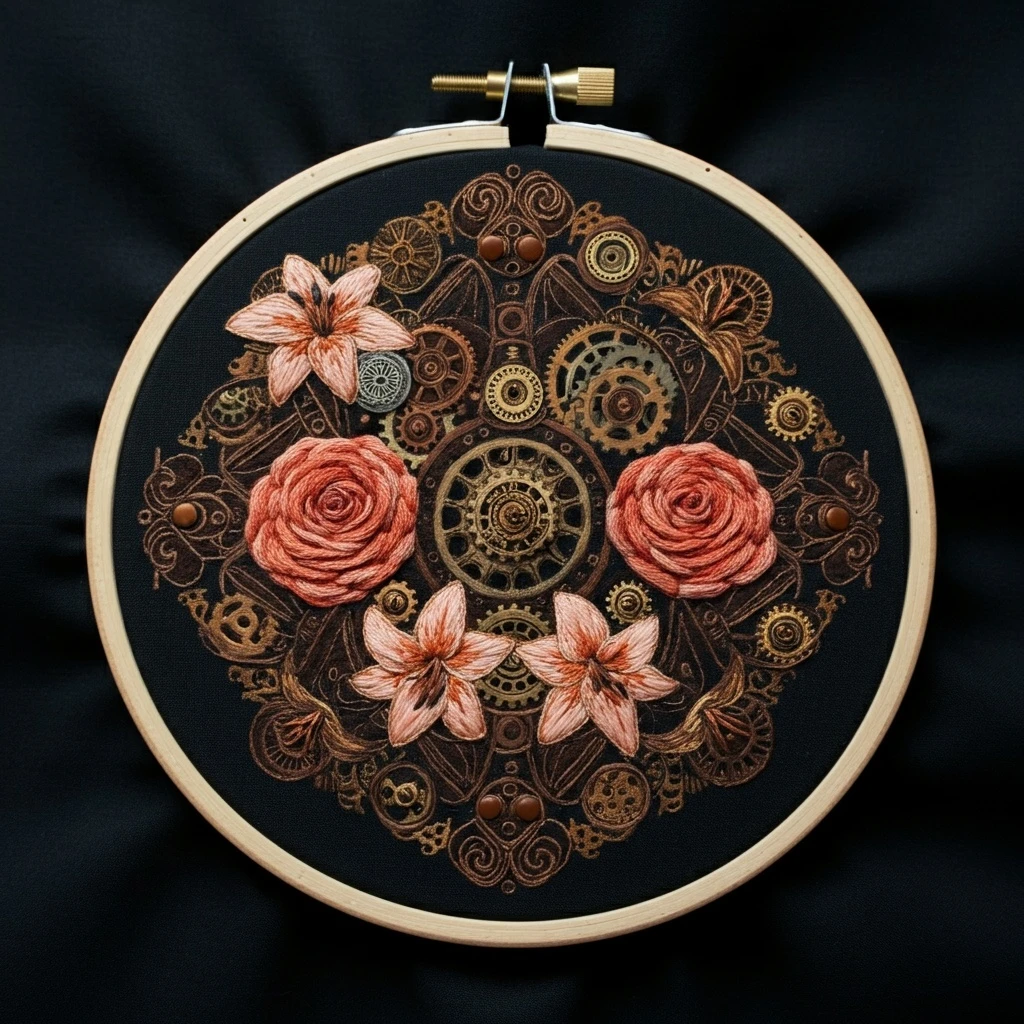
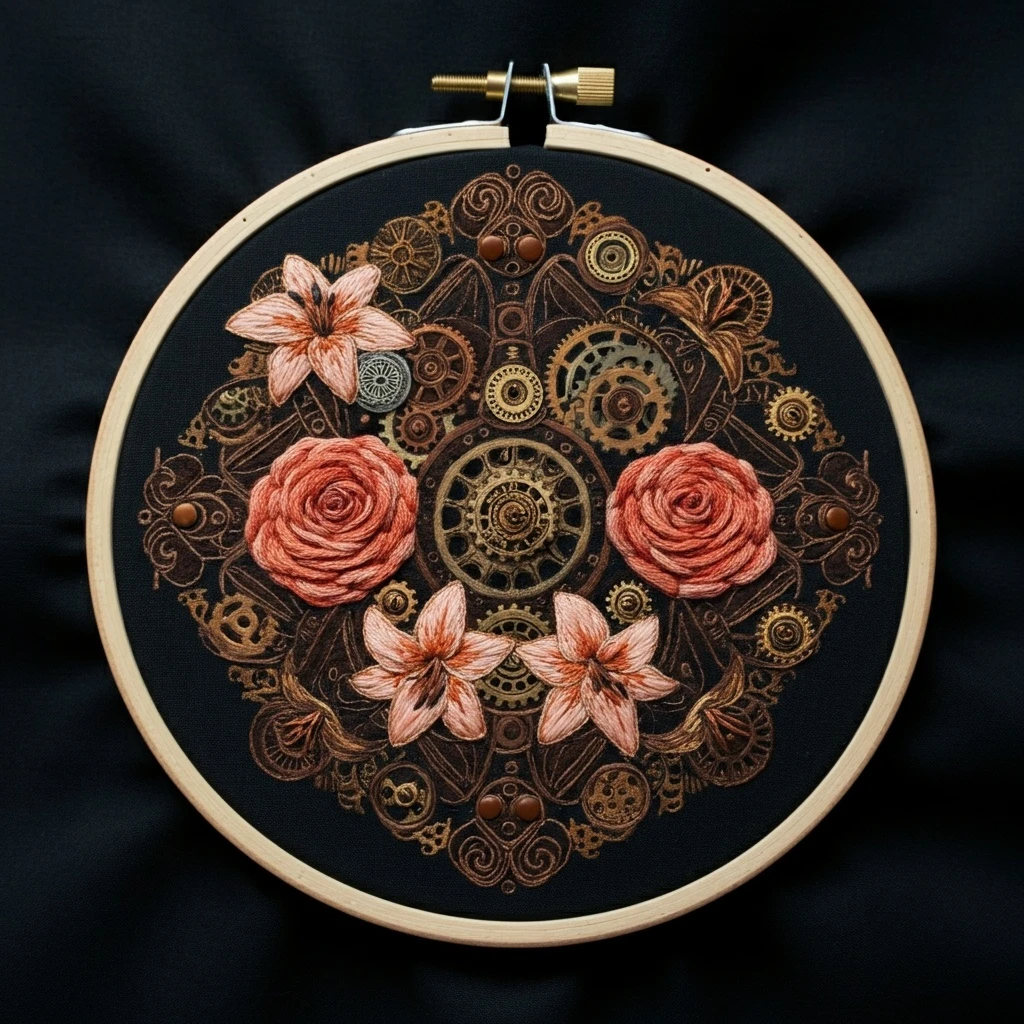
A dramatic black-ground hoop with romantic coral roses, pale peach lilies, antique brass gears, copper scrollwork, tiny rivets, and clockwork symmetry. The palette below is estimated from the visible preview and matched to practical DMC floss choices for a dimensional hand-embroidered finish.
Likely DMC Color Palette
Use the deepest shades sparingly but decisively: this design depends on crisp contrast between the black fabric, warm metal outlines, and soft floral highlights. Percentages are visual estimates, not exact thread usage.
Design Reading
The composition is a circular clockwork medallion on black fabric. Two large spiral roses dominate the lower left and right; pale lilies balance the top-left and bottom arc; fine brass gears, cogs, circles, rivets, fan shapes, and Victorian scrolls fill the background. The design works best when the florals are soft and dimensional, while the metalwork stays crisp, narrow, and slightly aged.
Thread Count Guide
- 1 strand: fine gear teeth, filigree curls, tiny spoke lines, rose vein details, and delicate outlines.
- 2 strands: most rose petals, lily petals, medium cogs, and primary decorative scrolls.
- 3 strands: raised rose ridges, larger brass rings, and bold areas that need to sit forward.
- 6 strands or pearl cotton: optional couched rivets or dramatic metallic-style raised accents.
Stitching Suggestions
Work from the strongest anchors outward: roses first, central gears next, pale flowers after that, then the fine decorative metalwork and final beads/knots.
| Element | Recommended stitch | Practical notes |
|---|---|---|
| Large spiral roses | Long and short stitch, woven rose, or curved satin stitch | Follow the spiral direction. Shade from DMC 921/353 in the center to 352 and a few 948 highlights on raised outer folds. |
| Pale lilies | Long and short stitch with split-stitch outline | Use 948 for petal bodies, then pull 920 or 921 from the throat outward in fine tapered veins. |
| Central cog wheels | Backstitch, whipped backstitch, couching | Outline rings first with 975, add teeth with 1 strand, then add 3829 only on top-left edges for antique brass shine. |
| Tiny gear teeth | Straight stitch and detached backstitch | Short, even stitches are better than long lines. Rotate the hoop often so each tooth is placed at a comfortable angle. |
| Victorian scrollwork | Stem stitch or whipped stem stitch | Use 898/975 for graceful curves. Keep line weight thin so the scrolls support the roses without crowding them. |
| Rivets and screw heads | French knots, colonial knots, or tiny padded satin dots | Use 921 or 977 with a dark 3371 shadow dot beside selected rivets to make them look raised. |
| Verdigris accent gear | Backstitch plus tiny satin sections | Use muted 924 as a cool counterpoint; add 1 strand of 3829 beside it if you want a tarnished-metal effect. |
| Black negative spaces | Leave unstitched, with occasional 310 correction | The dark fabric is part of the artwork. Reserve 310 for small holes and edge sharpening, not broad filling. |
Blending & Shading Ideas
- Rose blend: pair 1 strand 353 + 1 strand 352 for petal transitions; add single 921 stitches near the spiral core.
- Antique brass: stitch base lines in 975, shadow with 898, then add tiny 3829 highlights only where light would catch.
- Copper depth: combine 1 strand 921 + 1 strand 975 for warm mechanical outlines that do not look flat.
- Pale petal glow: use 948 as the main lily highlight and feather 920 outward from the center for warmth.
Texture Suggestions
- Raised centers: add French knots in 898/921 inside flower throats and selected gear hubs.
- Metal ridges: whip a backstitched line with 977 or 3829 to imitate polished brass edges.
- Petal softness: keep petal stitches slightly varied in length; perfectly even satin can look too flat for the roses.
- Clockwork detail: use short straight stitches for spokes rather than one long stitch, which may snag or loosen.
Beginner-Friendly Stitch Order
Helpful Notes
- Use a sharp embroidery needle for the dense rose areas and a smaller needle for tight gear teeth.
- Keep fabric very taut; circular mechanical lines distort quickly if the hoop tension is loose.
- For a metallic impression without metallic thread, use high contrast: dark brown shadow plus old-gold highlight.
- When outlining gears, stitch every other tooth first, then fill the gaps. This helps spacing stay even.
- Test French knots on scrap black fabric so the knot size matches the tiny rivets in the design.
- Step back often: this pattern needs both close detail and overall circular balance.