
Rustic Autumn Floral Bouquet
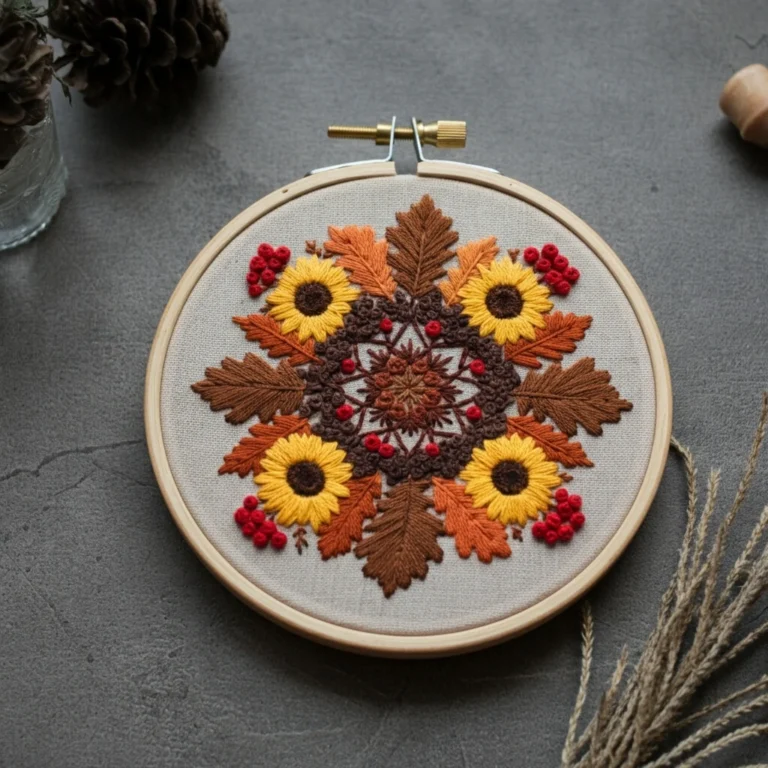
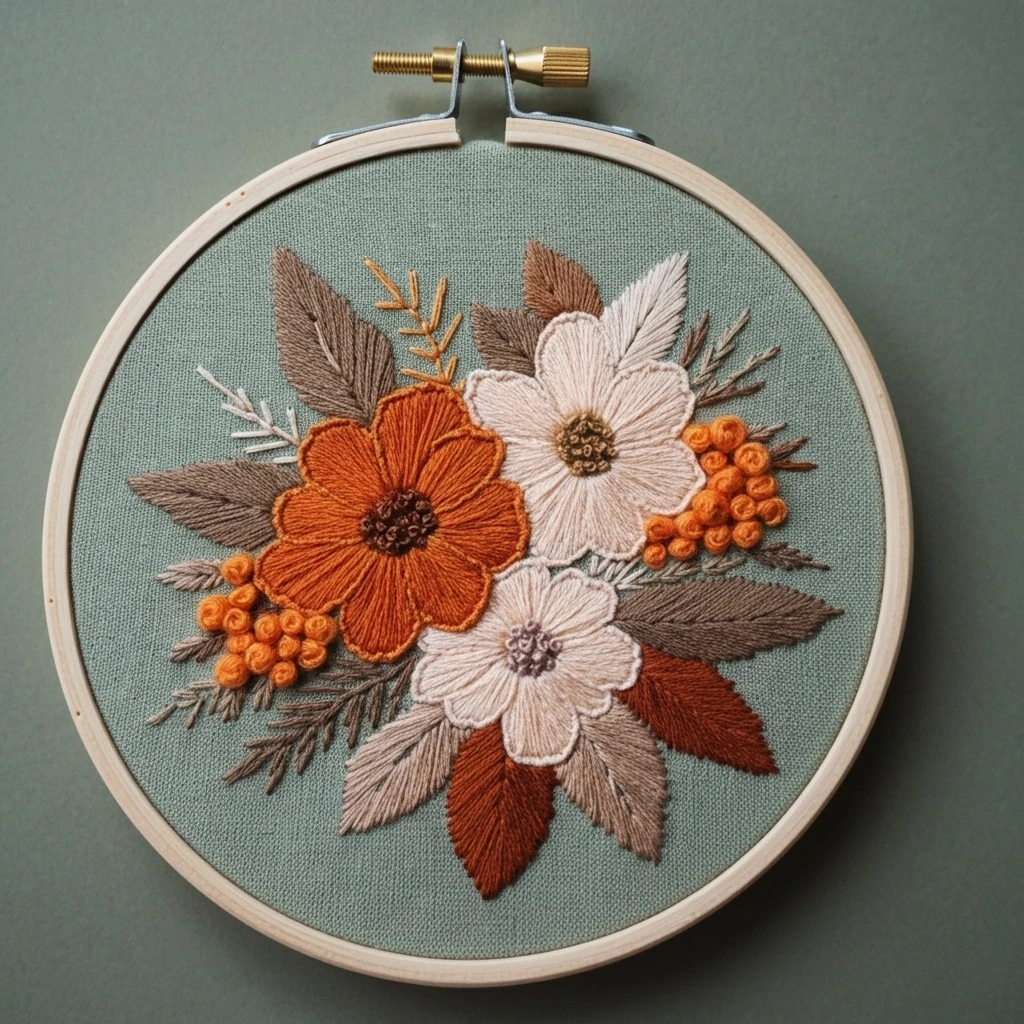
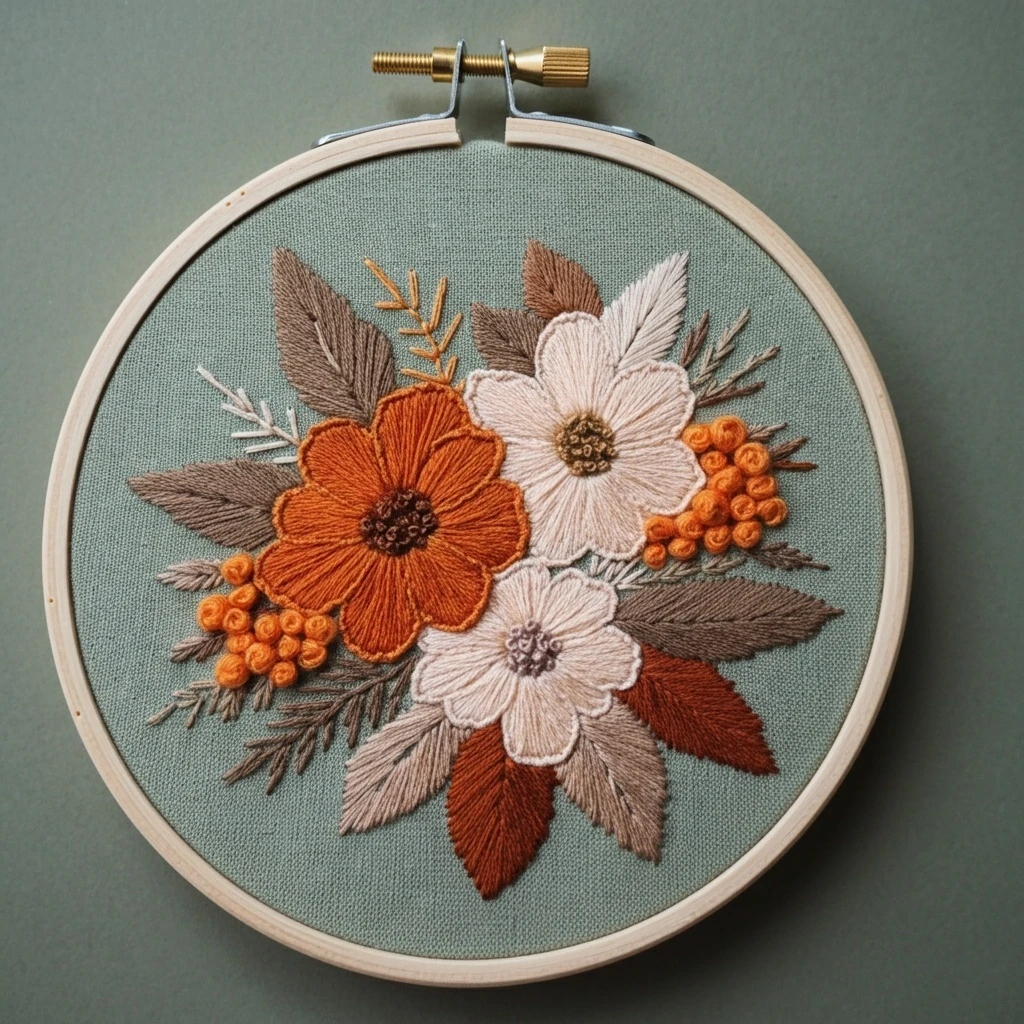
A warm, harvest-season embroidery guide built around copper petals, creamy white blossoms, taupe leaves, orange berries, dark seed centers, and the muted sage linen visible in the design reference.
Design read
The bouquet is compact and rounded inside a hoop, with one dominant rust-orange flower, two soft ivory flowers, clusters of raised orange berries, and layered autumn leaves in taupe, gray-brown, and burnt red. Thin twiggy stems and fern-like sprigs keep the arrangement airy, while the sage fabric gives the warm colors a subdued farmhouse feel.
Stitching mood
Aim for matte, softly shaded petals rather than glossy blocks of color. Use directional stitches that radiate from each flower center, slightly irregular berry knots, and crisp split-stitch outlines to preserve the hand-drawn charm of the bouquet.
Polished DMC palette
| Color | DMC | Name | Best use in the bouquet |
|---|---|---|---|
| 920 | Copper, Medium | Main body of the large rust flower petals; use as the central mid-tone for satin or long-and-short fill. | |
| 919 | Red Copper | Deep petal bases, folds, shadowed separations, and the lower burnt-red leaf. | |
| 921 | Copper | Warm highlights along rust flower ridges and outer petal tips. | |
| 922 | Copper, Light | Fine highlight strokes on the orange flower and a few bright berry glints. | |
| 740 | Tangerine | Bright raised berry knots and the liveliest orange accents. | |
| 741 | Tangerine, Medium | Berry mid-tone; wrap knots firmly so each berry looks round and dimensional. | |
| 971 | Pumpkin | Berry shadows and underside knots; blend with 741 for less neon orange. | |
| 3865 | Winter White | Brightest ivory petal highlights on the two cream flowers. | |
| 3774 | Desert Sand, Very Light | Soft blush shadows in white petals, especially near centers and overlapping edges. | |
| 739 | Tan, Ultra Very Light | Petal base warmth and subtle rim shading so the cream blossoms do not look flat. | |
| 642 | Beige Gray, Dark | Main taupe leaf fill; ideal for the large gray-brown leaves behind the flowers. | |
| 645 | Beaver Gray, Very Dark | Leaf veins, outer leaf shadows, and darker twig details. | |
| 3863 | Mocha Beige, Medium | Warm leaf highlights and dry botanical texture on tan leaves. | |
| 501 | Blue Green, Dark | Muted stems and fir-like sprigs where the design turns cooler against the sage fabric. | |
| 503 | Blue Green, Medium | Soft gray-green stem highlights; use sparingly so the greens remain rustic. | |
| 801 | Coffee Brown, Dark | Flower centers, berry shadows, and the darkest knots before adding near-black accents. | |
| 3371 | Black Brown | Tiny center dots, deepest seed shadows, and selective final outlining only. | |
| 3826 | Golden Brown | Ochre twig sprigs rising behind the flowers and warm seed-center glints. |
Optional fabric match: choose a dusty sage linen close to the reference, or use natural oatmeal linen for a warmer farmhouse finish. If stitching on dark green fabric, add one extra strand of 3865 or 739 in the cream flowers for visibility.
Petal direction
Work every petal from the flower center outward. Let the stitch direction fan slightly so the thread grain creates the same ribbed, embroidered texture visible in the reference.
Color balance
Keep the orange flower saturated, the cream flowers soft, and the leaves muted. The bouquet works because the strong copper and berry notes are surrounded by quiet taupe foliage.
Raised texture
Use denser stitches only for berries and flower centers. Leaves and petals should stay flatter so the knot clusters feel intentionally dimensional.
Stitch plan by motif
Thread-count guidance
Needles & fabric
- Use a size 7 or 8 embroidery needle for 2-strand filling and a size 5 or 6 needle for heavier knot clusters.
- A medium-weave linen, cotton-linen, or evenweave in sage green, mushroom, or oatmeal suits the rustic palette best.
- Back the fabric with lightweight stabilizer if it is soft or loose; long-and-short stitches look cleaner on stable fabric.
Blending, shading & outlining
Blended needle ideas
920 + 921919 + 9203865 + 3774642 + 3863501 + 503
For a softer illustrated look, thread the needle with two different colors at once. This is especially useful where petals transition from shadow to highlight or where dry leaves need a mottled autumn effect.
Outlining details
Use split stitch for petal edges because it gives a tidy boundary without looking too heavy. Reserve 3371 for tiny, high-contrast points only. Most outlines should be made with a darker version of the fill color, such as 919 around copper petals or 645 around taupe leaves.
Shading sequence
Fill shadows first, place mid-tones second, then add highlights last. On the rust flower, keep the deepest color near the center. On cream petals, shade the base and the overlapped side; leave the outer petal faces light.
Texture control
Separate all six floss strands before recombining the number you need. This keeps long satin and long-and-short stitches smooth, while knots can stay slightly tighter and more compact for texture.
Beginner-friendly practical tips
- Mark petal direction lines lightly before filling; they act like a map for long-and-short stitch.
- Do not try to make every berry identical. Slight size variation makes the clusters look organic.
- When a leaf disappears under a flower, stop the stitches just beneath the flower outline rather than carrying them all the way under the filled petal.
- Keep the back tidy around cream petals; dark thread tails can shadow through pale floss on light fabrics.
- After stitching, steam from the back into a towel and avoid pressing directly onto French knots or padded berries.