
Open Center Embroidered Floral
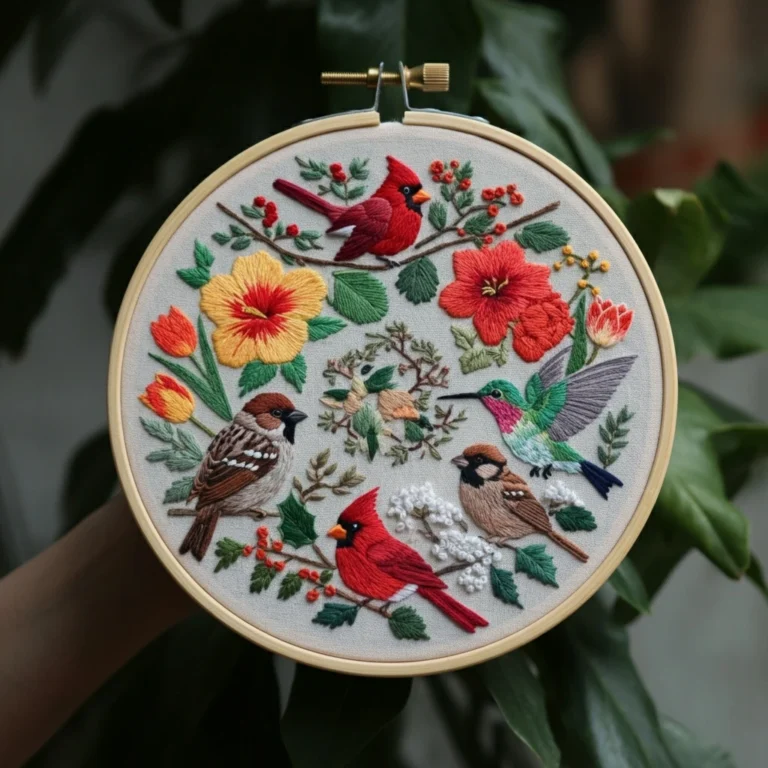
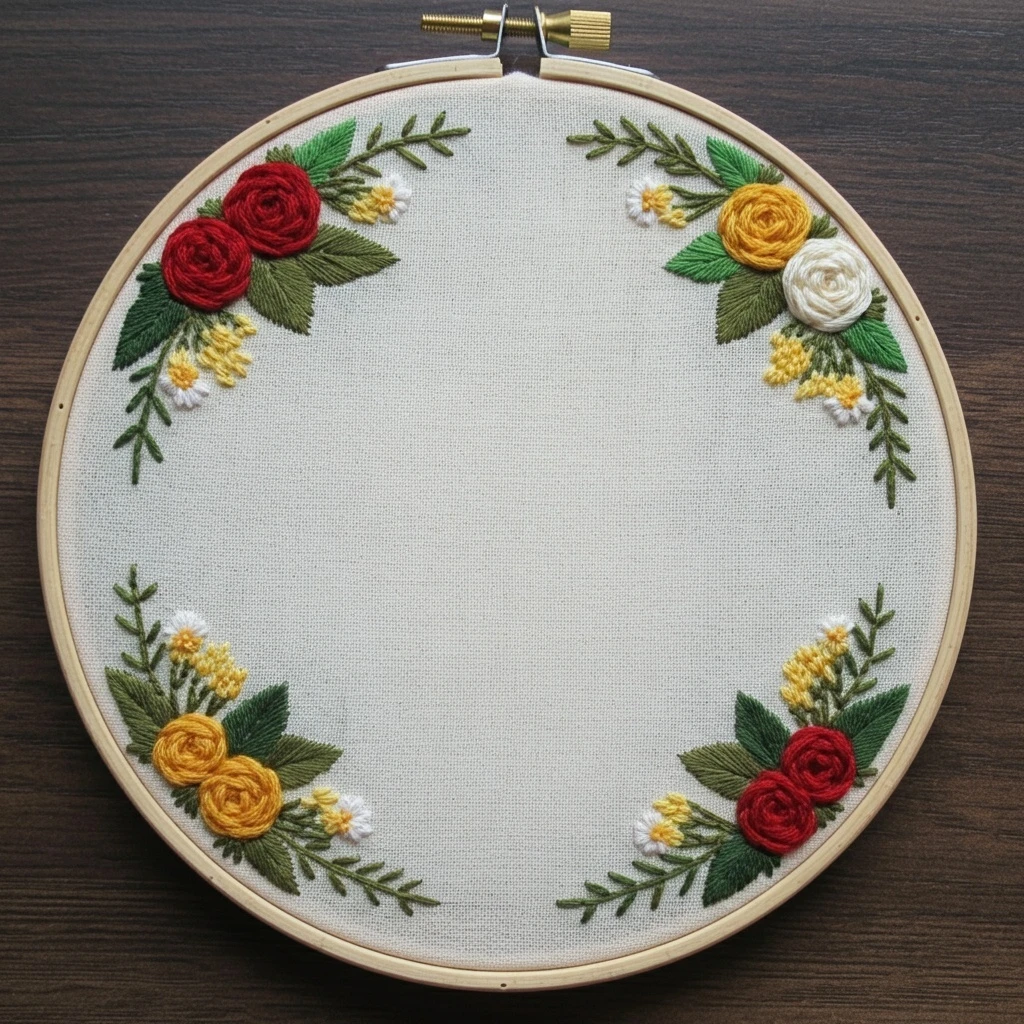
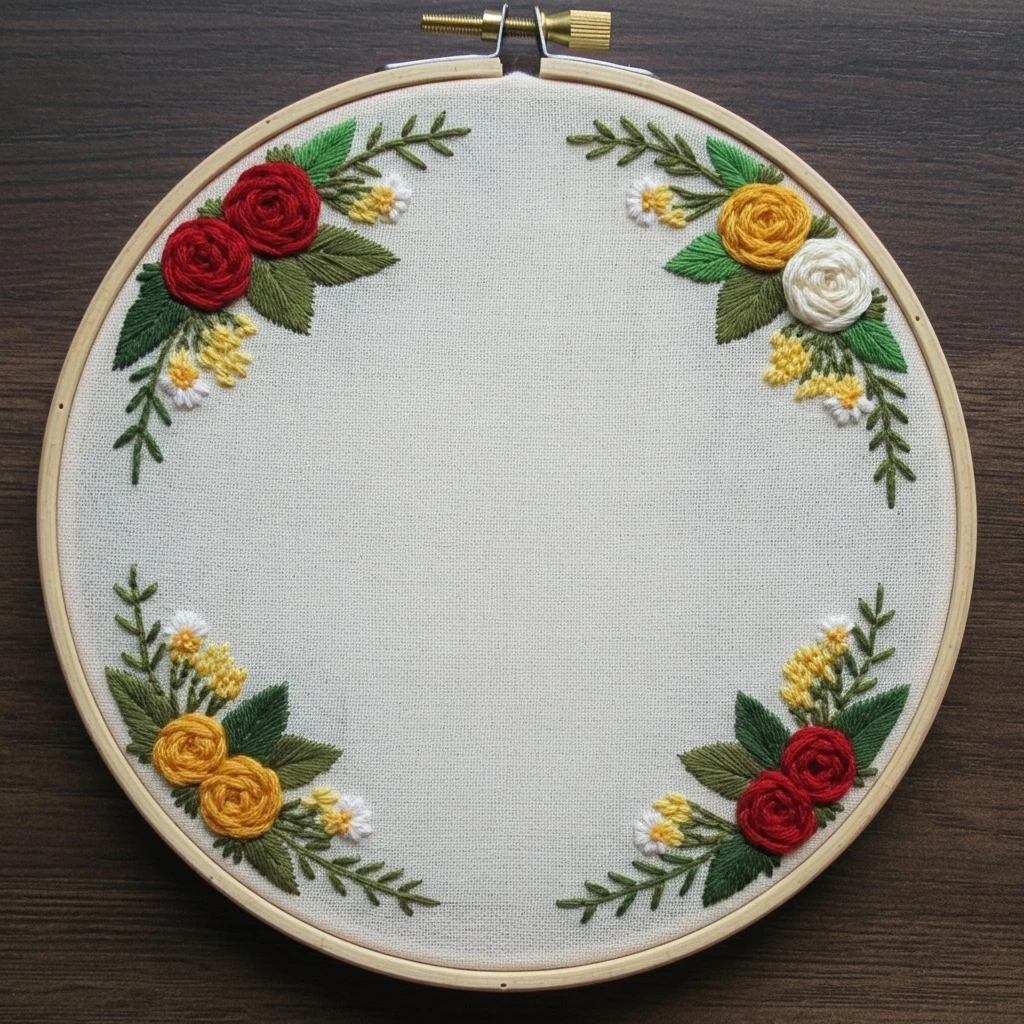
A balanced hoop border with four floral clusters, leaving a generous blank center for a monogram, quote, date, or heirloom message. The design combines dimensional red and golden roses, white daisies, yellow filler blossoms, layered green leaves, and airy olive sprigs around warm natural linen.
Best worked on natural linen or cotton-linen in a 6–8 inch hoopColor story observed from the artwork
The palette is garden-classic rather than pastel: deep crimson rose petals, golden ochre rosettes, creamy white blossoms, warm yellow centers, and several greens ranging from dark pine to soft olive. Keep the center visually quiet by using light linen and reserving the darkest values for the roses and leaf shadows.
Stitch map by design element
Dimensional roses
- Use woven wheel roses for the red and yellow rosettes: 5 spokes for small roses, 7 spokes for fuller blooms.
- Work the spokes with 2 strands, then weave with 4–6 strands for a raised, rounded petal effect.
- Blend 321 with 498 in alternating wraps near the red rose center, then switch to pure 321 toward the outer rim.
White daisies and tiny blossoms
- Use lazy daisy stitches with 2 strands of 3865 for crisp white petals.
- Add a tiny straight stitch or French knot cluster in 725 or 783 for centers.
- For the smallest white flowers, keep each petal short and evenly spaced so the blooms read as light accents.
Layered leaves
- Use fishbone stitch for broad leaves, beginning with a center vein and alternating side stitches.
- Shade each leaf from 890 or 895 at the base into 3362 or 3011 at the tip.
- For serrated edges, finish with tiny angled straight stitches in 895.
Olive sprigs and stems
- Use stem stitch or back stitch with 2 strands of 3051 for curved branches.
- Add small detached straight stitches for leaves, alternating left and right along the branch.
- Use one strand for the finest top sprigs so the border stays airy and open.
Thread-count and blending guidance
Recommended strand counts
- Rose wheels: 2 strands for spokes, 4–6 strands for woven wraps.
- Leaves: 2 strands for fishbone stitch; 1 strand for vein details.
- Stems and sprigs: 1–2 strands depending on how delicate the branch should look.
- Flower centers: 2 strands for French knots; wrap once for tiny dots, twice for plush centers.
Blends that suit the sample
- Red roses: 1 strand 321 + 1 strand 498 for inner shadows.
- Golden roses: 1 strand 783 + 1 strand 725 for lively marigold warmth.
- Olive leaves: 1 strand 3011 + 1 strand 3051 for muted background foliage.
- White blooms: 3865 with a touch of Ecru at the petal base prevents flat white shapes.
Order of stitching
Mark the wreath border with a fine removable pen. Leave the center free of heavy markings, especially if you plan to add lettering later.
Work the olive sprigs and branching stems before the flowers. This lets petals and leaves sit neatly on top of the greenery.
Place the darkest leaf bases first, then add mid-green strokes toward the tips. Keep matching clusters symmetrical, but not perfectly identical.
The woven roses are the raised focal points, so stitch them after surrounding leaves. Finish with daisies, yellow filler knots, and final highlights.
Outlining, shading, and texture notes
Shading approach
- Anchor red rose depth with 498 in the central spiral and under-overlapping petal turns.
- Use 783 in golden rose centers, then brighten the outer rings with 725.
- Place 890 at leaf bases nearest flowers, where natural shadow would fall.
Texture approach
- Combine woven wheels, fishbone stitch, French knots, and detached chains for varied surfaces.
- Use small random-length straight stitches for yellow filler blossoms so they look natural.
- Let some sprig tips extend lightly outward to mimic the airy sample border.
Beginner-friendly practical tips
Hoop and fabric prep
- Use tightly stretched cotton-linen; slack fabric makes woven roses loosen and distort.
- If the blank center will hold text, stitch the floral border first and add lettering after pressing.
- Test white thread on the fabric scrap. Use Blanc only on darker linen; 3865 is usually softer on natural cloth.
Neat finishing
- Keep the back tidy around the open center so no dark traveling threads show through.
- End dark red and dark green threads before crossing pale fabric areas.
- Steam lightly from the back over a towel to preserve the raised roses and French knots.
Palette is a practical DMC approximation based on the visible artwork: substitute nearby shades from your stash when needed, but preserve the value contrast between deep rose reds, warm golds, creamy whites, and layered greens.