
DMC Palette & Practical Stitch Guide
Embroidered Garden Garland
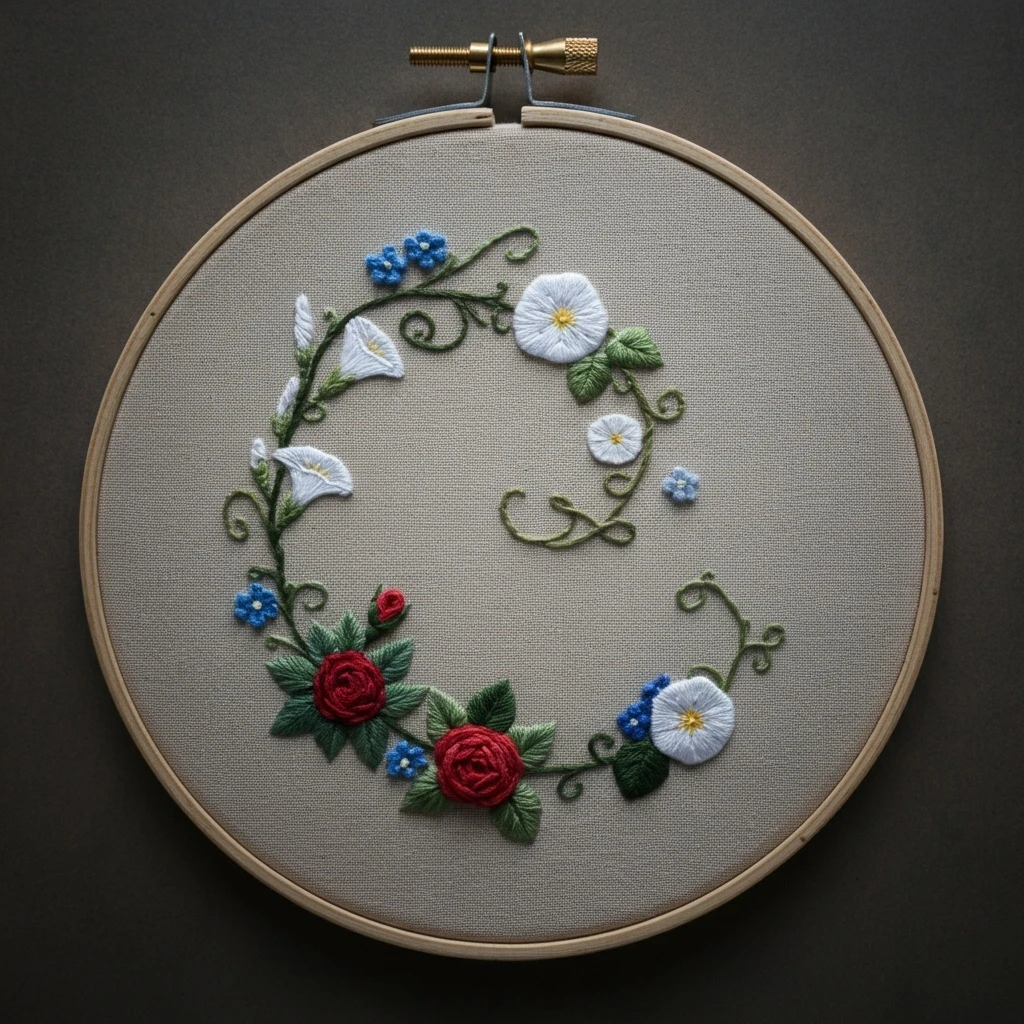
A soft circular garland with curling olive vines, white trumpet and round blossoms, raised red roses, blue forget-me-not clusters, leafy greenery, and warm yellow flower centers on natural linen.
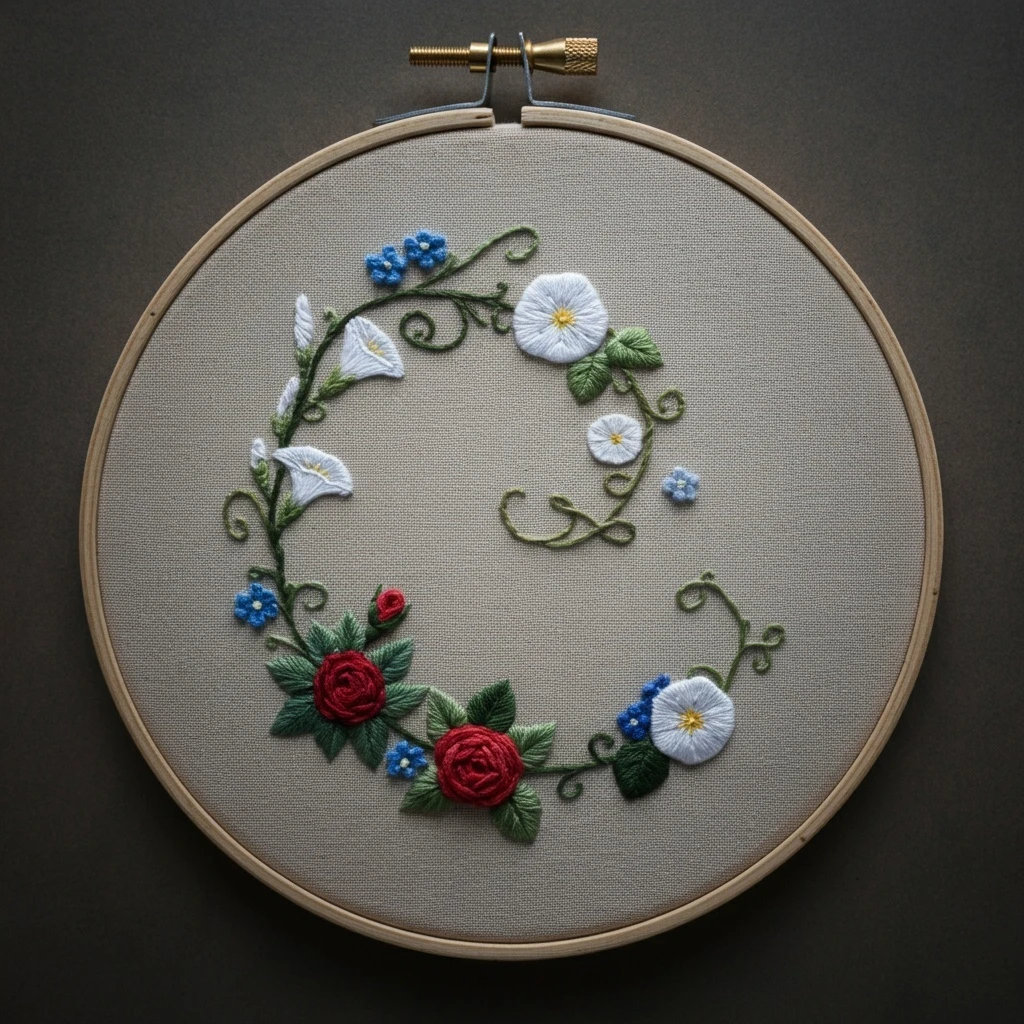
Preview image used for visual color matching and stitch planning.
Design read
This hoop is built as an airy broken wreath rather than a dense full circle. The main movement comes from thin scrolling vine lines that sweep around the hoop, with larger dimensional roses anchoring the lower left and lower center. White blossoms add light, blue knots give tiny meadow accents, and layered green leaves create depth around the red flowers.
The palette should feel natural and slightly vintage: linen neutrals, muted olive greens, cool white petals, cornflower blue accents, deep rose reds, and small golden centers.
Best approach: stitch the vine path first so the garland shape stays graceful, then add leaves and large flowers, saving tiny knots and petal highlights for the final pass.
Likely DMC Color Palette
These DMC shades are close practical matches to the visible threads. Coverage percentages are visual estimates only, not exact yardage.
Main vine curves, darker stems, curled tendrils, and deep leaf undersides.
Secondary vine work, mid-tone leaf veins, and soft transitions between dark and light foliage.
Raised leaf highlights, outer leaf tips, and lighter fern-like stitches around blossoms.
Deep shadows behind red roses and small dark leaf accents where the garland needs contrast.
Bright white petals on round flowers and trumpet blooms; use sparingly for crisp highlights.
Petal shadows in the white flowers, especially along folded trumpet edges and lower petal bases.
Main rose petals and bright red rolled flower areas.
Rose centers, tucked petal shadows, and under-stitches for dimensional red flowers.
Tiny blue flower clusters and darker knots in forget-me-not accents.
Light blue petals and highlights on the smaller clustered flowers.
Yellow centers for white flowers and pin-dot highlights inside blue blossoms.
Optional soft grounding shade for subtle linen-colored shadows or barely-there stem underdrawing.
Stitching Suggestions
| Element | Suggested stitches | Practical notes |
|---|---|---|
| Scrolling vine garland | Stem stitch, split stitch, or whipped backstitch | Use 1-2 strands of DMC 3363. Keep the curves smooth by shortening stitches around tight curls; whip a backstitched vine if you want a rounded cord effect. |
| Large red roses | Woven wheel rose, cast-on rose, or layered satin arcs | Start with DMC 814 in the center, then move to 321 on outer petals. Keep wraps snug but not tight so the rose sits raised and full. |
| White round flowers | Long and short stitch, satin stitch, or radiating straight stitch | Blend B5200 with 762 near the base of petals. Work stitches outward from the yellow center so the flower has a soft circular fan. |
| White trumpet flowers | Long and short stitch with split-stitch outline | Outline the flower lip first in one strand of 762, fill with B5200, then add a few pale gray directional stitches to show folds. |
| Blue flower clusters | French knots, colonial knots, or tiny detached chain | Use 798 for darker knots and 827 for highlights. One-wrap knots look delicate; two-wrap knots create a more raised forget-me-not cluster. |
| Leaf groups | Fishbone stitch, satin stitch, or fly stitch | Use 895 at the base, 3363 for the body, and 3347 on the outer tips. Angle stitches toward a central vein for natural leaf shaping. |
| Small berries and buds | French knots and short straight stitches | Add these last with 3052, 726, or blue shades so they sit cleanly above the vine and do not get buried by leaf stitches. |
| Fine outlines | One-strand backstitch or split backstitch | Use restrained outlining around flower folds and rose shadows only where definition is needed; too much outline can make the garland look heavy. |
Thread Count, Blending & Shading
Thread-count guide
Use 2 strands for most leaves, rose supports, and flower fills. Use 1 strand for curling vines, delicate tendrils, and pale petal fold lines. Use 3 strands only for extra-plump woven roses or prominent knots.
Blended greens
For fuller leaves, combine one strand of 3363 with one strand of 3347. For darker shadow leaves near the roses, combine 3363 with 895.
White petal dimension
White flowers need gentle shading. Place 762 at the petal base or under folded edges, then finish the visible surface with B5200 to keep the flowers bright.
Rose depth
Use DMC 814 in the center and between petal layers, then bring DMC 321 onto raised outer wraps. A few tiny 814 stitches under the petals make the roses read as dimensional.
Texture balance
Let the roses and blue knots be the raised textures. Keep the vine flatter with stem stitch so the overall hoop remains elegant and not bulky.
Beginner tip
Mark the wreath path lightly before stitching. Finish one section at a time, but check the full circle often so the garland stays open and balanced.
Suggested Stitching Order
- Transfer the vine curve and main flower placement clearly; the open negative space is part of the design.
- Stitch the main scrolling vine with 1-2 strands in a smooth stem stitch.
- Add the largest leaf clusters around the lower roses and the right-side white flower.
- Work the red roses next so you can tuck smaller leaves and blue blossoms around them naturally.
- Fill the white flowers with directional stitches, adding yellow centers after the petal work is complete.
- Finish with blue knots, tiny buds, and final one-strand highlights on leaves and petals.
Hoop finish: leave the linen background clean and lightly pressed. This design depends on quiet fabric space around the garland, so avoid overcrowding the open center.
Encouraging Finish
For the prettiest result, build contrast slowly: slim olive vines first, dimensional roses second, then bright white blossoms and tiny blue knots as the sparkling final details. The finished hoop should feel graceful, airy, and garden-grown rather than perfectly symmetrical.