
Dreaming Bloom Wreath
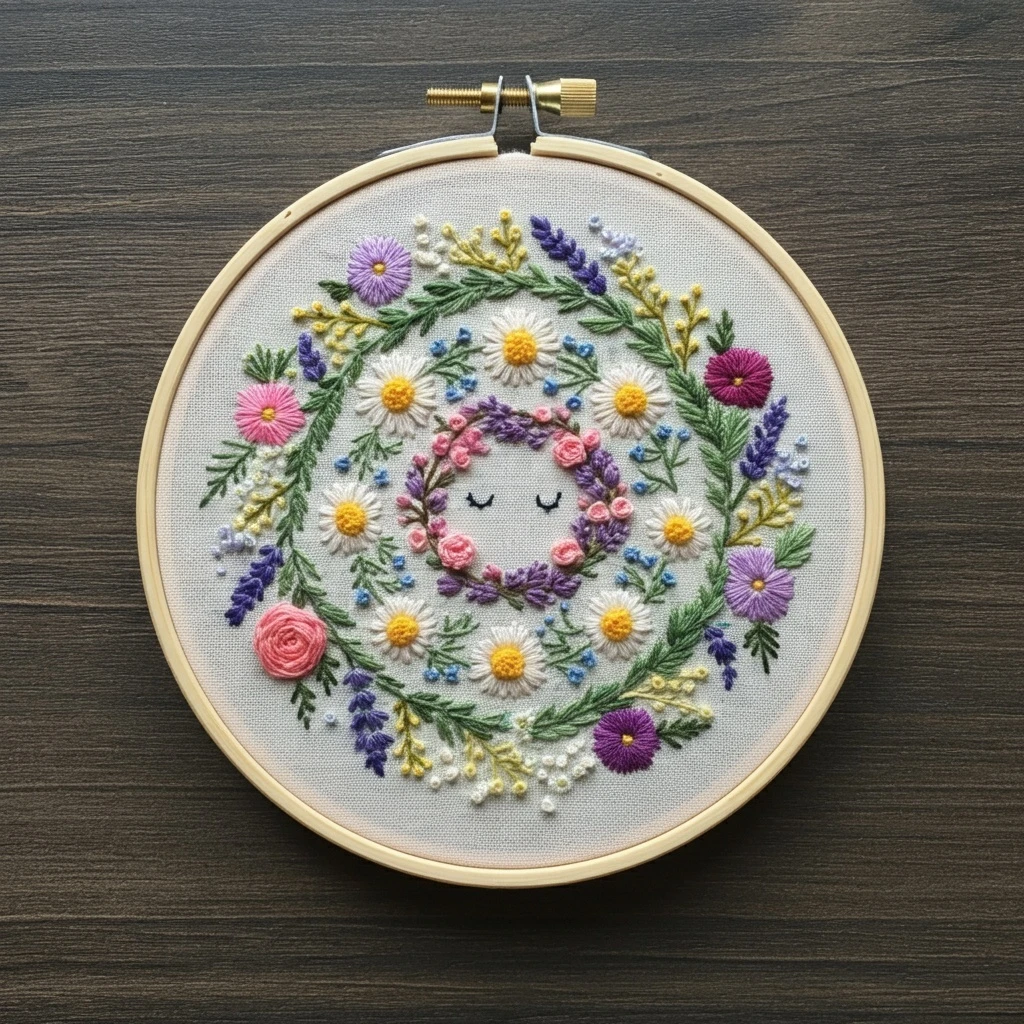
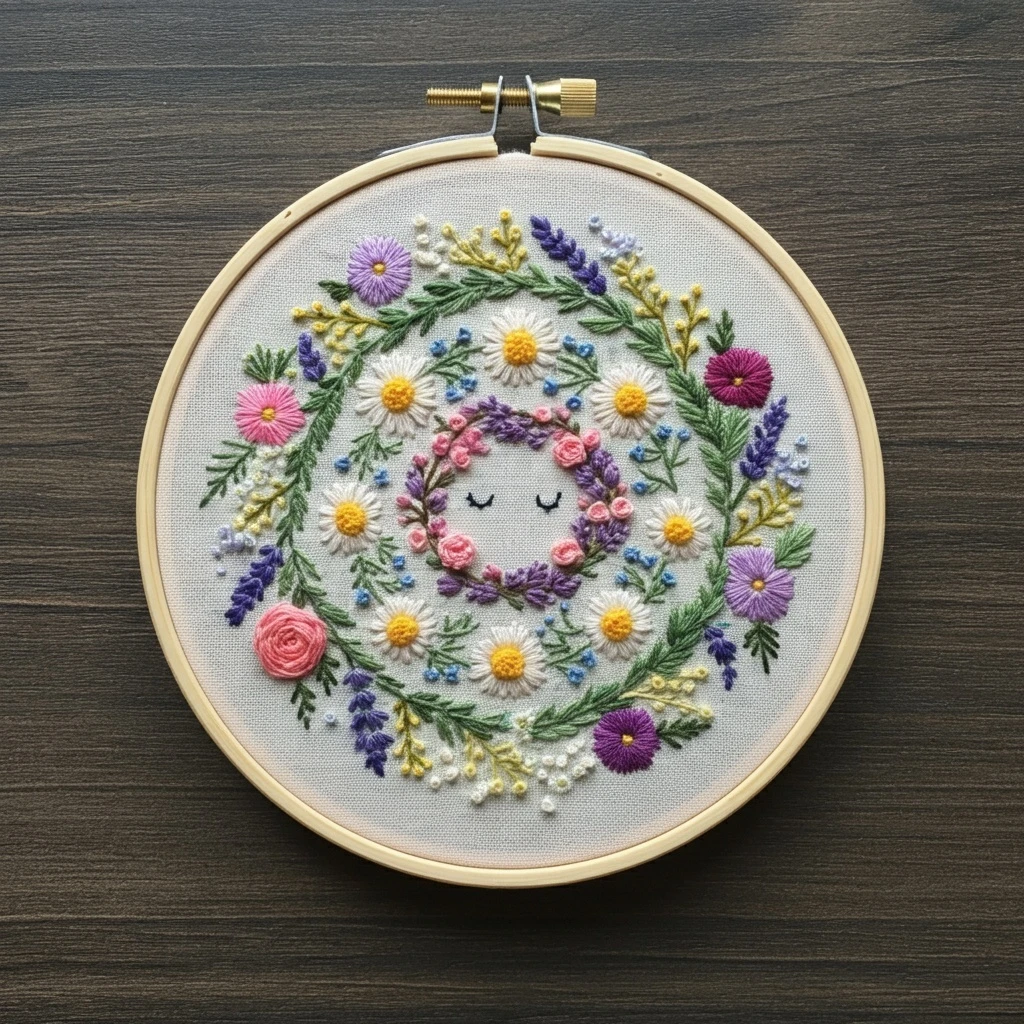
A soft romantic floral wreath with rounded pink blossoms, mauve-lilac accents, airy greenery, and tiny golden centers. The overall mood is gentle and dreamy, with layered blooms arranged around a circular botanical frame.
Palette overview
The design reads best as a tender garden wreath: dusty rose and blush for the main blooms, a few deeper mauves for petal depth, olive-sage greens for the circular stems, and small warm yellow touches to brighten the flower centers. Keep the colors softly blended rather than sharply blocked.
Stitch plan by design element
Build the wreath in layers: establish the curved green frame first, stitch the leaves next, then add the larger pink flowers and finish with raised centers and fine highlight details.
Soft botanical frame
Use stem stitch or split stitch with 1 strand of DMC 3051. For a rounder vine, whip a few sections with 3052 after the base line is complete.
Layered pink petals
Use long-and-short stitch, satin stitch, or loose fishbone petals. Shade from 3721 at the base through 223, then add 818 on the petal tips.
Dimensional accents
Try woven wheel roses with 2 strands of 223, adding one wrap of 3721 near the center and a final highlight wrap in 818.
Dreamy cool contrast
Use detached chain stitches or tiny satin petals in 3042 and 3041. Keep them smaller than the pink flowers so they support the wreath.
Sage-green texture
Use fishbone stitch for larger leaves and straight stitches for narrow sprigs. Blend 3052 with 3053 for soft leaf surfaces.
Raised golden detail
Use French knots with 2 strands of 729, then add a few smaller 744 knots at the highlight side of the flower center.
Thread count, blending & shading guidance
Recommended strands
- 1 strand: fine outlines, inner petal crease marks, thin stems, and delicate highlight strokes.
- 2 strands: most petals, leaves, woven wheels, detached chains, and French knots.
- 3 strands: only for a few raised foreground roses or large golden centers.
- Split one strand from the floss slowly before recombining colors for smoother blended shading.
Order of stitching
- Start with the wreath circle and major branching stems.
- Add leaves before flowers so petals can sit naturally over the foliage.
- Work larger blooms from back petals to front petals, keeping the darkest stitches near the center.
- Finish with knots, white highlights, and any tiny seed stitches after the main shapes are complete.
Blush petal blend
Thread one strand DMC 223 with one strand DMC 818 for soft petal tips. Use the blend as scattered top stitches rather than full coverage.
Deep rose shadow
Use one strand DMC 902 with one strand DMC 3721 only at bloom centers or tucked-under petals. This keeps the shadows rich but not harsh.
Sage foliage blend
Combine one strand DMC 3052 and one strand DMC 3053 for pale leaves. Use DMC 3051 alone for the main wreath skeleton.
Texture and outlining details
The wreath should feel full but not crowded. Let a little background fabric show between flower clusters and avoid heavy black outlines; tonal shading will look more graceful with this pastel botanical design.
Texture suggestions
- Use woven wheel roses for the roundest blooms and satin or long-and-short stitch for flatter petals.
- Vary French knot size in the centers by changing the number of wraps rather than adding bulk everywhere.
- Add tiny seed stitches in 3865 around the brightest pink blooms for a dreamy glint.
- Use a few detached chain leaves pointing outward to keep the wreath lively and circular.
Outlining approach
- Outline stems with 3051, but use petal-color outlines for flowers instead of dark gray or black.
- Define petal overlaps with 1 strand of 3721 or 902 in short curved stitches.
- Use 3865 only as a highlight separator where two pink petals meet.
- Keep the top of the wreath lighter and the lower floral clusters slightly denser for balance.
Beginner-friendly practical tips
Place tiny dots for each center before stitching petals so the bloom direction stays consistent.
Shorter stitches curve more easily around rounded flowers and reduce snagging on raised areas.
Leave breathing room inside the wreath so the design keeps its airy, dreaming quality.
One or two blended stitches per petal are enough to create softness without muddying the pinks.
Raised centers catch thread easily, so add French knots after surrounding petals and leaves are done.
Lay the finished piece face down on a towel and press gently from the back to protect woven roses and knots.