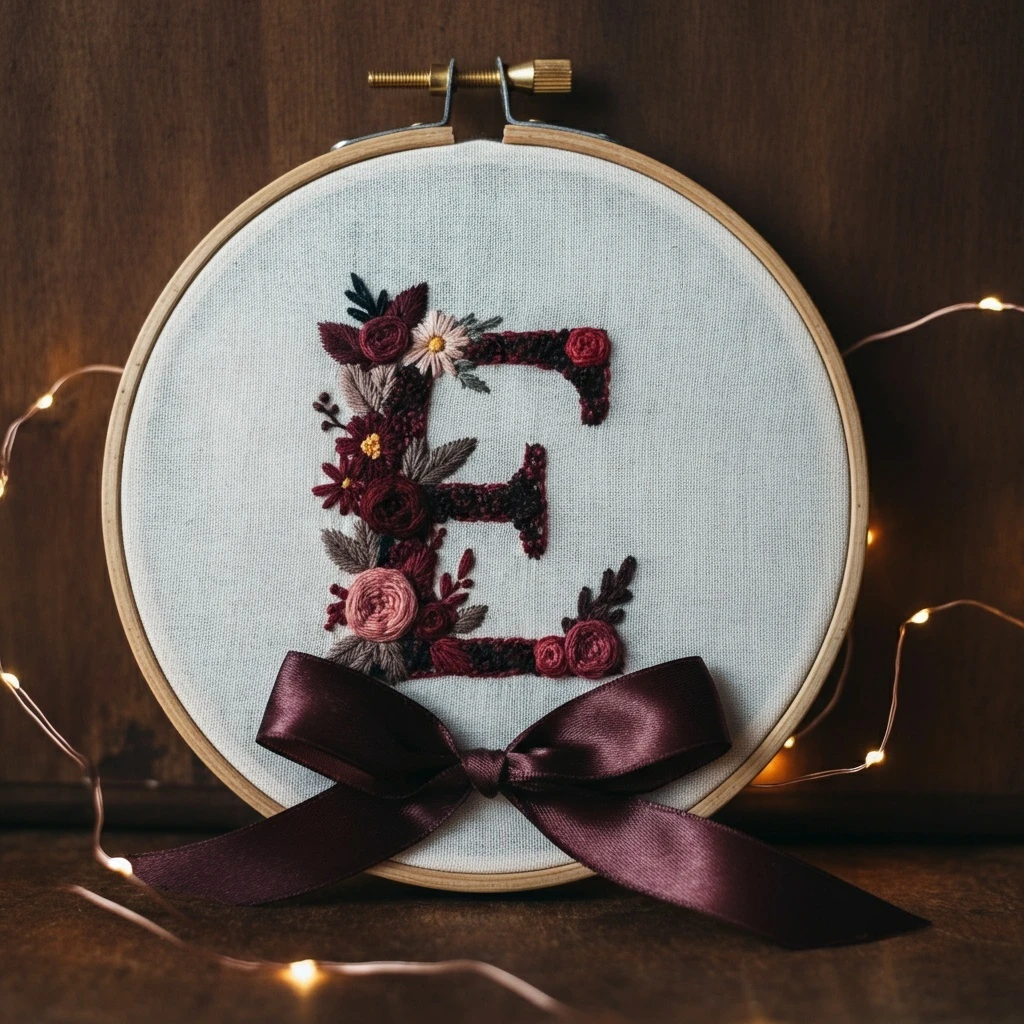


Burgundy Monogram E Floral Initial
This floral initial design pairs a graceful letter E with burgundy blossoms, dusty rose highlights, small buds, muted sage leaves, and refined decorative accents. The stitched version should keep the initial crisp and readable while allowing the flowers to soften the letter with romantic, wine-toned detail.
Polished DMC Color Palette
The palette below is built for a deep burgundy floral monogram: garnet shadows, wine mid-tones, blush highlights, antique mauve depth, muted green foliage, and warm golden knots for tiny centers. Keep the darkest colors concentrated at petal bases and letter shadows so the design stays elegant rather than heavy.
Stitch Map by Design Element
Thread Count & Blending Guide
Letter precision
Use 1 strand for the inside edges of the E, tight corners, narrow serifs, and tiny corrective outline stitches. This keeps the initial polished and legible.
Main floral work
Use 2 strands for petals, leaves, stems, and most letter fills. Two strands provide rich burgundy coverage while still allowing careful shaping around the monogram.
Raised accents
Use 2–3 strands for flower-center knots, decorative seed clusters, and textured bud tips. Use three strands only for the largest focal flowers.
Shading, Outlining & Texture Suggestions
Keep the E readable
- Define the vertical spine and three arms before adding heavy floral texture.
- Use short split stitches at the inner angles of the letter to avoid rounded corners.
- Let flowers overlap the E in only a few chosen places so the initial remains clear.
- Add a final one-strand outline in 814 or 815 if the letter edge softens too much.
Burgundy flower depth
- Keep 814 limited to petal bases, folds, and overlap lines.
- Use 316 between petals when you need a cool shadow rather than a darker red.
- Place 304 sparingly on lifted petal edges for warmth and glow.
- Add 3722 or 761 only at tips and small filler blooms to preserve the burgundy mood.
Leaf movement
- Angle stems outward from the letter so the floral spray feels intentional.
- Use darker leaves behind flowers and lighter leaves on the outer tips.
- Vary leaf length and direction so the arrangement does not look mirrored.
- Leave small areas of fabric showing between leaf clusters for an airy finish.
Outlining approach
- Outline after filling so the letter and petals sit crisply on top.
- Use darker shades from the same color family instead of black.
- Use split stitch for curved petal edges and back stitch for small straight marks.
- Skip some pale rose and leaf outlines for a softer botanical effect.
Beginner-Friendly Stitching Order
- Transfer lightly: mark the letter E, flower centers, main petal groups, buds, stems, and leaf clusters. Keep transfer lines very faint beneath blush and cream areas.
- Establish the E: stitch the spine and arms first with split stitch or satin stitch so the monogram stays clean as flowers are added.
- Add stems and back leaves: use 3051 and 3052 for foliage that sits behind the burgundy blooms.
- Stitch focal flowers: work dark bases first, then mid-tones, then rose and blush highlights at the petal tips.
- Add filler flowers and buds: distribute lighter rose and mauve tones to balance the composition around the letter.
- Finish with details: add golden knots, pale highlight dots, leaf veins, final outlines, and any small decorative seed stitches last.
Practical Tips for a Clean Finish
Fabric & hoop
Warm cream cotton, linen, or cotton-linen makes burgundy floss look rich and classic. Keep the fabric drum-tight so satin stitches on the E lie smooth and petal shading stays neat.
Needle choice
Use a sharp embroidery needle size 7–9 for one- and two-strand work. Move up slightly for three-strand knots so flower centers pull through cleanly without puckering.
Preventing dark show-through
Do not carry garnet or green floss behind pale rose, cream, or open fabric areas. End threads cleanly and restart nearby to keep the monogram bright.
Letter-edge control
If the E edges look uneven after floral stitching, add a final one-strand split-stitch outline in 815. Use the smallest stitches at the inner corners and ends of the arms.