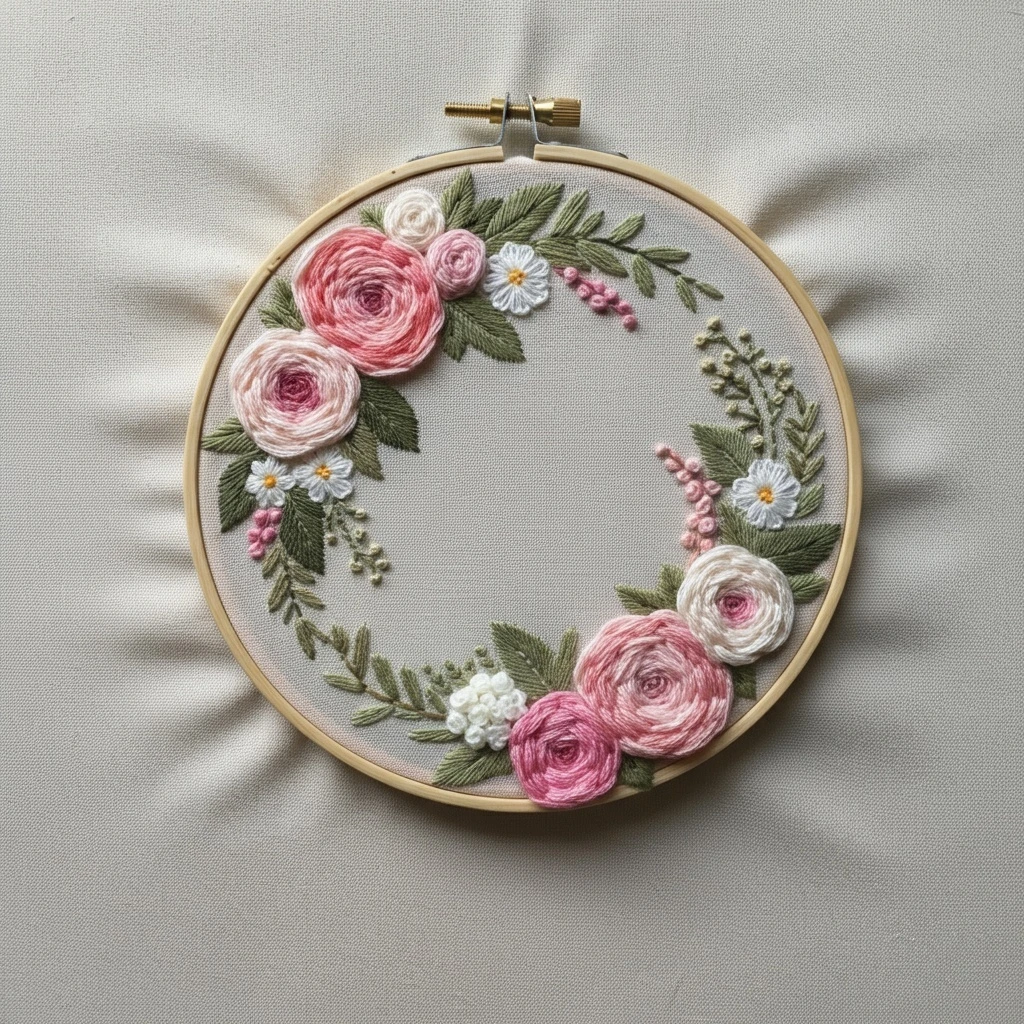

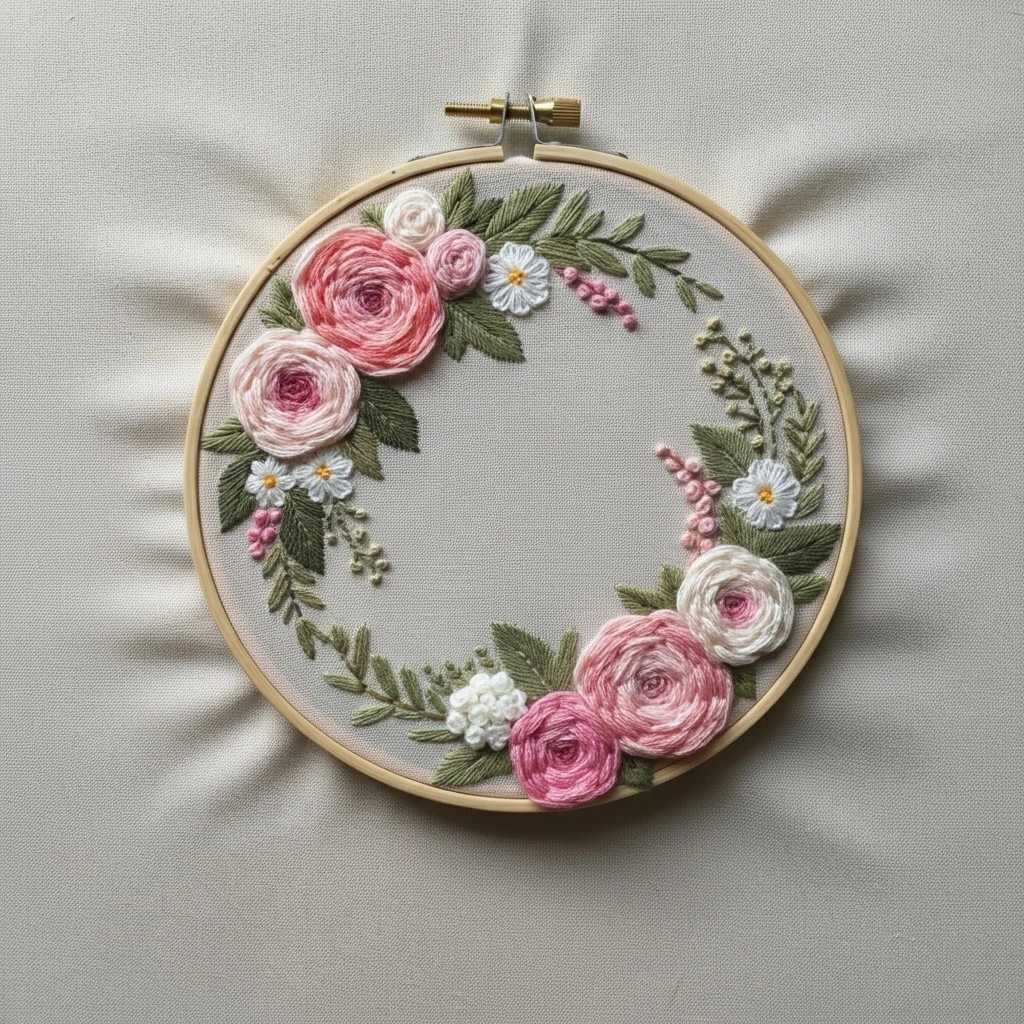
Romantic Rose and Daisy Wreath
A soft circular floral wreath with full pink-red roses, tiny white daisies, fresh green leaves, and airy sprigs. This guide focuses on romantic shading, clean outlines, dimensional petals, and beginner-friendly thread handling.
Color Story
The design reads as a delicate garden wreath: rosy blooms carry the visual weight, daisies brighten the outer rhythm, and muted greens keep the circular movement graceful rather than heavy. Use the darkest reds sparingly in petal folds and the palest creams for daisy highlights so the wreath remains light and romantic.
Recommended Stitch Map
| Design Area | Best Stitches | Thread Guidance | Practical Notes |
|---|---|---|---|
| Large roses | Long-and-short stitch, satin stitch, split stitch outline | 2 strands for filling; 1 strand for petal folds | Begin at the darkest inner curl with DMC 815, move through 3831, then feather 760 or 818 outward. |
| Daisies | Lazy daisy stitch, straight stitch, French knots | 2 strands for petals; 2 wraps for centers | Keep petals slightly uneven for a hand-drawn garden feel. Use 746 with tiny 726 knots in the center. |
| Leaves | Fishbone stitch, satin stitch, fly stitch | 2 strands for leaves; 1 strand for veins | Angle stitches toward the center vein. Add 3345 only on one side to avoid muddying the leaf shape. |
| Wreath stems | Stem stitch, whipped backstitch | 2 strands for main arcs; 1 strand for fine twigs | Stitch the circle in short sections so curves stay smooth. Whip with a lighter green for a raised vine effect. |
| Small buds and filler sprigs | French knots, detached chain, tiny straight stitches | 1-2 strands depending on scale | Scatter filler lightly. Too many knots can crowd the open, romantic spacing of the wreath. |
Blending & Shading
- Rose blend: thread one needle with 1 strand DMC 3831 + 1 strand DMC 760 for soft mid-petal transitions.
- Deep fold blend: use 1 strand DMC 815 + 1 strand DMC 3831 only in the tightest rose centers.
- Highlight control: reserve DMC 818 for the final few stitches so the flowers do not become too pale overall.
- Leaf depth: place DMC 3345 on lower edges and where leaves tuck behind roses; keep DMC 469 visible as the main green.
Texture Suggestions
- Use padded satin stitch on the largest rose petal sections for a raised, plush look.
- Add French knots in DMC 726 to daisy centers, varying wraps between one and two for natural texture.
- Use a few detached chain stitches as tiny leaves around the wreath perimeter to soften the silhouette.
- Keep filler sprigs airy with single-strand straight stitches; negative space is part of the charm.
Outlining, Thread Count & Finishing
Outlining Details
Outline roses with a single strand of DMC 815 or a blended 815/3831 only where petals need definition. For daisies, avoid dark outlines; use tiny pale stitches and let the petal shapes stay soft. Wreath stems look best in stem stitch with 2 strands of DMC 469, then selectively deepen intersections with DMC 3345.
Beginner-Friendly Thread Plan
Use 2 strands for most flowers and leaves, 1 strand for vein lines and petal creases, and 3 strands only for occasional raised knots or extra-plump rose centers. Separate all six floss strands first, then recombine them to reduce twisting and keep satin areas smooth.
Simple Working Sequence
- Transfer the wreath lightly so pencil or transfer lines do not show through pale daisy petals.
- Work the circular stems in short stem-stitch sections, rotating the hoop as needed for comfortable curves.
- Fill leaves with fishbone or satin stitch, adding darker green veins after the fills are complete.
- Shade the roses from dark centers outward, blending one color step at a time.
- Add daisies last with lazy daisy stitches and French knot centers, then finish with small filler sprigs.
- Steam from the back over a towel to lift padded petals and avoid flattening knots.