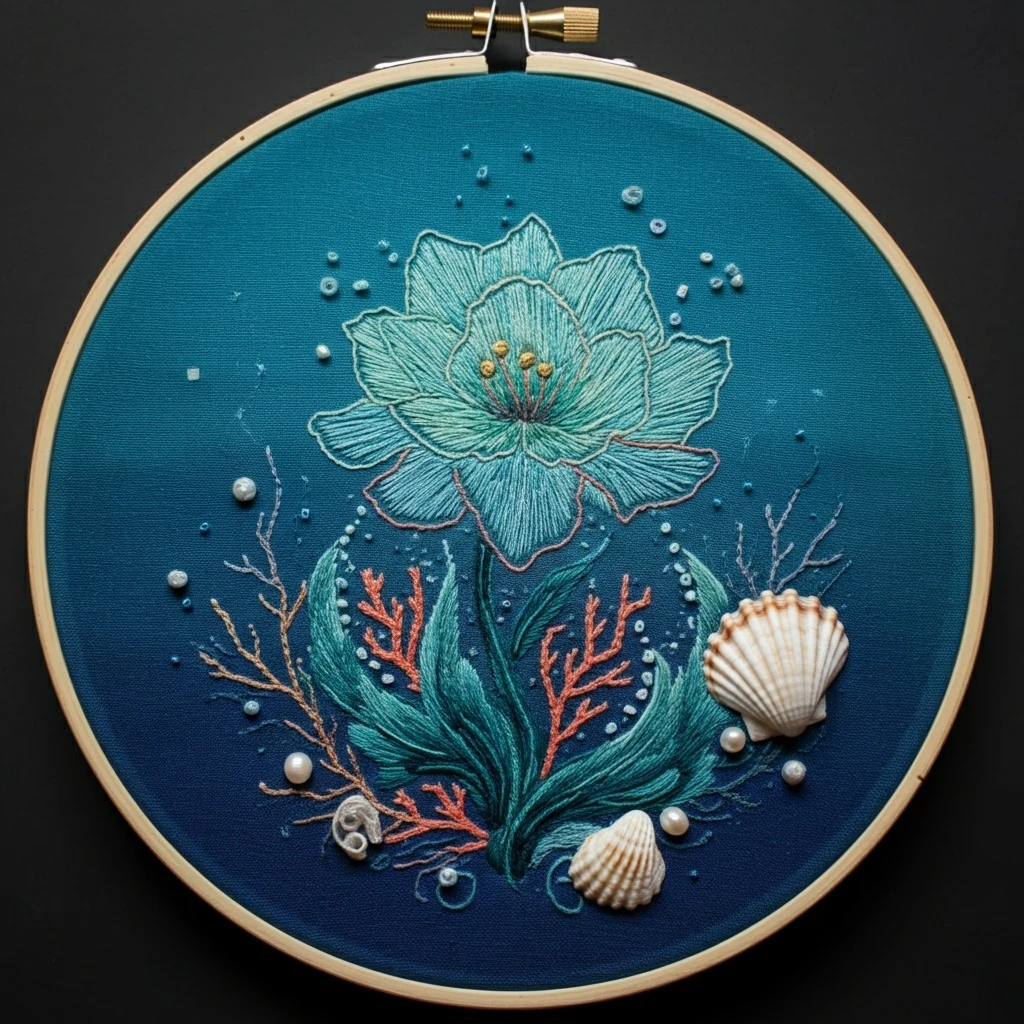


Deep Sea Floral Seashell
A refined embroidery guide for a coastal botanical shell design: cool teal shadows, soft shell-pink highlights, coral and rose florals, muted sea greens, and small golden accents. The palette is selected for depth on a light fabric while keeping the finished hoop elegant, readable, and beginner-friendly.
Overall mood
Dark aquatic outlines, pearly shell ridges, and clustered florals that feel like a tidepool bouquet.
Best fabric
Ivory, pale oatmeal, sand, or washed linen so the teal and coral shades remain crisp.
Skill level
Confident beginner to intermediate: simple fills, careful curves, and layered floral texture.
Suggested DMC Color Palette
Use these shades as practical substitutions for the visual colors in the reference image. The shell benefits from gentle value changes, while the floral details need a few stronger accents to stand out against the deep ocean tones.
DMC 924 - Very Dark Gray Green
Primary deep-sea outline for shell edges, inner shadow curves, and the darkest botanical stems.
DMC 926 - Medium Gray Green
Mid-tone blue-green for softer shell ribs, secondary outlines, and shaded waterlike transitions.
DMC 927 - Light Gray Green
Pale sea-glass highlight for shell ridge tips, tiny glints, and airy accents around curves.
DMC 948 - Very Light Peach
Pearl-shell base highlight; stitch short satin strokes along ridges for a smooth, polished shell feel.
DMC 754 - Light Peach
Warm shell shadow for lower ridge sections, inner shell curves, and soft blended shading.
DMC 356 - Medium Terra Cotta
Coral flower petals, warm flower centers, and a few small buds to echo seaside warmth.
DMC 335 - Rose
Dusty pink floral petals and petal tips; pairs well with 356 for dimensional blossoms.
DMC 902 - Very Dark Garnet
Deep burgundy centers, tiny shadow petals, and definition inside the darkest flowers.
DMC 3820 - Dark Straw
Golden pollen dots, miniature star accents, and warm highlights at flower centers.
DMC 3012 - Medium Khaki Green
Main leaf tone for muted coastal foliage; especially good for lazy daisy leaves and stems.
DMC 3362 - Dark Pine Green
Leaf shadows, stem bases, and contrast under flower clusters without turning black.
DMC 3865 - Winter White
Tiny pearl highlights, shell sparkle, and French knots where the design needs a lifted finish.
Stitch Map for the Motifs
Keep the shell crisp and the florals textured. The contrast between smooth shell ridges and raised flower details will make the design feel intentional rather than crowded.
| Area | Recommended stitches | Practical notes |
|---|---|---|
| Outer shell silhouette | Stem stitch, split stitch, or whipped back stitch | Use 2 strands of DMC 924 for a strong clean edge. Whip with 926 if you want a smoother corded outline. |
| Shell ribs and scallops | Long-and-short stitch, split stitch rows, short satin stitch | Start with 754 near shadowed bases, blend into 948, and add 927 or 3865 only on the brightest ridge tips. |
| Large flowers | Satin stitch, fishbone petals, woven wheel roses | Use 2 strands for petal fills. Work darker 902 at the petal base and 335 or 356 toward the tip. |
| Small blossoms and buds | Detached chain, lazy daisy, French knots | Use 1-2 strands to avoid bulky clusters. Add 3820 knots for centers after petals are finished. |
| Leaves and stems | Fishbone leaf, stem stitch, straight stitches | 3012 works as the main leaf color; add 3362 along one side of larger leaves for quiet depth. |
| Fine sea details | Single-strand back stitch, seed stitch, tiny straight stitch | Use 927 or 3865 sparingly for bubbles, sparkle, or subtle shell grain. |
Thread Counts, Blending & Shading
Thread-count guidance
- 1 strand: tiny outlines, interior shell lines, small veins, and delicate sparkle dots.
- 2 strands: most outlines, petals, leaves, and balanced shell shading on medium-weight cotton or linen.
- 3 strands: only for bold flower centers, raised knots, or areas you want to appear closer to the viewer.
Blending ideas
- Blend 1 strand 924 + 1 strand 926 for softened dark shell curves.
- Blend 1 strand 754 + 1 strand 948 for pearly peach shell transitions.
- Blend 1 strand 335 + 1 strand 356 for coral-rose petals that are neither too pink nor too orange.
- Blend 1 strand 3012 + 1 strand 3362 for shaded leaves near the flower bases.
Texture & Finishing Suggestions
Shell texture
Stitch ribs in the direction of the curve. Keep satin stitches short and staggered so the shell does not pucker. A few single-strand 3865 highlights can mimic pearlescence.
Floral texture
Use woven wheels or padded satin for the main blossoms, then keep smaller buds flatter. This creates a natural focal hierarchy without making the design bulky.
Outline details
Outline after fills when possible. A final 1-strand pass in 924 or 3362 sharpens petal edges, shell scallops, and any overlapping stems.
Beginner-Friendly Working Tips
Order of stitching
- Begin with the shell's main outer contour so the composition is anchored.
- Add shell shading from dark to light, following each curve rather than stitching straight across it.
- Work leaves and stems before flowers so petals can sit cleanly on top.
- Add French knots, gold centers, and tiny highlights last to keep them bright.
Clean finish habits
- Use shorter thread lengths, about 35-45 cm, to prevent fuzzy dark teal strands.
- Separate all six floss strands first, then recombine only the number needed for smoother stitches.
- Do not pull satin or long-and-short stitches too tightly; shell curves need a relaxed surface.
- Test dark shades on a fabric scrap if your ground fabric is very pale.