
DMC Palette & Hand Embroidery Tips
Vibrant Kaleidoscope Flower Arrangement
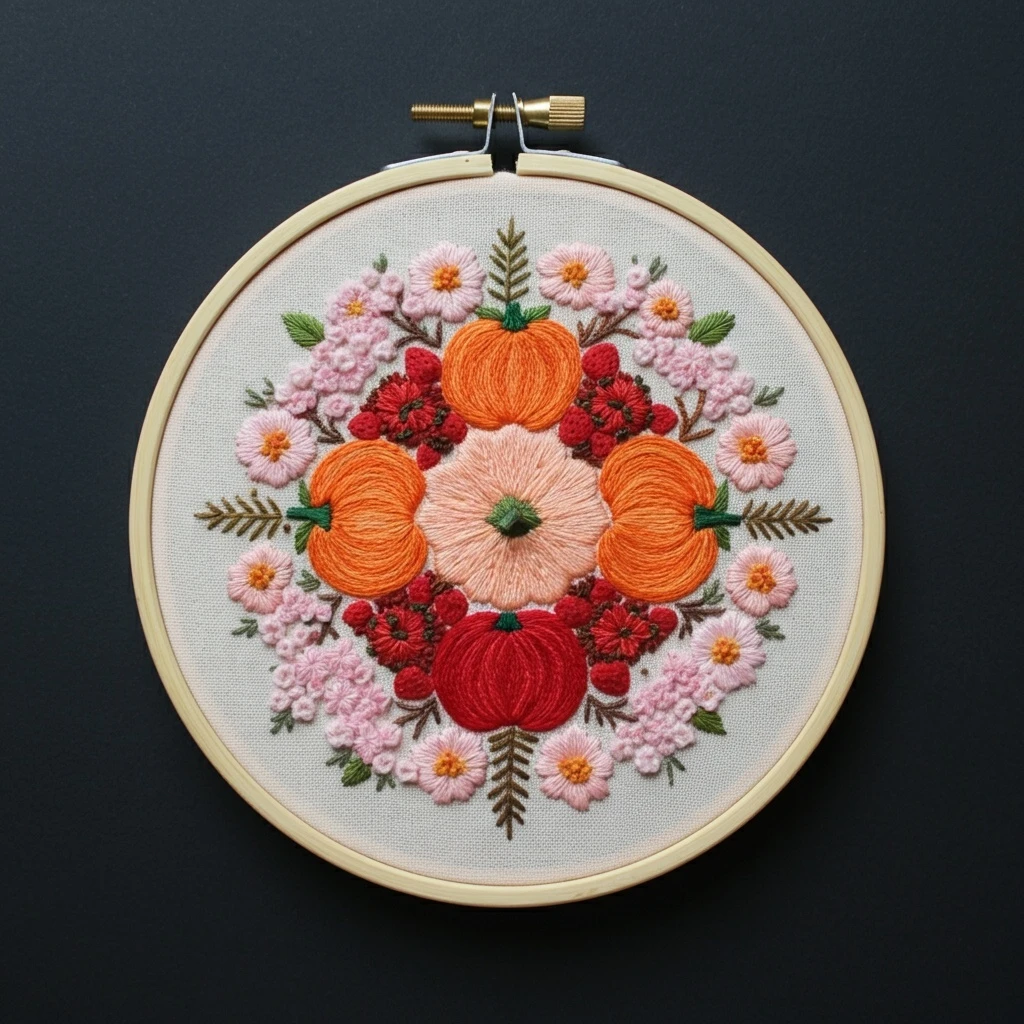
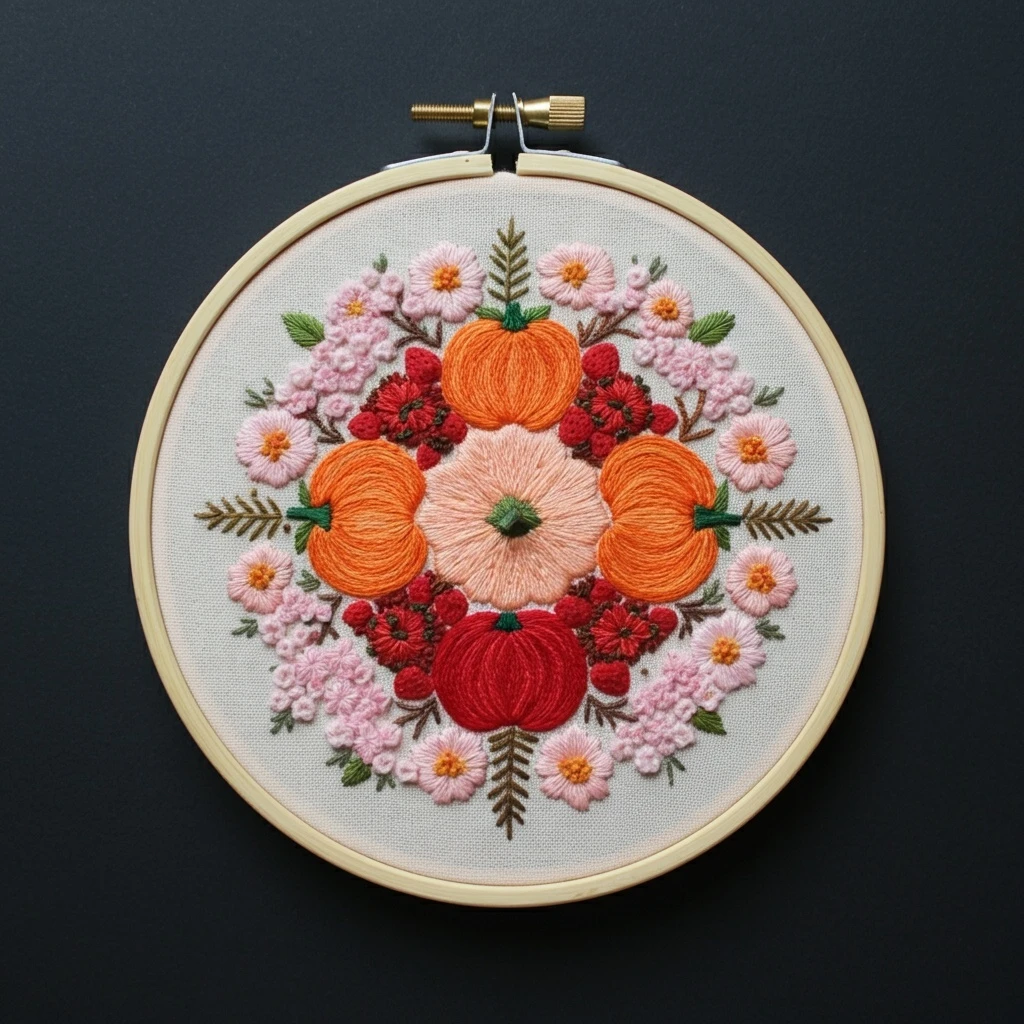
A polished color and stitching guide for a balanced hoop design with orange pumpkin-like blooms, a large blush center flower, red accent blossoms, pale pink clusters, olive fern sprigs, and a symmetrical folk-garden composition.
Design Color Read
The reference has a radial, kaleidoscope-like arrangement: four warm orange rounded blooms form the main compass points, a soft peach flower anchors the middle, and deep red flowers fill the diagonal pockets. Pale pink daisies and clustered knots soften the outer ring, while olive-brown stems and fern sprigs keep the composition structured.
The strongest visual contrast is between the saturated orange-red flowers and the muted linen background. Keep the centers crisp, the stems slim, and the outer pink clusters airy so the circular rhythm remains clear.
Suggested Mood
Warm, ornate, symmetrical, and festive. The palette works best when the reds and oranges are bold, the pinks stay powdery, and the greens remain earthy rather than neon.
Likely DMC Color Palette
These DMC shades are practical close matches for the preview image. Coverage notes are visual estimates, not exact thread quantities.
Stitching Suggestions
| Element | Best Stitch Type | Practical Notes |
|---|---|---|
| Orange rounded blooms | Long-and-short stitch or padded satin stitch | Stitch from the bloom edge toward the center crease. Use 741 as the main fill, 722 for top highlights, and 720 in the curved grooves. |
| Central peach flower | Radiating long-and-short stitch | Work every stitch outward from the center so the flower reads like a soft sunburst. Blend 352 with a few strands of 818 at the petal tips. |
| Red flowers | Satin stitch, fishbone petals, or detached chain petals | Keep red petals bold and compact. Add 902 at the petal bases or between petal groups for crisp definition. |
| Pale pink daisies | Lazy daisy stitch or straight stitch petals | Use 818 for most petals and 3326 near the flower center. Keep spacing even to protect the mandala symmetry. |
| Pink cluster blossoms | French knots, colonial knots, and tiny lazy daisies | Use one-wrap knots for small dots and two-wrap knots for raised berries. Scatter tones of 818 and 3326 so the clusters look soft, not flat. |
| Fern sprigs | Straight stitch or fly stitch | Use one strand of 3011 or 3052. Place each fern like a mirrored feather so the top, side, and bottom points align visually. |
| Branches and stems | Stem stitch, split stitch, or backstitch | Use 801 for dark twig lines and 3011 for olive stems. Keep branches narrow; heavy stems can overpower the flowers. |
| Flower centers | French knots and seed stitch | Use 742 for bright centers and 977 for depth. Add knots last so they stay clean and dimensional. |
Thread Count & Blending Guide
1 Strand
Fine stems, fern ribs, tiny leaf veins, small outline corrections, and subtle petal grooves.
2 Strands
Most flowers, leaves, medium stems, detached chains, and general long-and-short shading.
3 Strands
Raised orange bloom edges, plush red flower areas, large central petal fills, and bolder knot clusters.
Recommended Stitching Order
Beginner-Friendly Practical Tips
- Use a sharp embroidery needle for tight satin areas and a slightly larger needle for French knots.
- Keep fabric drum-tight in the hoop so round blooms do not pucker while you fill them.
- Shorten long satin stitches by splitting big petals into curved rows; it prevents snagging and improves control.
- When repeating left and right elements, stitch the matching pieces in the same sitting so tension and color placement stay consistent.
- Do not over-outline the pink clusters. A few darker knots create depth while preserving the soft floral cloud effect.
- Save the darkest red and brown details for the end; they act like final ink lines and make the whole arrangement pop.
Encouraging Finish
This design will shine when the symmetry is calm and the colors are lively. Let the oranges and reds carry the drama, use the pinks as soft breathing space, and keep the fern sprigs slender. Build it from the framework outward, and the finished hoop will feel bold, balanced, and richly dimensional.