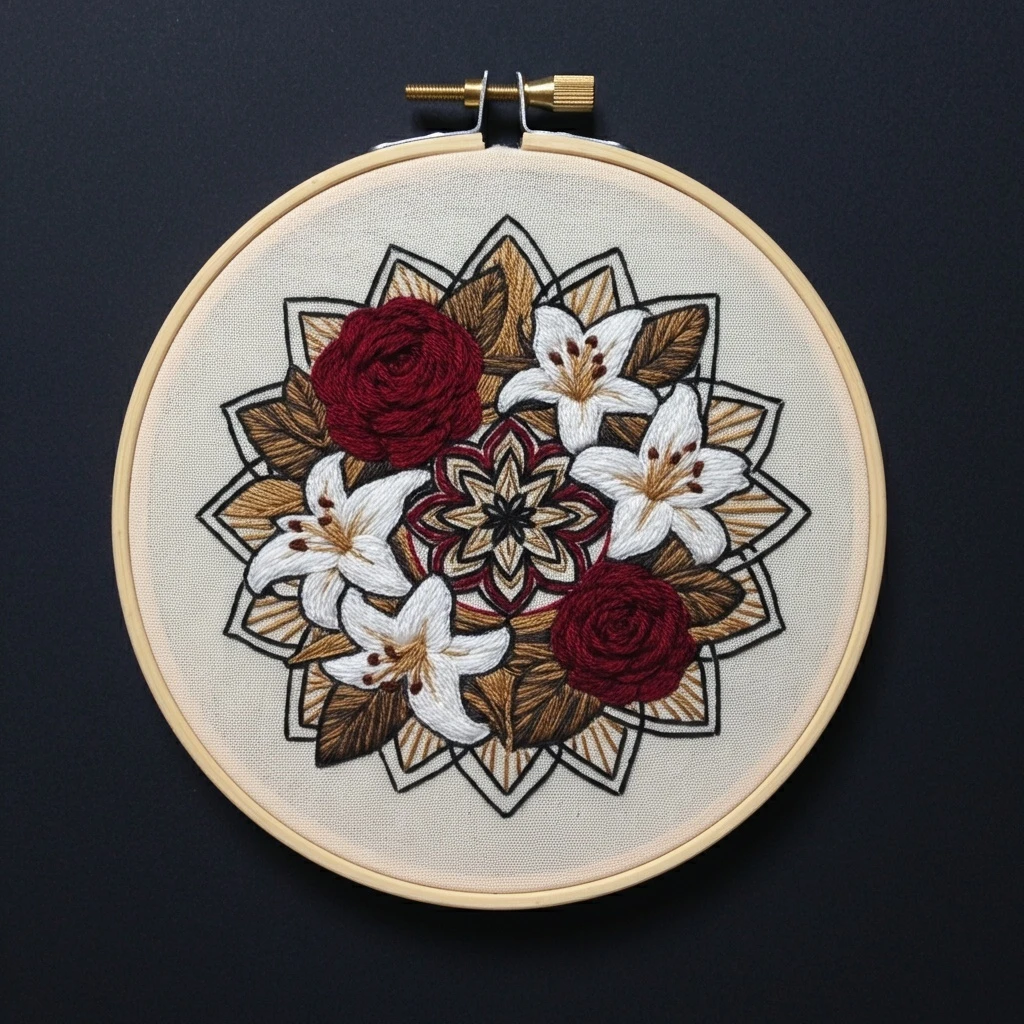

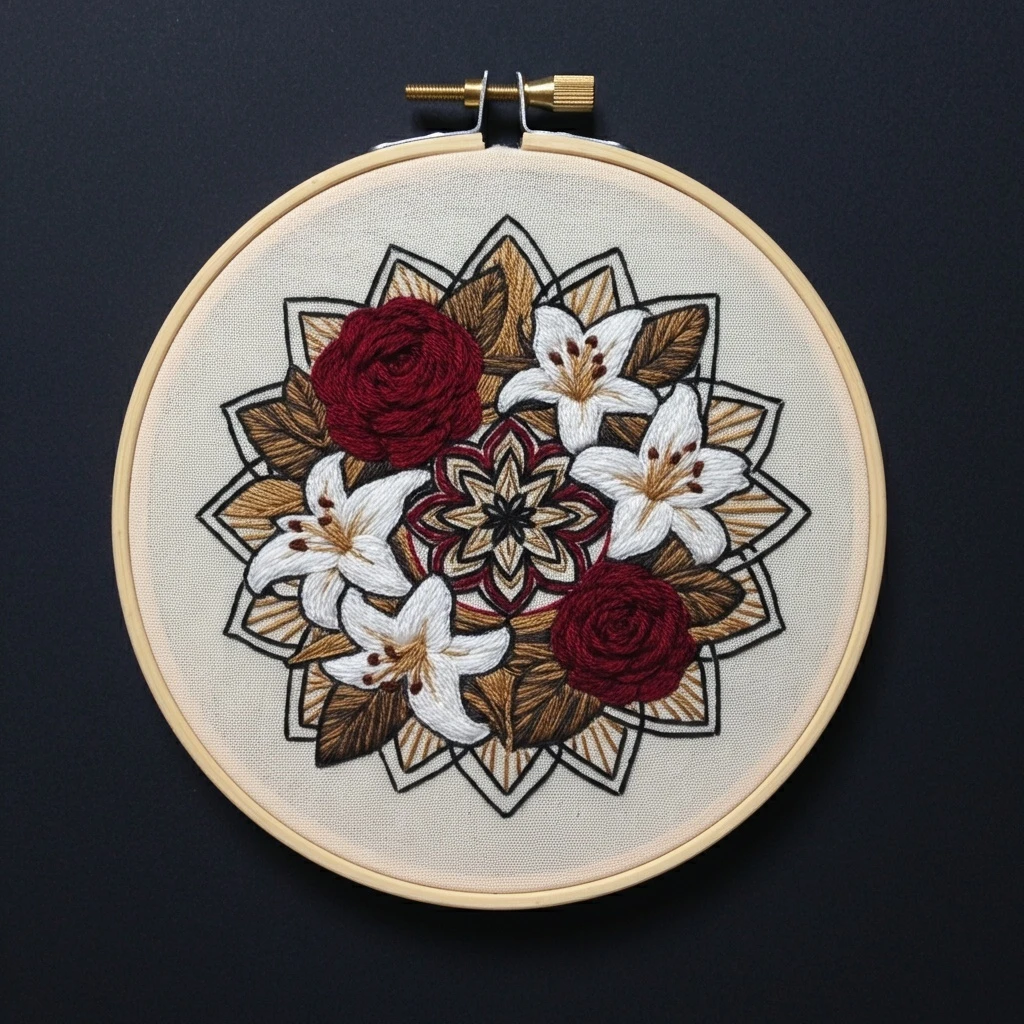
Autumnal Elegance Floral
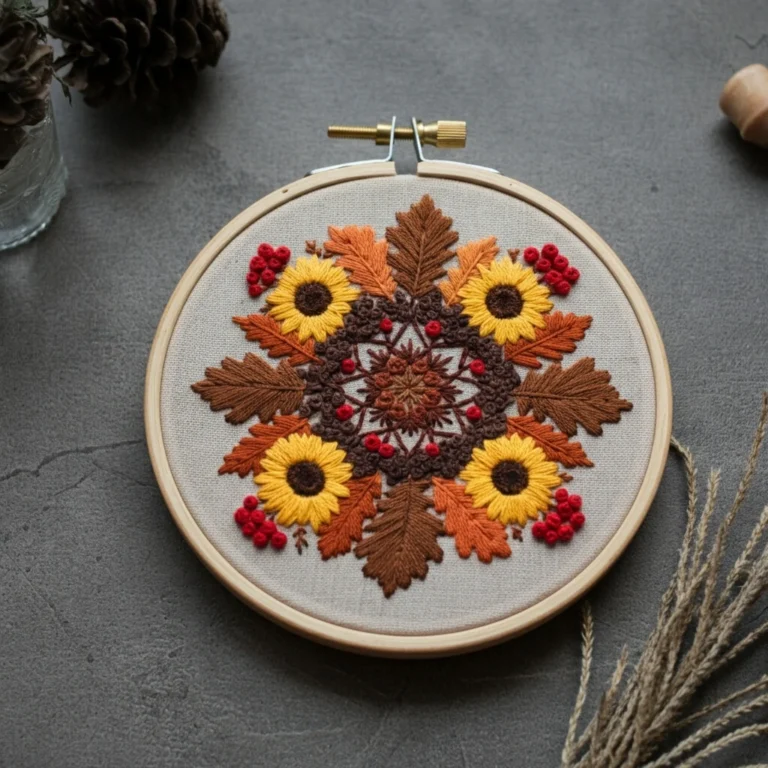
A polished floss and stitching guide for a graceful autumn bouquet: warm copper petals, muted rose blooms, golden centers, olive foliage, fine stems, and soft cream highlights arranged with elegant botanical movement.
Design Color Reading
The artwork reads as a refined fall floral composition rather than a bright garden bouquet. The strongest visual notes are terracotta-orange petals, muted cranberry/rose accents, honeyed ochre flower centers, soft beige highlights, and earthy olive leaves. Dark brown linework gives the bouquet definition while still keeping the finish gentle and handmade.
Use the darkest shades sparingly for petal folds, stem crossings, and tiny shadow pockets. Keep the cream and peach threads near the upper edges of petals so the flowers look lifted, and reserve olive tones for leaves and filler sprigs to prevent the palette from becoming overly orange.
Suggested DMC Palette
Stitch Plan by Design Element
| Area | Recommended stitches | Practical notes |
|---|---|---|
| Main petals | Long-and-short stitch, satin stitch, split stitch edging | Work from the petal tip toward the base. Alternate DMC 921 and 922 for a natural copper gradient. |
| Small rose/cranberry flowers | Woven wheel, lazy daisy, short satin | Blend DMC 315 with 3721. Keep stitches compact so the darker floral accents do not overpower the composition. |
| Flower centers | French knots, colonial knots, seed stitch | Use DMC 3852 with a few 3826 knots. Vary knot size by changing from 2 to 3 strands. |
| Leaves | Fishbone stitch, fly stitch, detached chain | Use DMC 732 for the body and 730 for the center vein or shaded half of each leaf. |
| Stems and tendrils | Stem stitch, whipped back stitch, couching | DMC 433 keeps stems warm; add DMC 938 only at crossings and lower curves. |
| Fine outlines | One-strand back stitch or split back stitch | Outline after fills are complete. Use a broken outline in highlights so the design stays airy. |
Shading & Texture Guidance
For a graceful floral finish, shade from dark at the petal base to light at the outer edge. Place DMC 938 only where petals tuck behind one another; too much dark brown will make the bouquet heavy. Use DMC 738 as the main highlight and reserve DMC 3865 for tiny final touches on petal tips and seed caps.
Texture should feel botanical and varied: smooth satin for larger petals, knot clusters for centers, fishbone leaves for structure, and tiny seed stitches around filler elements for movement.
Beginner-Friendly Workflow
Practical Finishing Tips
- Use a 6–7 inch hoop for comfortable tension; re-tighten fabric before stitching long satin areas.
- Keep thread lengths around 14–16 inches to reduce fuzzing in the warm orange and mauve shades.
- For smoother petals, lay stitches with a needle or laying tool and avoid crossing long satin stitches at different angles.
- Press from the back on a padded towel when finished so knots and raised flower centers stay dimensional.
- When substituting colors, preserve contrast first: one dark brown, one medium copper, one light peach/cream, one olive pair, and one rose accent are the essentials.