
DMC color palette & embroidery planning notes
Daisy And Lavender Wreath
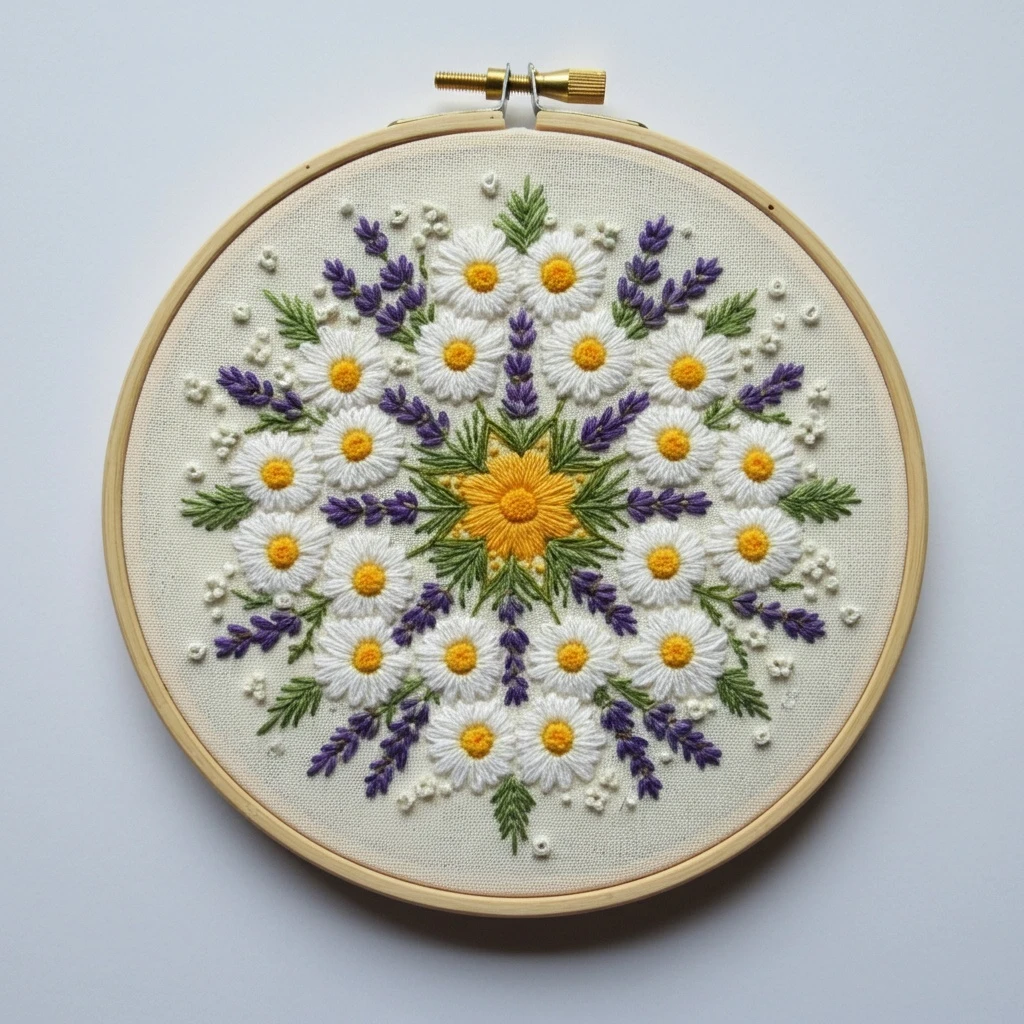
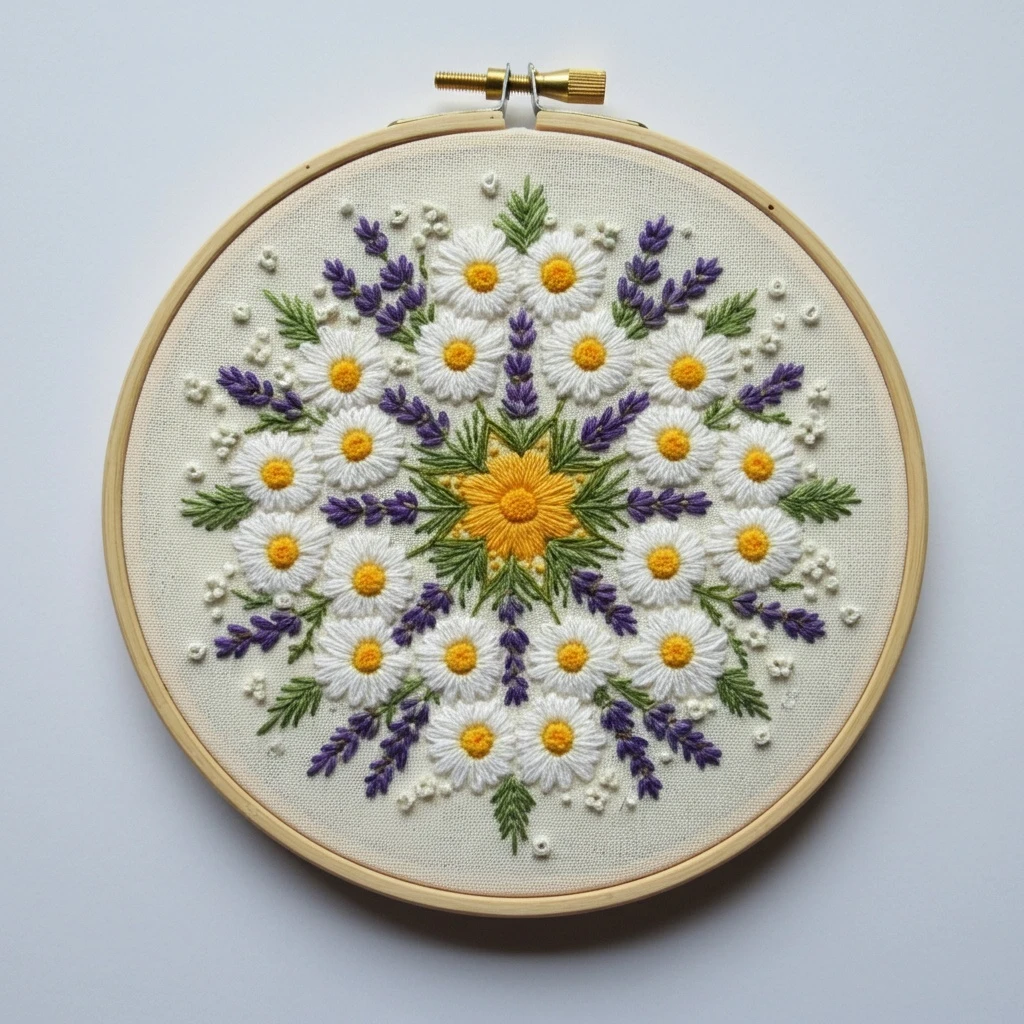
A gentle botanical hoop built around white daisies, golden centers, lavender sprigs, and airy green wreath stems. The palette below keeps the flowers crisp and fresh while adding soft violet depth and natural leafy movement for a beginner-friendly hand embroidery finish.
Design color read
The design is centered on a circular wreath composition: small daisies with bright yellow centers, slim lavender flower spikes, soft greenery, and fine curved stems. The strongest contrast comes from clean white petals against green stems, with lavender acting as the decorative accent.
Keep the stitches light and slightly open. This motif looks best when the wreath breathes, so avoid over-filling every leaf or petal. Let the fabric show between sprigs to preserve the delicate garden feel.
Thread-count overview
- Daisy petals: 2 strands for satin or lazy daisy petals; 1 strand for tiny inner petal definition.
- Lavender buds: 2 strands for French knots or detached chain; add a few 1-strand darker accents for depth.
- Stems and outlines: 1 strand for graceful curves, 2 strands only on main wreath arcs.
- Leaf fill: 2 strands for fishbone or satin stitch, with 1 strand for central veins.
- Centers: 2 strands for French knots; mix two yellows for a speckled pollen look.
Suggested DMC floss palette
Stitch map
| Area | Recommended stitches | Practical notes |
|---|---|---|
| Daisy petals | Lazy daisy, satin stitch, split stitch edge | Use lazy daisy for quick rounded petals. For a fuller look, satin stitch each petal from base to tip and couch the tip with a tiny anchoring stitch. |
| Daisy centers | French knots, colonial knots, seed stitch | Cluster knots unevenly with DMC 726 and 729 so the center looks textured rather than like a flat circle. |
| Lavender sprigs | French knots, detached chain, straight stitch | Place darker knots near the stem and lighter lavender toward the outside tips to create a soft blooming effect. |
| Leaves | Fishbone stitch, satin stitch, fly stitch | Fishbone stitch gives quick leaf shape and a built-in center vein. Keep leaf points sharp with shorter final stitches. |
| Curved stems | Stem stitch, split backstitch, whipped backstitch | Work slow, short stitches around the wreath curve. Whip the main arc if you want a smooth botanical line. |
| Tiny fillers | Seed stitch, single straight stitch, small knots | Add sparingly around gaps to balance the wreath without crowding the open circular composition. |
Blending and shading guidance
- Petal softness: combine one strand Blanc with one strand 3865 for a warmer white shadow on overlapped daisy petals.
- Lavender depth: blend one strand 209 with one strand 210 for mid-light buds; reserve 208 for the base or hidden side of sprigs.
- Leaf variation: alternate DMC 734 and 3011 on different leaves, then use 732 for the shared stem line so the wreath feels cohesive.
- Golden centers: scatter 729 knots slightly lower or off-center, then place 726 on the upper side to mimic light catching the pollen.
- Fine outline: avoid heavy black outlines. Use 732 or a single strand of 3371 only where a stem passes behind a petal.
Texture tips
Outlining details
Beginner tips
Suggested stitching order
- Stitch the wreath stems in DMC 732 using stem stitch, keeping the curve even and light.
- Add larger leaves with fishbone stitch in 734 and 3011; use 3345 only for tiny shaded bases.
- Work lavender sprigs with scattered knots in 210, 209, and 208, building darker color closer to the stem.
- Stitch daisy petals with Blanc and 3865, keeping petal direction consistent from center outward.
- Finish with daisy centers in 726 and 729, then add a few seed stitches to balance any open gaps.