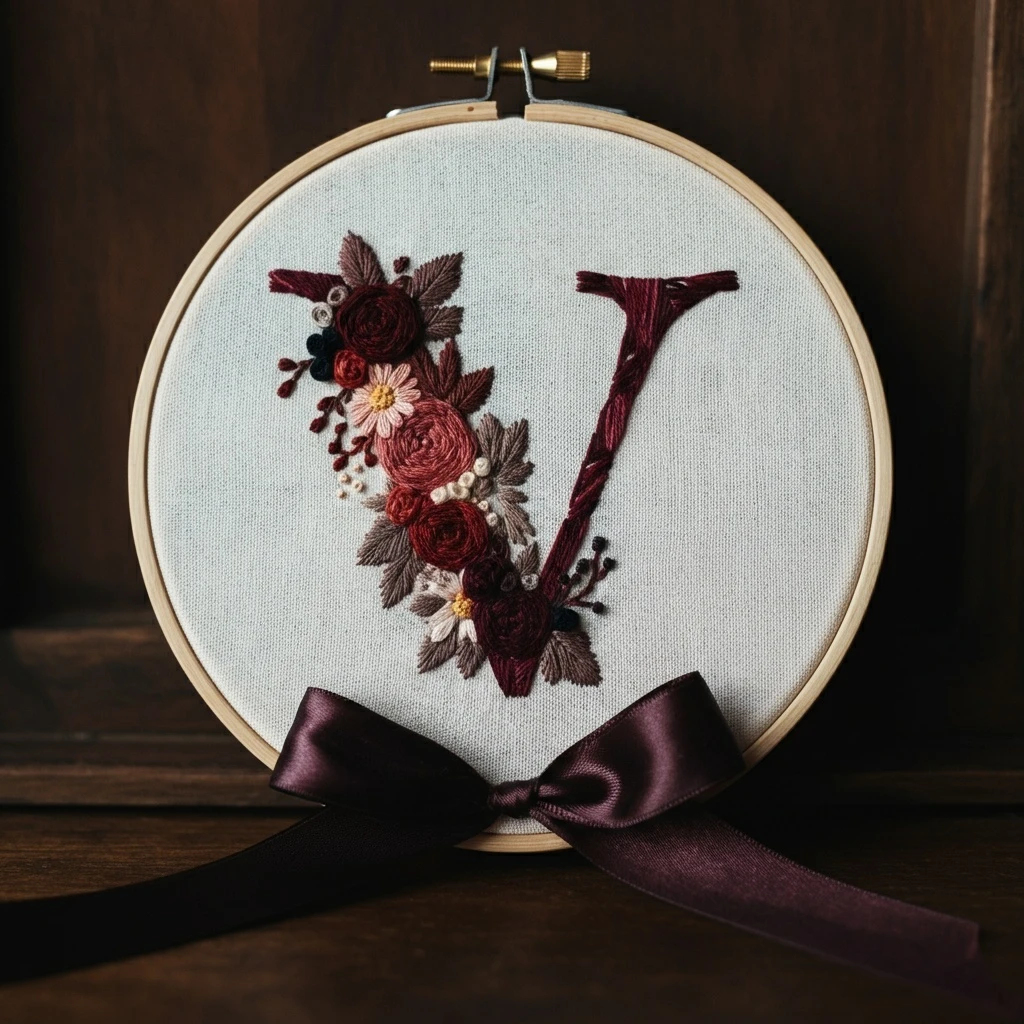


Burgundy Floral Monogram V
This elegant monogram design combines a strong letterform with deep burgundy florals, soft rose highlights, muted greenery, and small warm accents. The stitched result should feel refined and balanced: a clean letter V, dimensional wine-colored petals, graceful leaves, and decorative details that frame the monogram without overwhelming it.
Polished DMC Color Palette
The palette centers on rich wine and burgundy flowers with dusty rose highlights, antique mauve shadows, sage-green foliage, and a few warm golden details. Use the deepest shades for petal bases and the monogram’s strongest definition, then soften edges with rose and blush tones.
Stitch Map by Design Element
Thread Count & Blending Guide
Monogram detail
Use 1 strand for the inner outline, narrow curves, the sharp lower point of the V, and any small decorative linework. This keeps the letter clean and elegant.
Main fills
Use 2 strands for flower petals, medium leaves, stems, and most satin-filled monogram sections. Two strands give rich color while keeping edges controllable.
Raised accents
Use 2–3 strands for French knots and textured flower centers. Three strands is best for large focal blooms; two strands is neater for smaller filler flowers.
Shading, Outlining & Texture Suggestions
Elegant monogram edges
- Stitch the V outline slowly with short split stitches so curves and corners remain smooth.
- Use the same outline color on both sides of the letter for a consistent silhouette.
- Add a few 3865 highlight stitches only where the letter catches light.
- Keep floral elements slightly overlapping the letter in places for a custom monogram feel.
Burgundy flower depth
- Use 814 only in the deepest petal bases and overlaps so the flowers do not become too dark.
- Angle stitches inward toward each flower center to create a cupped shape.
- Add 304 sparingly for warmth on petal tips; too much can shift the palette from burgundy to red.
- Use 316 between petals where a cool shadow is more natural than black.
Leaf balance
- Place dark leaves behind flower clusters and pale leaves on the outside edges.
- Vary leaf lengths so the greenery looks botanical rather than patterned.
- Use fishbone stitch on larger leaves to form a natural center vein.
- Keep stems thin with one or two strands so they do not compete with the monogram.
Outlining approach
- Outline after filling so the monogram and flowers look crisp on top.
- Use darker shades from the same color family rather than black outlines.
- Use split stitch for petal curves and back stitch for small straight decorative marks.
- Skip some leaf outlines for a softer, romantic floral finish.
Beginner-Friendly Stitching Order
- Transfer carefully: mark the V shape, major flower centers, petal groups, buds, stems, and leaf clusters. Keep transfer lines faint under pale rose and white accents.
- Stitch the monogram outline: define the V first so all floral elements can be placed in relation to the letter.
- Work stems and back leaves: add 3051 and 3052 foliage behind the flowers before the petals are stitched.
- Fill burgundy focal flowers: shade from dark bases to lighter petal tips, keeping stitch direction aimed toward the center.
- Add filler flowers and buds: distribute rose, blush, and mauve tones around the V to balance the composition.
- Finish with accents: add golden knots, tiny white highlights, final outlines, leaf veins, and any small decorative seed stitches last.
Practical Tips for a Clean Finish
Fabric & hoop
Warm cream cotton, linen, or cotton-linen makes burgundy floss look rich and elegant. Keep the fabric drum-tight, especially while satin stitching the monogram and long-and-short stitching petals.
Needle choice
Use a sharp size 7–9 embroidery needle for one- and two-strand details. Move to a slightly larger needle only for three-strand knots or denser flower centers.
Preventing dark show-through
Do not carry burgundy or green floss behind pale rose or white areas. End threads cleanly and restart nearby so the light stitches stay fresh.
Keeping the V crisp
Work the letter point with short stitches and avoid pulling too tightly. If the point becomes rounded, add one final one-strand stitch in 814 to sharpen the angle.