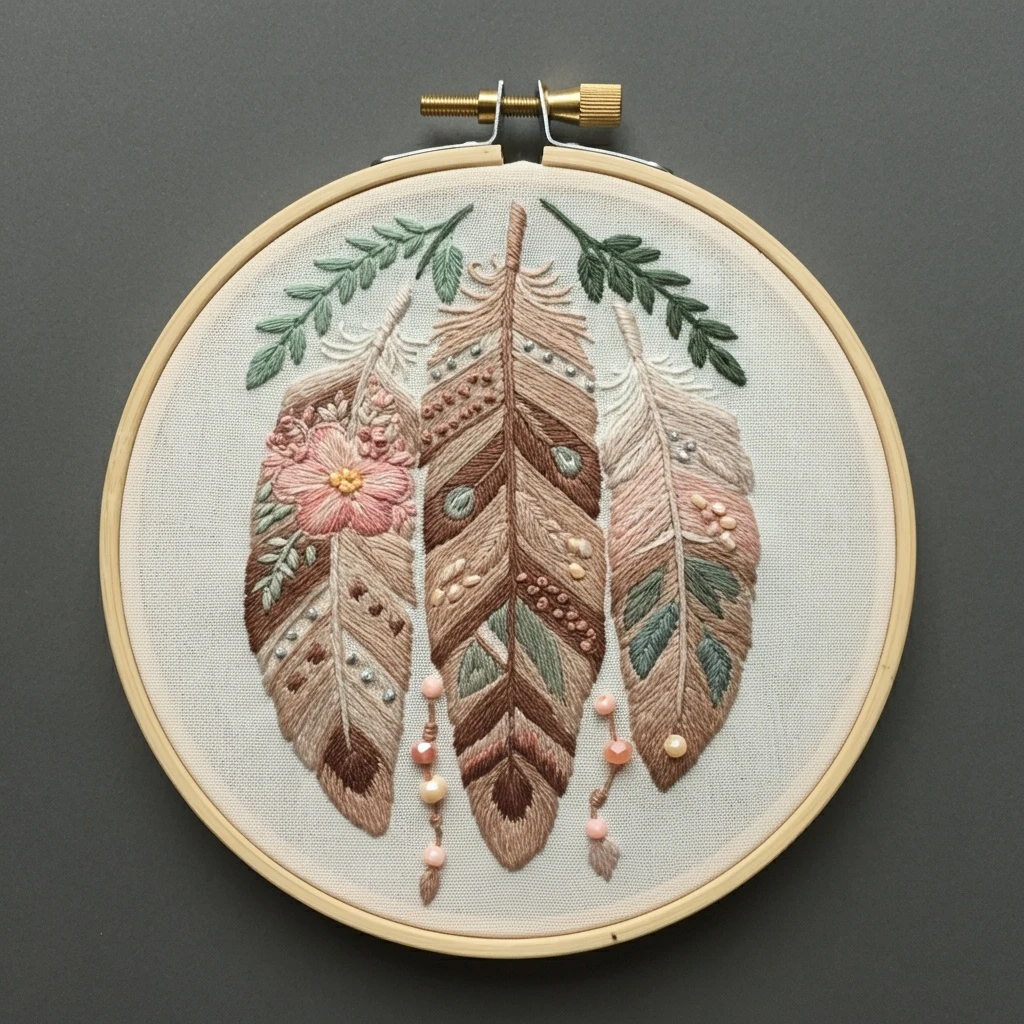

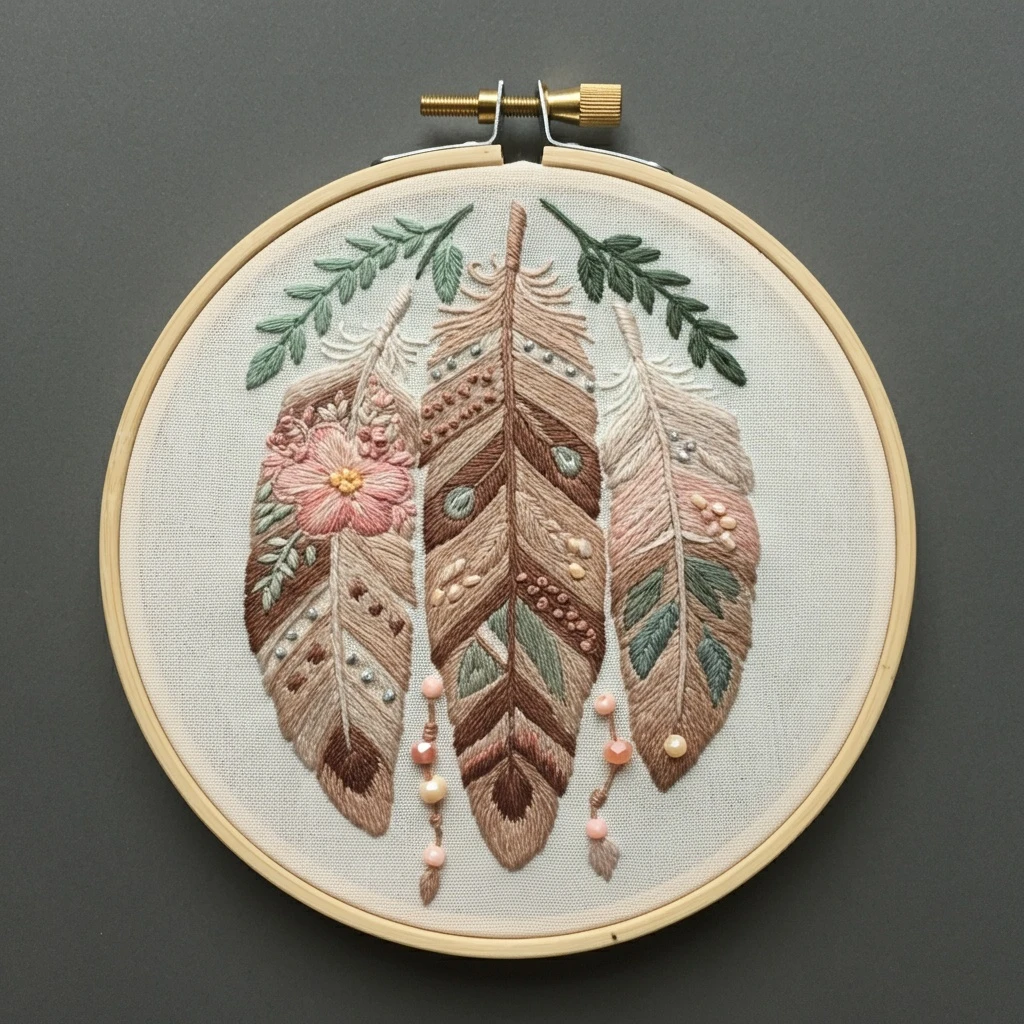
Boho Feather Trio
This design reads as a relaxed boho trio of hanging feathers, likely with warm earthy bands, subtle bead details, and softly tapered feather edges. The strongest look comes from mixing tan, ochre, copper, russet, olive, and dusty teal so each feather feels distinct but still part of one natural palette.
The stitching plan below focuses on directional feather texture, clean center shafts, decorative boho accents, and practical blending choices for a polished handmade finish.
Suggested DMC floss palette
A grounded boho palette for three feathers with warm, cool, and muted accent variation.
| Swatch | DMC | Color name | Practical use notes |
|---|---|---|---|
| 739 | Tan - Ultra Very Light | Soft feather tips, pale highlights, and warm cream stitch accents. | |
| 3828 | Hazelnut Brown | Golden ochre bands, warm feather highlights, and decorative boho stripes. | |
| 977 | Golden Brown - Light | Main tan-brown feather sections and soft midtone shading. | |
| 420 | Hazelnut Brown - Dark | Feather shafts, cord details, and warm outline structure. | |
| 839 | Beige Brown - Dark | Deep feather shadows, lower edges, and grounding linework. | |
| 921 | Copper | Rust-orange accent bands, autumn warmth, and small decorative motifs. | |
| 919 | Red Copper | Deep copper tips, shadowed feather bases, and strong warm contrast. | |
| 3820 | Straw - Dark | Muted mustard accents, small dots, and decorative thread-wrap effects. | |
| 3012 | Khaki Green - Medium | Olive-sage accents, small leafy details, and earthy contrast between feathers. | |
| 3011 | Khaki Green - Dark | Deep olive shading and small darker boho separators. | |
| 3768 | Gray Green - Dark | Dusty teal accent sections for cool contrast in the trio. | |
| 924 | Gray Green - Very Dark | Deep teal-blue definition, tiny shadow dots, and select outline accents. |
Design elements to notice
Three-feather rhythm
Keep the center feather slightly stronger or longer, then let the side feathers angle outward for movement.
Directional barbs
Feather stitches should angle away from the center shaft, tapering toward the edges and tips.
Decorative bands
Small ochre, copper, sage, or teal bands give the feathers a boho handmade feel.
Natural imbalance
The trio should feel balanced, but not perfectly identical. Slight color variation makes it more organic.
Stitch types
Use structured stitches for the shafts and soft directional stitches for the feather bodies.
Thread-count guidance
- 1 strand: fine feather tips, delicate edge barbs, tiny dots, and subtle color overlays.
- 2 strands: the best count for feather bodies, shafts, cords, and most decorative bands.
- 3 strands: bolder center shafts, prominent lower feather shadows, and raised top wraps.
- 4-6 strands: reserve for chunky bead-like knots only; dense thread can make feather tips look heavy.
Blending, outlining, and shading guidance
- Warm feather: blend 739 into 3828, then 977 and 921 through the middle, with 919 only at the deepest base or shadow side.
- Brown feather: use 977 and 420 for the main body, then 839 along one lower edge for grounding.
- Cool accent feather: combine 3012, 3768, and small touches of 924 to create a muted teal-sage variation.
- Needle blending: pair one strand of 3828 with one strand of 921 for golden copper transitions; pair 3012 with 3768 for soft green-blue blending.
- Outlining: outline the center shaft clearly, but keep outer feather edges broken and wispy rather than solid.
- Band accents: use 3820, 921, and 3768 in small repeated stripes so the trio feels cohesive.
Texture suggestions
- Use varied stitch lengths along feather edges to create a natural frayed silhouette.
- Add tiny French knots above the feathers to mimic beads or knots in the hanging cords.
- Layer a few one-strand highlight stitches over darker feather areas for a soft sheen.
- Stitch the lower feather tips with fewer strands so they taper gracefully.
- Use satin stitch only for decorative bands, not the full feather body, to avoid a stiff look.
Beginner-friendly stitch order
- Transfer the feather shafts and outer silhouettes lightly.
- Stitch hanging cords and bead details first.
- Work each center shaft from top to tip with split stitch.
- Add decorative top wraps and color bands.
- Fill feather bodies with angled long-and-short stitches from the shaft outward.
- Finish with one-strand wispy edges and small dark shadow touches.
Practical finishing tips
- Turn the hoop often so your feather barbs stay comfortable and consistent.
- Use short floss lengths, especially for long-and-short stitch, to prevent fuzzy feather texture.
- Keep the center feather most detailed and simplify the side feathers for an elegant hierarchy.
- Check the trio from a distance before adding dark outlines; too many dark lines can flatten the feathers.
- Natural linen, oatmeal cotton, warm ivory, or tea-dyed fabric will flatter this earthy palette.
- Press face down over a towel to preserve raised knots and feather texture.