
DMC palette & stitching suggestions
Embroidered Wheel of the Four Seasons
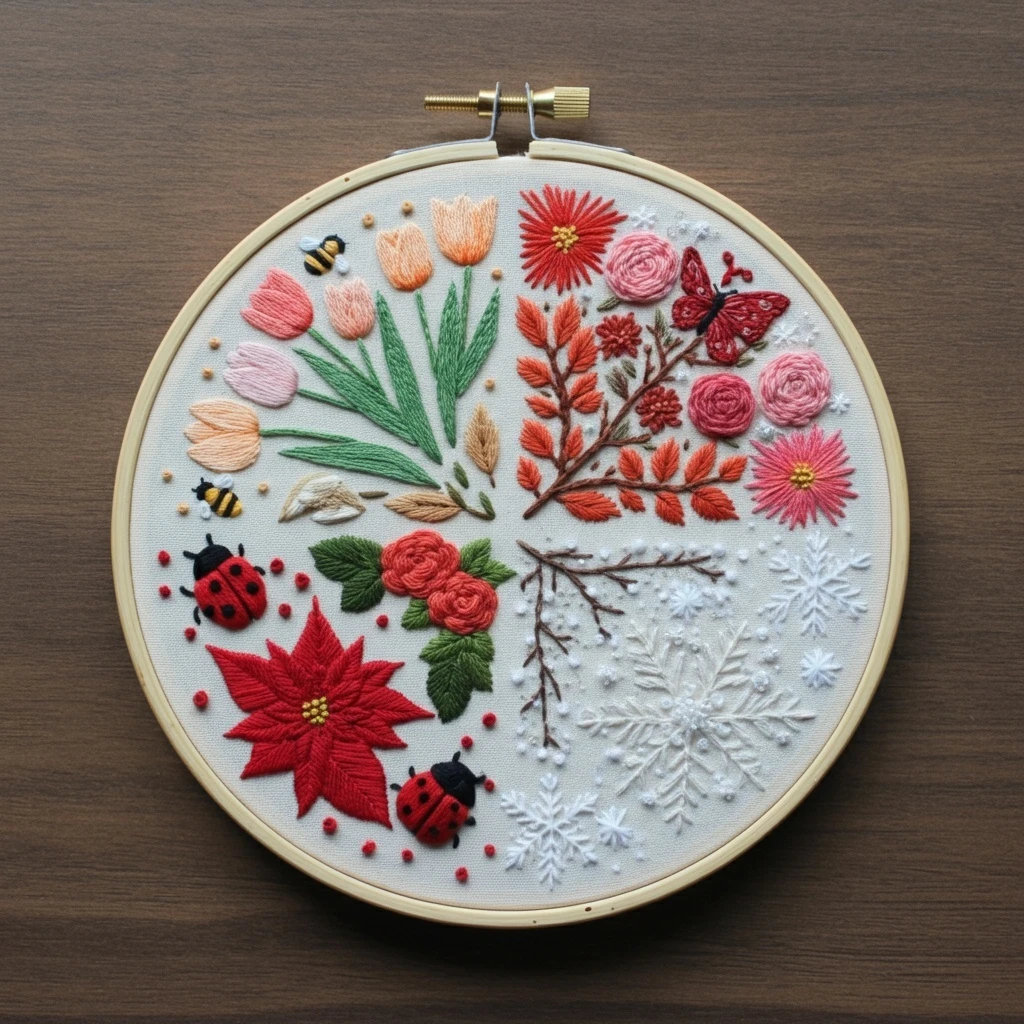
A circular sampler divided into spring tulips and bees, summer roses and ladybirds, autumn leaves with a butterfly, and a frosty winter snowflake quadrant. The design works best when each season has its own color family while the cream ground, brown branch lines, and small French-knot accents keep the whole hoop unified.
Color read of the design
The hoop is built around a soft natural fabric with four distinct moods: pastel spring, hot red summer/holiday florals, coppery autumn, and nearly white winter. Keep the strongest reds and dark outlines localized so the airy white snowflake quadrant does not feel crowded.
Spring quadrant
Peach, shell-pink and coral tulips, long green blades, beige seed heads, tiny gold knots and two striped bees.
Summer quadrant
Textured red roses, deep green leaves, a large scarlet poinsettia-style flower and glossy ladybirds with black heads.
Autumn quadrant
Brown stems, rust-orange leaves, red-pink blooms and a crimson butterfly with small pale highlights.
Winter quadrant
White, ecru and pale grey snowflakes, raised knots, bare brown twigs and crisp radial straight stitches.
Suggested DMC floss palette
Use these as practical close matches; choose one fewer shade if you prefer a simpler beginner kit, or add more adjacent values for smoother long-and-short shading.
Stitch plan by design element
Flowers, leaves and insects
- Tulips: satin stitch or long-and-short stitch with 2 strands. Work each petal from base to tip, mixing 754/352/351 for a rounded cup effect.
- Roses: woven wheel or cast-on rose with 3 strands for raised spiral texture. Start dark in the center and switch to lighter pink on the outer wraps.
- Large red poinsettia: padded satin or fishbone stitch with 3 strands; add a single central vein in 817 before filling with 321/666.
- Leaves: fishbone stitch for broad rose leaves, straight stitch or split stitch for slender tulip blades. Use 469 at the base and 368 at the tips.
- Bees and ladybirds: padded satin with 2–3 strands. Use 310 for heads and spots, 725 for bee stripes, and one strand of 762 or Blanc for wing glints.
Branches, snow and fine texture
- Autumn branches: stem stitch or whipped backstitch in 839. Add 841 on the lit side so the branch does not look flat.
- Orange leaves: detached chain, fishbone, or straight stitches in 921/920. Vary direction so the quadrant looks windblown and lively.
- Snowflakes: straight stitch spokes with 1–2 strands of Blanc, then add small fly stitches, lazy daisy tips, and French knots in Blanc/Ecru/762.
- Scattered dots: French knots with two wraps for pollen, berries and snow. Use 1 strand for tiny specks; use 2 strands for raised berries.
- Divider feel: keep open fabric between seasonal groups. Resist overfilling the center so the circular wheel remains readable.
Thread-count and blending guidance
| Area | Recommended strands | Why it works |
|---|---|---|
| Large red flower and tulips | 2–3 strands | Gives smooth coverage and enough lift for bold seasonal flowers without bulky edges. |
| Woven roses | 3 strands for wraps, 2 strands for spokes | Creates plush round blooms while keeping the anchor spokes neat and hidden. |
| Fine branches and insect details | 1–2 strands | Preserves crisp twig angles, antennae, ladybird spots and small bee stripes. |
| Snowflakes | 1 strand for arms, 2 strands for main spokes | Lets winter stay delicate, lace-like and bright against the cream fabric. |
| French knots | 1–2 strands, one or two wraps | Controls dot size: tiny pollen and snow with one wrap, raised berries with two wraps. |
Shading, outlining and texture notes
- Shade petals by placing darker stitches at the base and center fold, then lighter stitches toward the outer edge.
- Use split stitch outlines under satin-filled petals if the fabric is loosely woven; it gives a clean rim and stops floss from sinking.
- For the butterfly, stitch the wing shape in 817 first, fill with 321/3712, then add tiny Blanc or 762 straight-stitch highlights.
- For rose leaves, alternate 469 and 367 along the fishbone center line. Add 368 as a final single-strand highlight only on the top edge.
- For winter, avoid heavy knots at the exact center of a snowflake until all spokes are stitched; this keeps the radial structure tidy.
Beginner-friendly workflow
1. Transfer lightly
Use a fine water-soluble pen. Mark the main stems, flower centers and snowflake spokes, but keep tiny dots optional until stitching.
2. Start with stems
Stitch branches, flower stems and leaf center lines first. They act as a map for the crowded seasonal clusters.
3. Fill broad shapes
Complete large petals and leaves before knots. This stops raised dots from catching your thread while you satin stitch.
4. Add knots last
Finish with pollen, berries, snow and insect spots. Knot size is easier to judge after the surrounding shapes are complete.
Hoop tip: use a 6–7 inch hoop, medium-weight cotton or linen, and a fresh size 7–9 embroidery needle. Keep fabric drum-tight for satin stitch and loosen the hoop between sessions to avoid ring marks.
Quick seasonal stitch recipe
Spring: Split-stitch stems in 367, satin-stitch tulips in 754/352/3716, then add 725 French knots and small padded bees.
Summer: Work red woven roses, fishbone leaves, ladybirds and the large 321/666 flower. Use 817 sparingly for shadow and drama.
Autumn: Stem-stitch brown twigs, add copper detached-chain leaves, then stitch the butterfly in red tones with tiny pale highlights.
Winter: Build snowflakes from straight stitches outward, then add French knots in Blanc, Ecru and 762 for icy dimension.