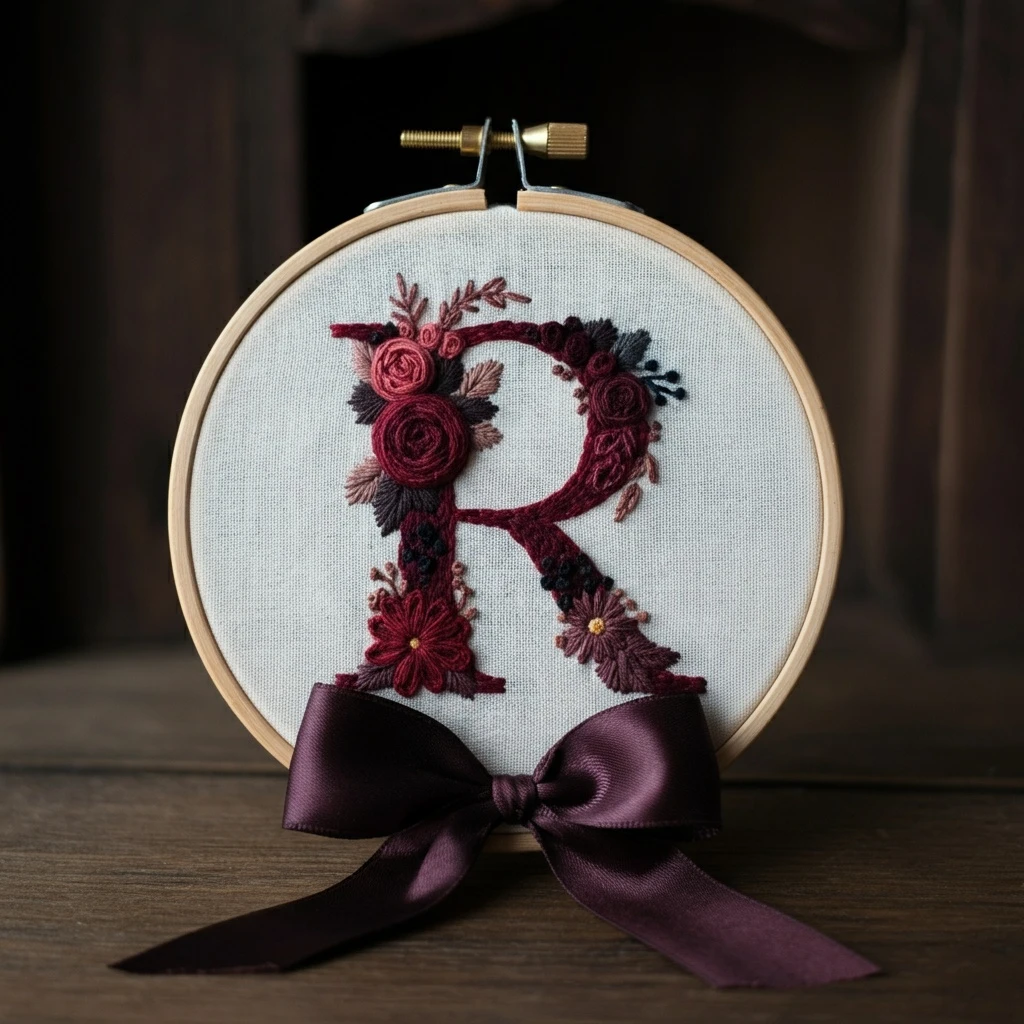


Deep Burgundy Floral Monogram R
A romantic monogram worked in wine, garnet and dusty rose tones, softened with smoky foliage and a warm cream fabric ground. This guide focuses on dimensional flowers, clean letter edges, rich shadowing and beginner-friendly control for a polished hoop finish.
Design color reading
The design is built around a large serif letter R filled with dark wine stitching, raised rosette blooms, small berry-like accents, mauve-pink leaves and nearly black charcoal foliage. The strongest contrast comes from the cream linen background against the burgundy letterform, while small gold centers add a quiet highlight.
Main shadow color for the monogram stem, deepest rose centers and the darkest folds inside the large blooms.
Primary burgundy for the letter R fill, rose petals and the lower floral mass where the design needs richness.
Use as the midtone on petal ridges, outside curves of the R and raised woven-wheel rose spirals.
A muted rosy highlight for small upper roses, petal tips and selective blending with the burgundy family.
Perfect for dusty leaves and soft sepals so the foliage stays elegant rather than bright green.
Deepens mauve leaves, adds lowlights under petals and gives the floral clusters a vintage tone.
Use for the almost-black foliage, tiny berry dots and crisp shadow accents beside the letter.
A gentler smoky companion for charcoal leaves and a few directional stitches in dark fronds.
Tiny flower centers only; one or two knots are enough to catch the light without overpowering the burgundy.
Optional thread for invisible couching, subtle fabric-toned corrections, or soft seed stitches around the monogram.
Stitch plan by design element
Letter R structure
- Outline: work a neat split stitch or stem stitch in DMC 902 with 2 strands before filling. This creates a firm edge for the curves and serif feet.
- Fill: use long-and-short stitch with 2 strands, alternating DMC 814 and 815 along the curves. Keep the stitch direction following the letter stroke.
- Shadow: add single-strand DMC 902 along the inner bowl, lower leg and left side of the vertical stem for a carved, dimensional look.
Raised roses and blossoms
- Large roses: woven wheel rose with 3 strands for the spokes and 4 strands for the wrap. Start with 902 in the center, then transition to 814 and 815.
- Small rosettes: use bullion knots or whipped spider wheels in DMC 3721 and 815 for compact floral buds.
- Open flower: detached chain petals or fishbone-style petals in 814, tipped with 815; add a DMC 783 French knot center.
Thread-count guidance and blending
| Area | Recommended strands | Practical note |
|---|---|---|
| Monogram outline | 2 strands | Keep tension even and place stitches close together so the R reads cleanly against the pale fabric. |
| Monogram fill | 2 strands, occasionally 1 | Use 2 strands for coverage; switch to 1 strand near tight curves and inner counters to avoid bulk. |
| Woven roses | 3 to 4 strands | More strands create the plush dimensional rose seen in the reference. Do not pull the wraps too tight. |
| Leaves and fronds | 1 to 2 strands | Use 1 strand for fine branch tips and 2 strands for larger mauve leaves or charcoal fan shapes. |
| French knots and berry dots | 2 strands | Wrap the needle twice for small dots; wrap three times only where a raised berry is wanted. |
Blending ideas
For a smooth burgundy gradient, thread the needle with one strand of DMC 902 and one strand of DMC 814 in the deepest sections, then one strand of 814 plus one strand of 815 for the midtone edges. For dusty floral leaves, blend one strand of 315 with one strand of 316. These mixed needles soften the transitions and prevent the dark palette from looking flat.
Texture, outlining and shading details
Petal depth
Place the darkest shade at the rose center and under overlapping petals. Add the lighter 3721 only on the upper petal edges, not everywhere.
Leaf direction
Use fishbone stitch for mauve leaves and straight stitch for narrow sprigs. Angle every stitch toward the leaf tip for natural movement.
Charcoal contrast
Keep DMC 3799 accents small and deliberate. A few dark leaves beside the burgundy flowers make the roses appear fuller.
Clean serifs
Work the letter serifs last with short satin or split stitches, using 1 strand where the shape narrows.
Raised flower control
Use a milliner needle for bullion knots and woven roses. It slides through wraps more easily and keeps petals round.
Background restraint
Leave the cream ground mostly open. The empty fabric around the R is what makes the dark floral silhouette feel elegant.
Beginner-friendly practical tips
- Mount the fabric drum-tight in the hoop before stitching the letter. Dark fill stitches show puckering quickly, so retighten often.
- Start with the monogram outline, then stitch the largest roses, then fill the R around them. This prevents bulky flowers from distorting nearby lines.
- Use shorter thread lengths, about 14 to 16 inches, because burgundy floss can fuzz when pulled repeatedly through dense areas.
- Park darker threads on the back carefully and avoid long jumps across the pale fabric. Deep garnet threads may shadow through light linen.
- For a gift finish, echo the dark satin bow mood by backing the hoop with burgundy felt or ribbon, but keep the front embroidery uncluttered.