

DMC palette & practical embroidery guide
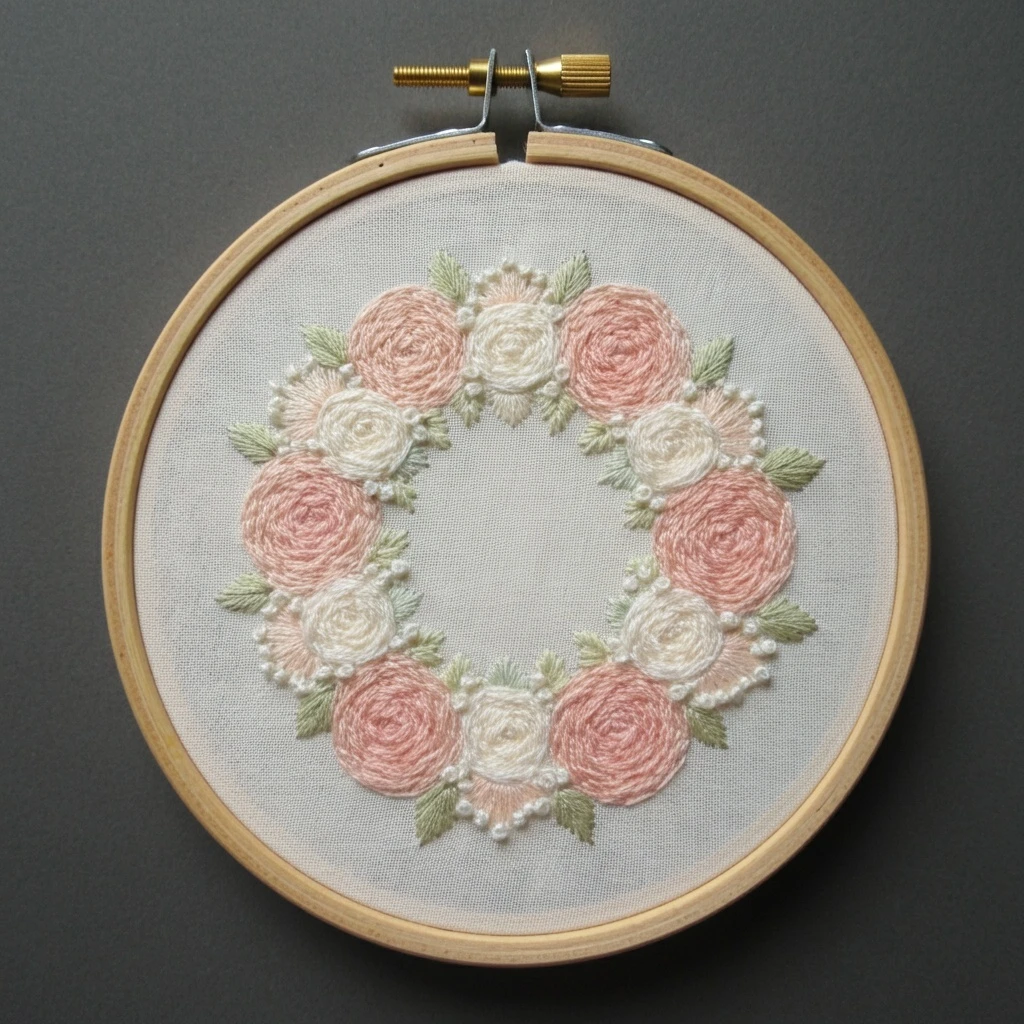
Pastel Hydrangea Rose Wreath
A soft hoop design built from dusty shell-pink roses, warm ivory blooms, pale blush hydrangea tufts, sage leaves, and tiny pearl-like floral dots. The overall look is airy, romantic, and intentionally low-contrast, so the stitching should rely on gentle blending and texture rather than hard outlines.
Color read of the design
The wreath is a quiet pastel composition: the largest flower heads are dusty peach-pink, the smaller roses are antique ivory, the hydrangea-style filler areas are barely-there blush, and the leaves sit in muted gray-green tones. Creamy French knots add the dotted “hydrangea bead” effect around the blooms. Avoid saturated pinks or bright greens; this design looks best when the colors feel slightly powdered and sun-faded.
Suggested DMC floss palette
Main highlight for rose spirals; blend into outer petals for a soft chalky finish.
Primary dusty rose shade for the large woven-wheel flower heads.
Use in the deepest turns of the rose center and under overlapping petals.
Soft blush filler for hydrangea puffs and background petal shadows.
Warm highlights on ivory roses and pearl-knot clusters.
Main ivory rose color; warmer than white and better on natural linen.
Subtle shadow at the base of cream roses and between packed knots.
Leaf highlight and pale stems tucked behind the flowers.
Main leaf color for fishbone or satin-stitched leaf shapes.
Leaf veins, shaded leaf bases, and the darkest greenery accents.
Excellent muted connector shade for stems and small filler leaves.
Optional soft outline on pale flowers when the linen is too close in value.
Stitch plan by design element
Large dusty rose heads
- Work as woven wheel roses using 5 or 7 spokes. Keep the center slightly tighter and let the outer passes loosen.
- Use 3 strands for a medium raised rose; switch to 4 strands if your hoop is larger than 6 inches.
- Blend one strand DMC 223 with one strand DMC 225 on the final outer rounds for a powdery petal edge.
Ivory roses
- Use the same woven-wheel method, but start with DMC 739 or 712 in the center, then finish with DMC 746.
- For tiny roses, use whipped back stitch spirals instead of a full woven wheel.
- Do not over-outline; a single broken shadow line in DMC 644 is enough.
Hydrangea bead clusters
- Use French knots or colonial knots with 2 strands and one or two wraps.
- Mix DMC 746, 712, and a few DMC 739 knots so the clusters look dimensional, not flat white.
- Place knots irregularly along the curve; leave tiny linen gaps for a natural airy effect.
Sage leaves and stems
- Use fishbone stitch for pointed leaves; angle stitches from the outer edge toward a central vein.
- Use DMC 523 for the main fill, DMC 524 on the tip, and DMC 522 near the base.
- For small sprigs, use lazy daisy leaves with a straight stitch vein.
Thread-count, blending, and shading notes
Beginner-friendly working order
1. Transfer lightly. Use a fine erasable fabric pen or pale transfer paper. Heavy lines can show through the ivory thread.
2. Stitch stems and leaves first. This lets the roses sit visually on top of the greenery. Keep stem stitches slim with 1–2 strands.
3. Add the largest roses. Build the wreath balance by stitching the peach roses around the circle before adding small flowers.
4. Fill with ivory roses and hydrangea knots. Use knots to soften gaps and hide transitions between leaves and flowers.
5. Finish with highlights. Add a few final single-strand stitches in DMC 746 and 225 at the upper-left edges of blooms, then stop before the design becomes too busy.