Classic Red White Rose Bouquet with Gold Script

Classic Red White Rose Bouquet with Gold Script — DMC Palette & Stitching Guide
Classic Red & White Rose Bouquet with Gold Script
DMC palette & stitching notes

Classic Red White Rose Bouquet with Gold Script

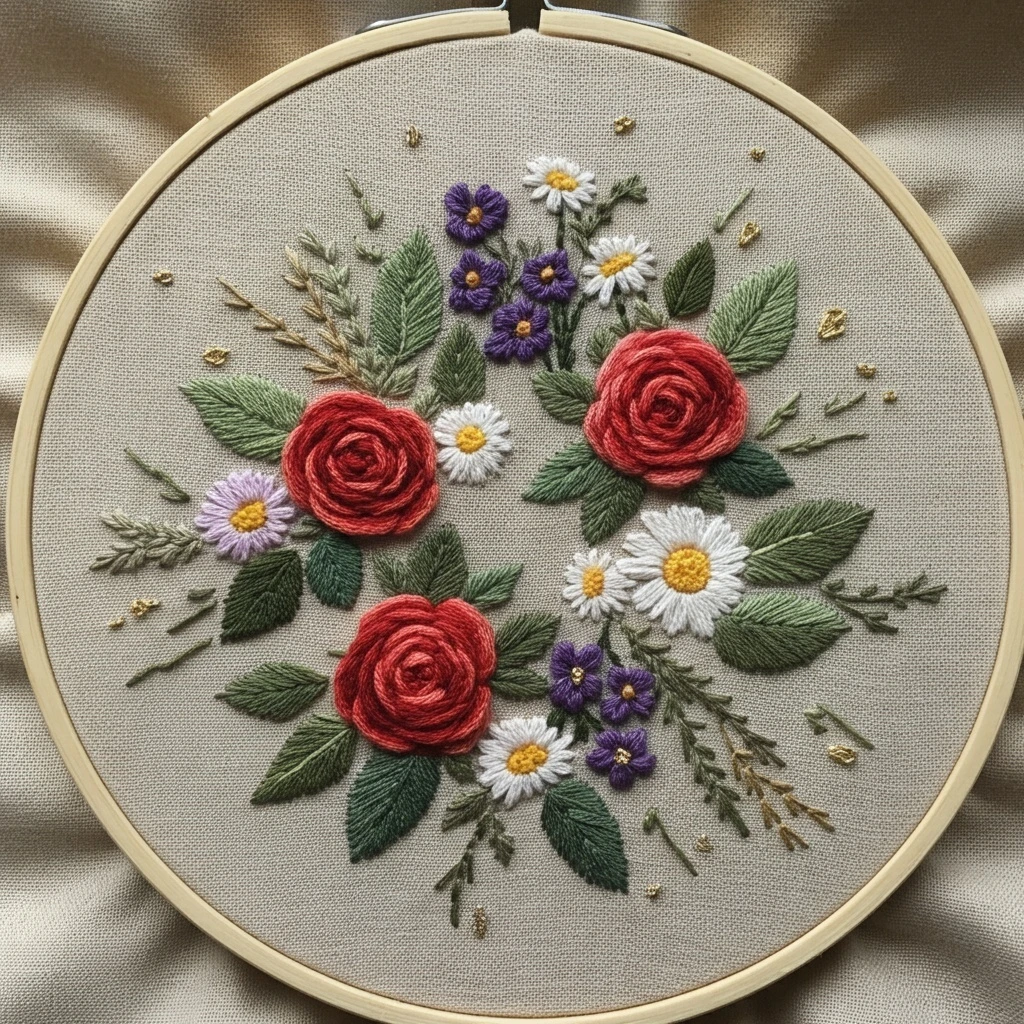
This elegant bouquet design combines deep red roses, creamy white roses, soft greenery, and flowing gold script. The stitched version should feel romantic and polished: dimensional rose petals, crisp pale highlights, darker red centers, muted leaves behind the blooms, and smooth gold lettering that looks graceful without overpowering the flowers.

Polished DMC Color Palette

This palette is built around rich red roses, ivory-white roses, muted botanical greens, warm stems, and gold script. Use the darkest red only at inner folds and rose bases, keep white roses softly shaded with cream and beige-gray, and stitch the script with golden tones plus a few bright glints.

DMC 815
Garnet Medium
Deep red rose centers, shadowed petal folds, and dramatic underside accents.
DMC 321
Red
Main red rose petals, saturated bloom areas, and classic bouquet focal color.
DMC 347
Salmon Very Dark
Red rose highlights, lifted petal edges, and warm transition strokes.
DMC 3722
Shell Pink Medium
Soft rose transitions, muted red petal tips, and blush shading beside whites.
DMC 3865
Winter White
Bright white rose petal tips, crisp highlights, and small sparkle stitches.
DMC 746
Off White
Main white rose petals, warm ivory fill, and smooth pale transitions.
DMC 822
Beige Gray Light
White rose shadow, folded petal depth, and subtle cream-to-gray shading.
DMC 644
Beige Gray Medium
Deepest shadows in white petals and muted outline accents on ivory roses.
DMC 783
Topaz Medium
Main gold script, flower centers, warm lettering body, and decorative dots.
DMC 3821
Straw
Bright gold script highlights, letter glints, and lifted center accents.
DMC 977
Golden Brown Light
Gold script shadow, deeper letter underside, and warm rose-center details.
DMC 801
Coffee Brown Dark
Fine stems, script shadow touches, rose-center depth, and earthy outlines.
DMC 3051
Green Gray Dark
Leaf shadows, foliage tucked behind roses, and dark stem structure.
DMC 3052
Green Gray Medium
Main leaves, rose stems, bouquet framework, and muted greenery.
DMC 3053
Green Gray
Leaf highlights, small sprigs, and soft light-facing foliage edges.
DMC 3013
Khaki Green Light
Pale leaf tips, tiny buds, and delicate botanical highlight stitches.
DMC 433
Brown Medium
Warm stems, tiny twig accents, and natural shadows behind the bouquet.
DMC 819
Baby Pink Light
Soft blush on white petals, tiny pale rose buds, and gentle petal transitions.
DMC 932
Antique Blue Light
Optional cool shadow under white roses and pale background accent stitches.
DMC 3799
Pewter Gray Very Dark
Very tiny deepest points only: under petals, letter crossing shadows, or pin-dot contrast.

Stitch Map by Design Element

Red roses
Use long-and-short stitch, satin stitch, or woven wheel. Place 815 in the center and under folded petals, fill the rose body with 321, and add 347 or 3722 on lifted petal tips for a velvety red finish.
White roses
Use satin stitch or long-and-short stitch in soft petal arcs. Fill with 746, shade petal bases with 822 and 644, and reserve 3865 for the brightest petal edges and final glints.
Rose centers
Use tight spiral stem stitch, small satin strokes, or tiny French knots. Keep centers compact, darker at the base, and slightly brighter on the lifted inner curl.
Gold script
Use split stitch, stem stitch, whipped back stitch, or couching in 783. Shade the underside of thicker curves with 977, then add small 3821 stitches along the top of curves for a metallic-style shine.
Letter flourishes
Use one strand for thin entry and exit strokes, then two strands for heavier downstrokes. Keep curves smooth by using shorter stitches around tight loops and slightly longer stitches on sweeping lines.
Leaves
Use fishbone stitch for larger leaves, lazy daisy for small leaves, and straight stitches for tiny sprigs. Work 3051 at the base, 3052 as the main leaf, and 3053 or 3013 on the upper edge and tips.
Stems and buds
Use one-strand stem stitch or back stitch in 3051, 3052, 801, and 433. Buds can be small satin stitches in 815, 321, 819, 746, and 3013 with a tiny green sepal underneath.

Thread Count & Blending Guide

Fine details

Use 1 strand for script hairlines, petal-edge outlines, tiny stems, rose-center curls, leaf veins, and final correction stitches. One strand keeps the design elegant.

Main forms

Use 2 strands for rose petals, main leaves, thicker script downstrokes, and bouquet fills. Two strands gives enough color saturation while preserving detail.

Raised accents

Use 2–3 strands only for selected French knots in rose centers or decorative gold dots. Avoid heavy raised stitches on the script so the lettering stays smooth.

Blending idea: Blend 321 with 347 for soft red rose highlights, 815 with 321 for deep red petal folds, 746 with 822 for ivory rose shading, 783 with 3821 for bright gold script, and 3052 with 3053 for leaf transitions.

Shading, Outlining & Texture Suggestions

Velvety red roses

  • Keep the deepest garnet inside rose centers and under overlapping petals.
  • Use red mid-tones across the main petals and lighter salmon-red on lifted edges.
  • Follow each petal curve with stitch direction to avoid a flat red patch.
  • Use tiny one-strand outlines only where petals overlap.

Dimensional white roses

  • Use off white as the main fill and winter white only for the brightest edges.
  • Place beige-gray shadows at the petal bases to make white roses readable.
  • Add a few soft blush stitches near the center if the reference shows warmth.
  • Do not over-outline white petals; gentle shading is cleaner.

Elegant gold script

  • Trace the lettering lightly and stitch slowly around curves.
  • Use one strand on thin strokes and two strands on thicker downstrokes.
  • Add gold highlights on the upper side of curves and darker gold underneath.
  • For extra polish, couch a gold-colored strand with matching DMC rather than making bulky satin letters.

Greenery support

  • Place darker leaves behind roses and lighter tips around the outside.
  • Use muted greens so the red roses and gold lettering remain the focal points.
  • Let stems disappear behind flowers for a natural bouquet arrangement.
  • Use leaf veins sparingly and only on larger visible leaves.

Beginner-Friendly Stitching Order

  1. Transfer carefully: mark the rose shapes, gold script baseline, major leaves, stems, and any buds. Keep script lines very fine so they are easy to cover.
  2. Stitch greenery first: add stems and darker background leaves so flowers can sit on top.
  3. Build white roses: stitch ivory petals with soft beige-gray shading and finish with tiny winter-white highlights.
  4. Build red roses: stitch darker centers first, then red petal bodies, then lighter red tips and edge accents.
  5. Stitch the gold script: work slow, smooth split stitch or whipped back stitch, thickening downstrokes after the base line is clean.
  6. Finish details: add buds, rose centers, gold glints, leaf veins, petal highlights, and final outline corrections last.

Practical Tips for a Clean Finish

Fabric & hoop

Warm cream, natural linen, or pale champagne cotton-linen complements red roses, white roses, and gold lettering. Keep the hoop drum-tight so script curves and satin petals stay smooth.

Needle choice

Use a sharp embroidery needle size 7–9 for one- and two-strand stitching. For couching a thicker gold-look line, use a needle that lets the couching thread move easily without snagging.

Keeping script legible

Stitch script before adding tiny surrounding highlights, but after large flowers if the lettering overlaps them. Keep curves smooth and avoid over-thickening loops.

Balancing red, white, and gold

Let red roses be the strongest color, white roses provide contrast, and gold script act as the refined accent. A few small gold glints are enough to connect the lettering to the bouquet.
Best beginner shortcut: use satin stitch for rose petals, fishbone stitch for leaves, stem stitch for stems, and whipped back stitch for the gold script.
Best polish upgrade: shade every rose in three values: dark inner fold, saturated petal body, and pale lifted edge, then finish the script with tiny 3821 highlights.
Designed as a practical DMC floss and stitch-planning companion for the Classic Red White Rose Bouquet with Gold Script embroidery artwork.

Leave a Reply

Your email address will not be published. Required fields are marked *