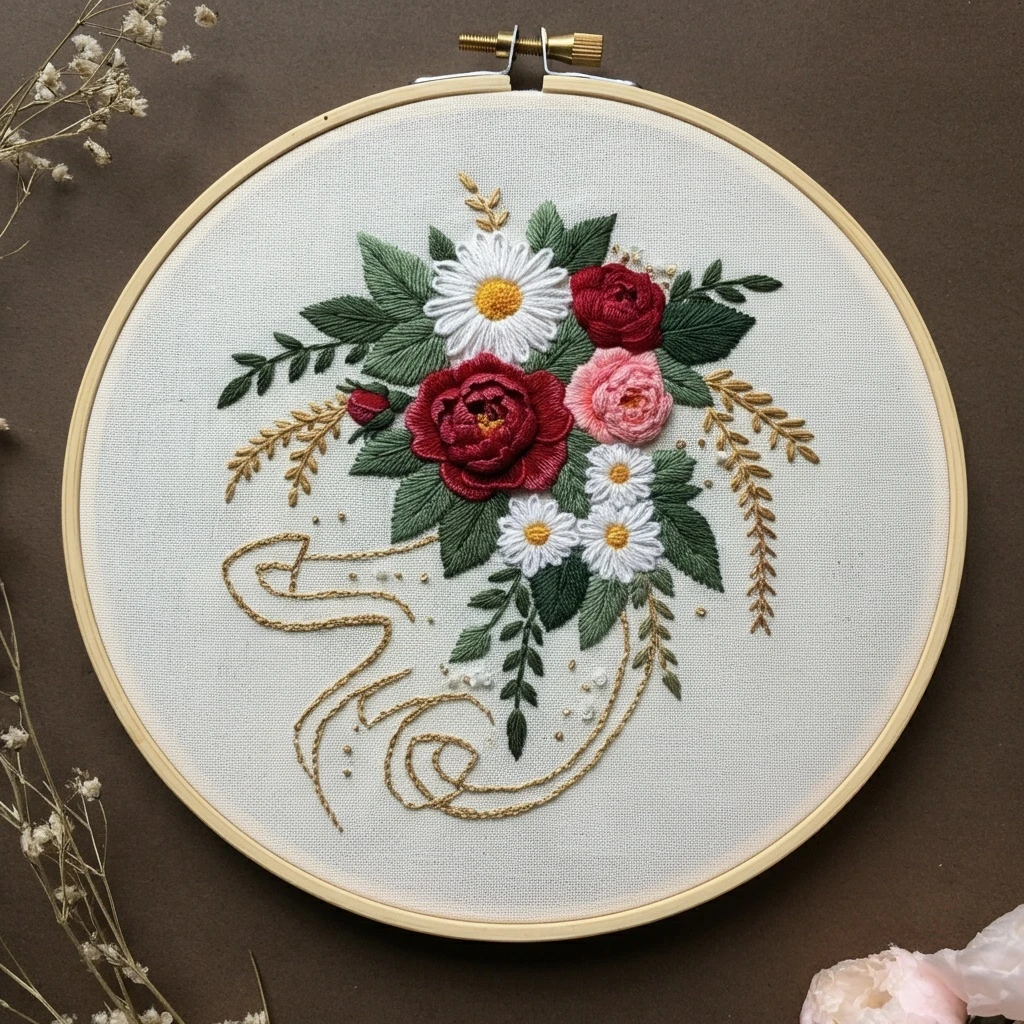

Floral Arch Wreath
A polished stitching plan for a romantic crescent bouquet: burgundy roses, soft pink florals, white daisies, deep leafy greenery, and warm golden trailing arch details on natural linen.
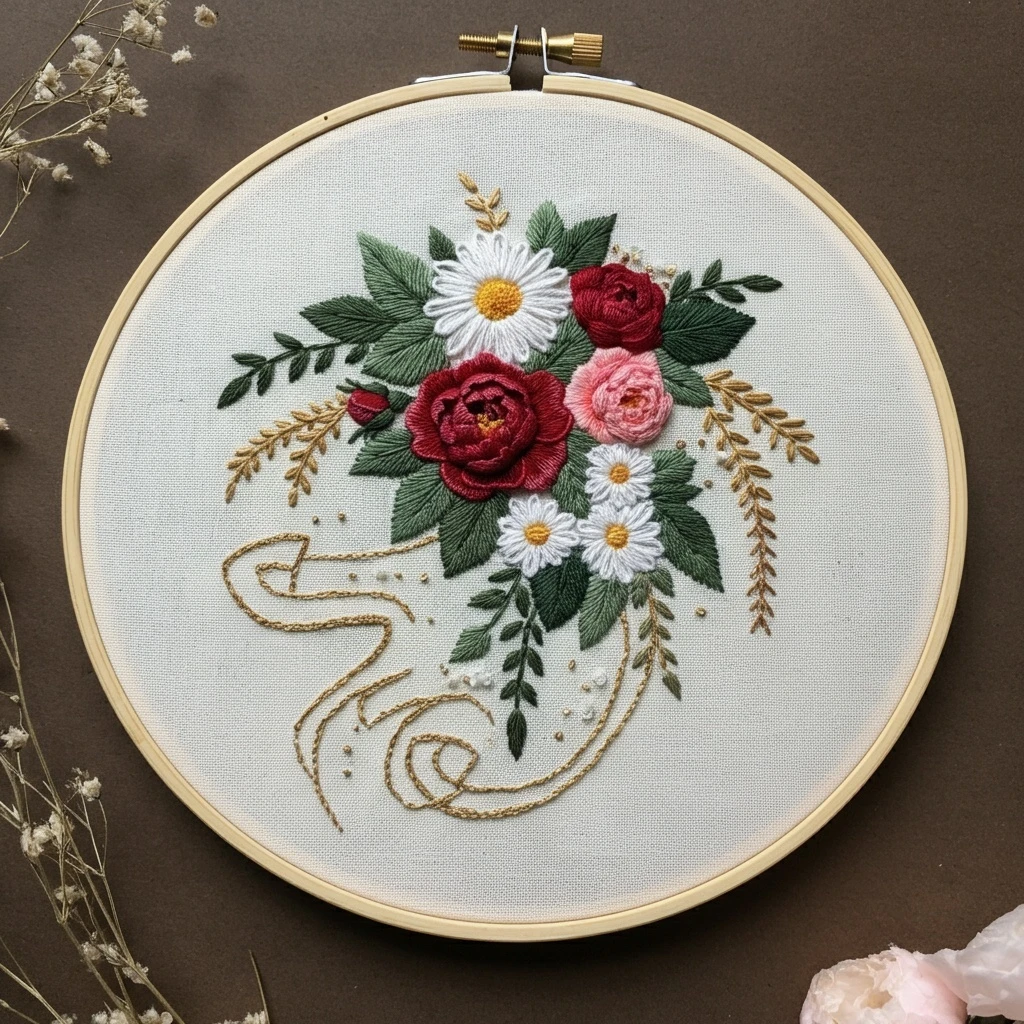
Design read
This design is built around a loose arch shape: the visual weight sits in the upper centre with large red roses, white daisies, and layered green leaves, while the lower half is airy and decorative with gold vine curves and scattered seed-like dots.
The most important color relationships are the contrast between cool white petals and warm yellow centres, deep garnet rose shadows against brighter red highlights, and several green values that separate background leaves from fine sprigs.
Suggested DMC floss palette
The palette below is chosen to match the visible tones in the reference: crisp whites, sunflower-gold daisy centres, burgundy and rosy florals, pine greens, and antique-gold arch accents.
Large roses
Use padded satin stitch or woven wheel centres, then build outer petals with long-and-short stitch. Work 814 in the deepest folds, 498 through the body, and touch 3685/3326 on lifted petal edges.
Daisies
Use fishbone stitch or detached chain for white petals. Keep the centre raised with French knots in 783, adding a few 3823 knots around the edge for a softer transition.
Green leaves
Use fishbone stitch for pointed leaves, placing 934 along the base or underside and 936/3051 toward the lit edges. Keep leaf veins consistent so the bouquet feels cohesive.
Stitch map
- Arch lines: stem stitch or whipped back stitch in 3045; add a second pass only on the lower curves for a corded look.
- Wheat sprays: straight stitch stems with lazy daisy or detached chain grains in 3045 and 783.
- Tiny gold dots: French knots, 1 wrap for subtle dots and 2 wraps for focal beads.
- Small leafy sprigs: back stitch stems with single detached chain leaves using 936 or 3011.
- White filler flowers: small straight stitches around a French knot centre; leave breathing space so they do not compete with the daisies.
Thread-count guidance
- Large flowers: 2 strands for fill; 1 strand for final petal lines and shadows.
- Leaves: 2 strands for broad leaves; 1 strand for narrow sprigs and veins.
- Gold arch: 2 strands for stem stitch; 3 strands if you want the arch to read as a raised cord.
- French knots: 2 strands with 1-2 wraps for daisy centres; 1 strand for tiny scattered dots.
- Outlining: 1 strand in a darker shade keeps the design refined rather than heavy.
Blending, shading & texture suggestions
For the red roses, blend by stitching short dark strokes first in DMC 814, then filling beside them with 498. Add tiny 3685 strokes only where petals curl forward. For the pink rosette, begin with 3685 in the spiral centre and switch to 3326 on the outer curve; this gives the flower a soft rolled shape.
For leaves, alternate 936 and 3051 within the same fishbone stitch area rather than making flat blocks of green. A few 934 stitches near flower overlaps help the bouquet feel layered. On the arch, use 3045 as the main line and dot in 783 sparingly so the metallic-gold impression remains warm but not flashy.
Fabric & hoop
Natural linen or cotton-linen in cream works best. Keep the fabric drum-tight, especially before satin stitching the roses, so the petals stay smooth.
Needles
Use a size 7 embroidery needle for 2-strand work, a size 9 for single-strand outlines, and a milliner needle for tidy French knots.
Finishing
After stitching, gently steam from the back over a towel. Avoid pressing the rose centres and knots directly so the dimensional texture remains raised.