
Floral Bouquet With Calligraphy
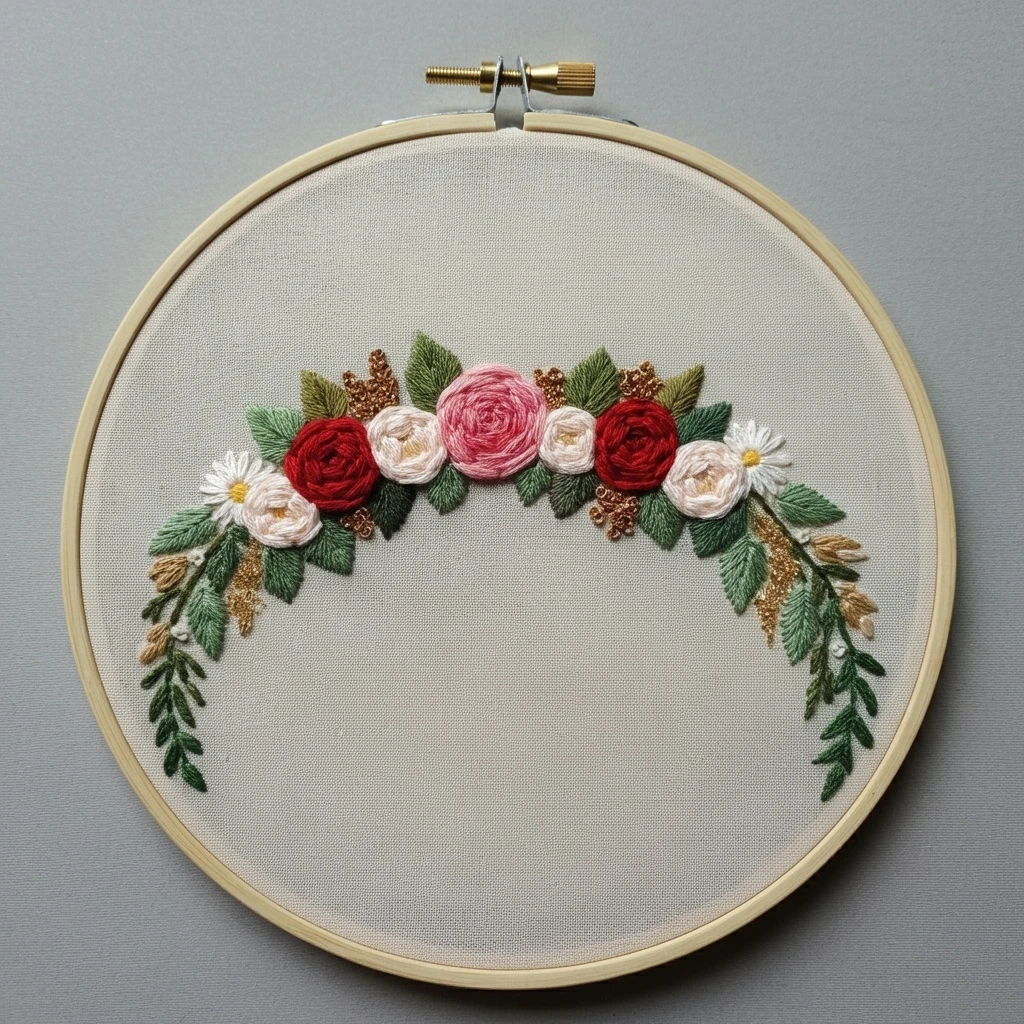
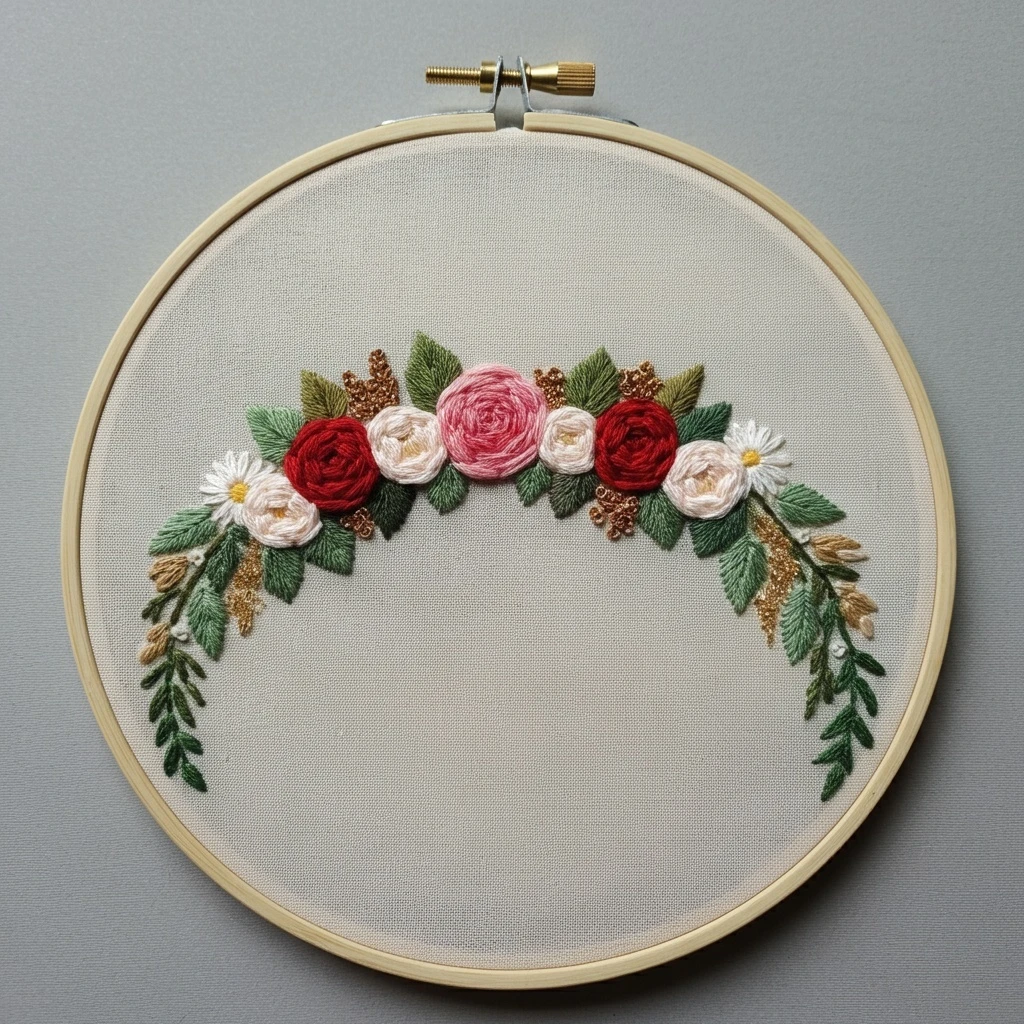
A graceful semicircle bouquet designed to frame calligraphy: deep red roses, a pink center bloom, ivory rosettes, white daisies, warm golden filler, and layered pine-green leaves. The stitching plan keeps the floral arch dimensional while preserving a clean, readable lettering area.
Color Story
The reference uses a calm linen background with strong floral contrast: dark crimson roses at either side, a soft rose-pink blossom in the center, creamy spiral flowers, white daisies, bronze-gold berry sprays, and cool evergreen foliage. Keep the calligraphy darker and flatter than the flowers so it reads clearly without competing with the raised knots and woven floral textures.
Design Element Stitch Plan
| Area | Suggested stitches | Practical notes |
|---|---|---|
| Deep red roses | Woven wheel rose, whipped back stitch, stem stitch spirals | Begin with 814 in the center, then build outward with 321. Add a few 814 stitches tucked between rows to keep the rose from looking flat. |
| Center pink bloom | Long-and-short stitch, satin stitch, split stitch | Use 335 for the body and 3326 on upper petal edges. Curve the stitches around the flower center instead of stitching straight across. |
| Ivory rosettes | Woven wheel rose, satin stitch, French knots | Work the base in 712 and add B5200 highlights only on the upper-left ridges. 842 can be used sparingly under petals for beige depth. |
| White daisies | Lazy daisy, detached chain, French knots | Stitch petals in B5200 with 1 strand of 712 near the center. Fill the middle with 783 knots and one or two 975 shadow dots. |
| Golden berry sprays | French knots, colonial knots, couched straight stitch | Use 783 for bright berries and 975 for bronze shadows. Scatter knots irregularly so they resemble natural seed heads. |
| Layered leaves | Fishbone stitch, satin stitch, fly stitch, stem stitch | Use 3011 and 3051 on top leaves, then place 3363 and 3362 under the flowers for depth. Add 522 only at tips that need a lighter edge. |
| Calligraphy phrase | Stem stitch, whipped back stitch, split stitch | Use 801 for most lettering. For thick downstrokes, stitch two parallel stem-stitch lines or whip the line with a second pass. Add 3371 only to tiny shadow accents. |
Blending Ideas
Blend one strand 335 with one strand 3326 for the pink flower transition. For cream rosettes, alternate 712 and B5200 rather than blending in the same needle so the spiral ridges remain visible.
Outlining Details
Outline petals with matching shades: 321 for red roses, 335 for pink petals, 712 for cream rosettes, and 3363 for leaves. Avoid black outlines; the design should feel soft and botanical.
Texture Suggestions
Let roses and berry clusters sit highest. Keep the calligraphy flat and smooth, then place knots around it sparingly so the text area remains elegant and readable.
Beginner-Friendly Working Order
- Mark the lettering zone: Transfer the calligraphy lightly first, then keep at least a finger-width of breathing room between letters and heavy floral knots.
- Stitch stems and leaf skeletons: Work the arch structure in 1–2 strands of green before adding raised flowers.
- Fill leaves: Use fishbone stitch for broad leaves and fly stitch for trailing fern fronds. Darker greens belong underneath the flower heads.
- Work the calligraphy: Use 801 in stem stitch. Complete lettering while the fabric is still smooth and before bulky roses are added.
- Add large flowers: Build red roses, the center pink bloom, and ivory rosettes from the center outward, keeping stitch direction circular.
- Finish tiny accents: Add daisies, gold berries, and final highlight knots last. Stop before the top arch becomes too crowded.
Practical Finishing Tips
- Use a 6-inch hoop with firm, drum-tight fabric so the calligraphy curves do not wobble.
- Shorten thread lengths to 12–14 inches when stitching roses; repeated wrapping can roughen floss quickly.
- When a woven rose feels too bulky, switch to whipped back stitch spirals for a flatter beginner-friendly version.
- Press only from the back on a padded towel so French knots and woven roses keep their raised texture.