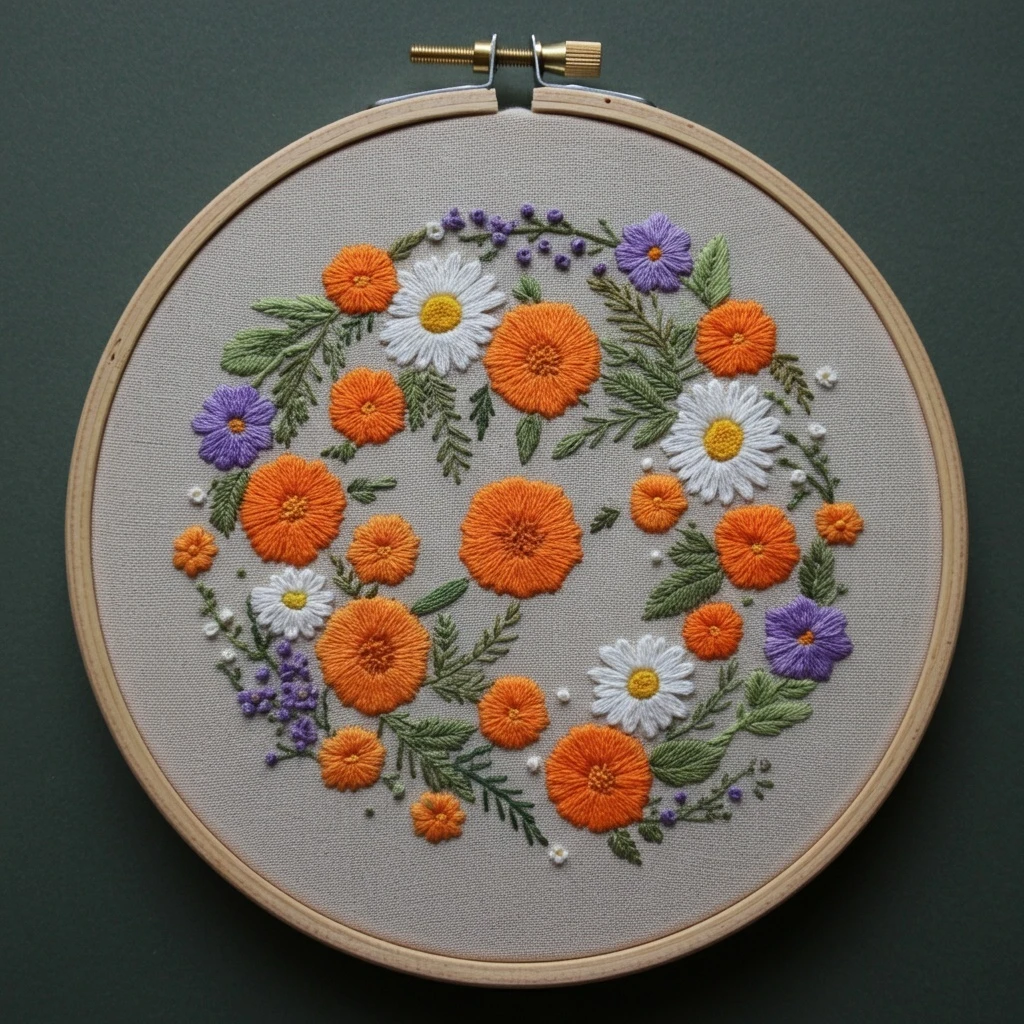


Orange White Floral Wreath
A cheerful circular floral hoop built from bold orange blooms, crisp white daisies, small violet accent flowers, yellow centers, and layered herb-like greenery on warm gray linen. The open wreath shape feels bright and garden-fresh while leaving comfortable negative space around the center.
Best worked on natural gray linen or cotton-linen in a 6–8 inch hoopColor story observed from the artwork
The design is led by saturated marigold-orange flowers, softened by clean white petals and balanced with cool purple blossoms. Greenery ranges from deep pine stems to dusty sage leaves, which keeps the circular wreath grounded against the neutral linen. Use the darkest shades only for leaf veins, stems, and flower-center depth so the orange and white blooms remain the focus.
Stitch map by design element
Orange focal flowers
- Use woven wheel roses for the round marigold-style blooms: 5 spokes for small flowers, 7 spokes for the largest blooms.
- Make the spokes with 2 strands of 720, then weave with 4–6 strands of 721 or 741 for raised texture.
- For petal-style orange flowers, use long-and-short stitch radiating outward from the center, keeping the stitches slightly uneven for a natural look.
White daisies
- Use detached chain or lazy daisy stitches with 2 strands of 3865 for each petal.
- Add a small straight stitch in 822 at the petal base when a little shadow is needed.
- Keep the daisy centers round with compact French knots in 725 and a few deeper 783 knots near the lower edge.
Purple accent flowers
- Use satin stitch or short long-and-short stitches in 209 for the petal surface.
- Add 333 at the center and between petals to create the darker folded look seen in the reference.
- For tiny violet berry clusters, use French knots wrapped twice with 2 strands.
Leaves, ferns, and stems
- Use fishbone stitch for larger leaves, working from a center vein outward.
- Use stem stitch for curved branches and back stitch for very slender stems.
- Use small straight stitches for fern fronds, alternating left and right along a central line.
Thread-count and blending guidance
Recommended strand counts
- Woven flower wheels: 2 strands for spokes, 4–6 strands for weaving.
- Long-and-short petals: 2 strands for smooth coverage; use 1 strand only for final highlight strokes.
- Leaves: 2 strands for fishbone fill, 1 strand for vein accents and serrated edges.
- Stems and tendrils: 1–2 strands; use 1 strand for the wispy outer sprigs.
- French knots: 2 strands with one wrap for tiny dots, two wraps for raised centers and berry clusters.
Useful blends
- Orange depth: 1 strand 720 + 1 strand 721 for petal bases and inner flower rings.
- Orange highlight: 1 strand 721 + 1 strand 741 for upper petals catching light.
- White petal shadow: 1 strand 3865 + 1 strand 822 for understated daisy shading.
- Leaf transition: 1 strand 3011 + 1 strand 3051 for olive leaves that sit behind the flowers.
- Purple petals: 1 strand 333 + 1 strand 209 for mid-tone violet folds.
Order of stitching
Mark the circular placement and main stems first. Keep transfer marks pale so the gray linen remains clean around the open negative space.
Stitch the supporting green structure before petals. This lets flowers overlap the foliage naturally and hides small stem ends.
Place 890 or 3011 at the base of leaves, then finish with 3051 toward the tips and outer sprigs.
Stitch the orange flowers next so they become the raised anchors of the wreath. Balance the largest blooms across the circle before filling smaller ones.
Add white petals, yellow centers, purple flowers, and final French-knot dots last for clean, dimensional detail.
Outlining, shading, and texture notes
Shading approach
- Shade orange blooms with 720 nearest the center and under overlapping petals.
- Use 741 only on the top-facing petal tips; too much highlight can flatten the round flowers.
- Place 822 at the inner end of white petals to separate them from the linen without making them gray.
- Deepen purple flowers with 333 in the petal grooves and center knots.
Texture approach
- Use raised woven wheels for the largest orange flowers to echo the plush sample surface.
- Keep daisies flatter with lazy daisy or satin stitches so they contrast with the rosettes.
- Add fern fronds using quick straight stitches; vary length to prevent a mechanical look.
- Scatter a few tiny French knots in green, white, or violet to imitate buds and filler blossoms.
Beginner-friendly practical tips
Hoop and fabric prep
- Choose a firmly woven linen or cotton-linen so woven flowers stay round and lifted.
- Hoop the fabric drum-tight before beginning; raised stitches look uneven if the fabric slackens.
- Use a size 7 or 8 embroidery needle for most 2-strand work and a larger needle when weaving with 6 strands.
Clean finishing
- Do not carry orange or dark green thread across empty linen; end and restart to avoid shadows showing through.
- Trim thread tails after each color family so they do not catch inside woven wheels.
- Press from the back on a folded towel so the French knots and raised flowers are not crushed.
Palette is a practical DMC approximation based on the visible artwork: substitute close stash colors if needed, but preserve the warm orange focal blooms, creamy whites, muted olive greenery, and small violet accents.