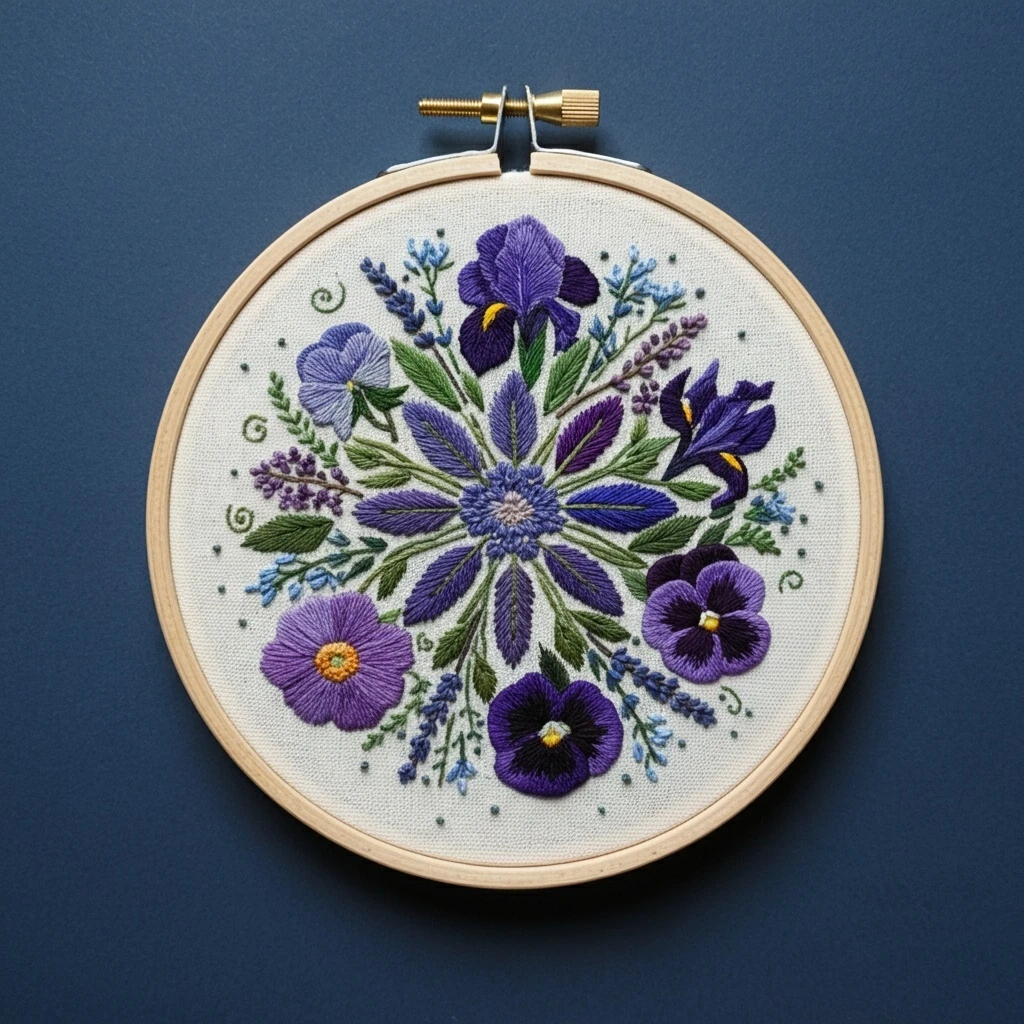


Deep Purple Iris Pansy
A richly layered hoop bouquet with velvety pansies, iris-like petals, a radial mandala flower, cool blue sprigs, fresh green leaves, and tiny golden centers. The palette leans jewel-toned and dramatic, softened with lavender highlights and natural leaf greens.
Suggested DMC Color Palette
Use these flosses to capture the dark violet pansies, iris petals, lavender-blue sprigs, mossy leaves, and small yellow accents visible in the design. The notes below are practical substitutions and placement cues rather than rigid rules.
DMC 550 – Very Dark Violet
Deepest pansy throats, iris shadow folds, and the darkest outer petal edges.
DMC 333 – Very Dark Blue Violet
Main saturated purple for bold iris petals and the central star flower.
DMC 340 – Medium Blue Violet
Mid-tone petal body color; excellent for long-and-short blending.
DMC 341 – Light Blue Violet
Soft lavender highlights on pansy faces and petal tips catching light.
DMC 3743 – Very Light Antique Violet
Pale veining, tiny highlight strokes, and gentle transition stitches.
DMC 820 – Very Dark Royal Blue
Cool blue-violet shadow accents in the iris petals and central flower points.
DMC 312 – Very Dark Baby Blue
Blue lavender buds, cool sprig tips, and small blue details between leaves.
DMC 809 – Delft Blue
Light blue buds and airy accents that keep the bouquet from feeling too heavy.
DMC 936 – Very Dark Avocado Green
Deep leaf undersides, central stems, and grounding outlines for greenery.
DMC 3346 – Hunter Green
Main leaf fill and stitched stem lines around the radial bouquet.
DMC 3052 – Medium Green Gray
Softer leaf highlights and curl details so the greenery has depth.
DMC 728 – Topaz
Pansy and iris centers; use sparingly for bright, jewel-like focal dots.
DMC 842 – Very Light Beige Brown
Warm center shading and subtle neutral knots in the middle flower.
DMC 924 – Very Dark Gray Green
Tiny background dots, shadowed stems, and optional outline definition.
Stitch Plan by Design Area
Iris & large petals
- Use long-and-short stitch with 2 strands for the main fills.
- Start dark at the folded bases with 550, transition through 333 and 340, then feather 341 or 3743 at tips.
- Add one-strand split-stitch veins after filling to sharpen the ribbed petal texture.
Pansy faces
- Work padded satin or short satin stitches from the petal edge inward.
- Keep the throat very dark with 550, then add 728 or a tiny white highlight in the center.
- Curve stitches to follow each rounded lobe instead of stitching straight across.
Central radial flower
- Outline each pointed petal with split stitch, then fill with directional satin stitches.
- Alternate 333, 340, and 820 around the flower for a mandala-like rhythm.
- Use seed stitch or French knots in 842 and 3743 for the soft center.
Leaves & stems
- Stitch stems with stem stitch or whipped backstitch in 936.
- Fill leaves with fishbone stitch using 3346, adding 3052 on the top edge.
- For narrow leaves, use straight stitches from vein to edge for a crisp botanical look.
Blue sprigs & buds
- Use lazy daisy stitches for small petals and detached chain buds.
- Combine 312 and 809 on the same sprig to show depth and sparkle.
- French knots in 333 or 312 make compact lavender-like seed clusters.
Dots, curls & finishing
- Use 1-strand backstitch for delicate green curls so they stay airy.
- Make tiny dots with single-wrap French knots in 924 or 936.
- Keep decorative dots unevenly spaced for a natural hand-stitched finish.
Thread Count, Blending & Shading
Beginner-Friendly Practical Tips
Order of stitching
Stitch stems first, then leaves, then the largest flowers, then small sprigs, knots, curls, and final highlights. This helps the bouquet layer naturally from back to front.
Hoop tension
Keep the fabric drum-tight while working dense satin areas. Re-tighten before each large flower so long stitches lie smooth and do not ripple.
Needle choice
A size 7 or 8 embroidery needle works well for two-strand fills; switch to a finer needle for one-strand veins and tiny background knots.
Finishing note: Step back often while stitching. The design reads best when dark purple masses are balanced across the hoop, with small blue and yellow details acting as accents rather than competing focal points.