
:root{
–paper: #f6f1e8;
–card: #fffdf8;
–ink: #25231f;
–muted: #6d675e;
–line: #d9d0c2;
–accent: #8d6547;
–accent-dark: #5d4331;
–soft: #eee5d8;
–shadow: 0 14px 34px rgba(54, 43, 32, .12);
}.emb-post{ box-sizing: border-box; }.emb-post{ scroll-behavior: smooth; }.emb-post{
margin: 0;
background:
radial-gradient(circle at 12% 10%, rgba(141, 101, 71, .08), transparent 24rem),
linear-gradient(180deg, #fbf8f2 0%, var(–paper) 100%);
color: var(–ink);
font-family: Georgia, “Times New Roman”, serif;
line-height: 1.65;
}.emb-post a{ color: var(–accent-dark); text-underline-offset: .18em; }.emb-post img{ display: block; max-width: 100%; }.emb-post .page{ width: min(1120px, calc(100% – 32px)); margin: 36px auto 64px; }.emb-post .hero,.emb-post .panel{
background: rgba(255, 253, 248, .96);
border: 1px solid var(–line);
border-radius: 18px;
box-shadow: var(–shadow);
}.emb-post .hero{ overflow: hidden; }.emb-post .hero-copy{ padding: 38px 42px 28px; text-align: center; }.emb-post .eyebrow{
margin: 0 0 10px;
color: var(–accent);
font-family: Arial, Helvetica, sans-serif;
font-size: .78rem;
font-weight: 700;
letter-spacing: .16em;
text-transform: uppercase;
}.emb-post h1,.emb-post h2,.emb-post h3{ line-height: 1.18; }.emb-post h1{ margin: 0; font-size: clamp(2rem, 5vw, 4.4rem); font-weight: 700; }.emb-post .intro{ max-width: 820px; margin: 18px auto 0; color: var(–muted); font-size: 1.08rem; }.emb-post .facts{
display: flex;
flex-wrap: wrap;
justify-content: center;
gap: 10px;
margin-top: 24px;
font-family: Arial, Helvetica, sans-serif;
font-size: .9rem;
}.emb-post .facts span{ padding: 9px 13px; border: 1px solid var(–line); border-radius: 999px; background: var(–soft); }.emb-post .image-wrap{ padding: 0 24px 24px; }.emb-post .image-card{
max-width: 860px;
margin: 0 auto;
padding: 12px;
border: 1px solid var(–line);
border-radius: 15px;
background: #fff;
}.emb-post .image-card img{ width: 100%; border-radius: 10px; }.emb-post figcaption{
padding: 11px 4px 2px;
text-align: center;
color: var(–muted);
font-family: Arial, Helvetica, sans-serif;
font-size: .9rem;
}.emb-post main{ display: grid; gap: 24px; margin-top: 24px; }.emb-post .panel{ padding: 30px 34px; }.emb-post h2{ margin: 0 0 13px; font-size: clamp(1.45rem, 3vw, 2rem); }.emb-post h3{ margin: 24px 0 6px; font-size: 1.1rem; }.emb-post p{ margin: 0 0 14px; }.emb-post .lead{ color: var(–muted); }.emb-post table{ width: 100%; border-collapse: collapse; margin-top: 18px; font-family: Arial, Helvetica, sans-serif; font-size: .94rem; }.emb-post th,.emb-post td{ padding: 12px 13px; border-bottom: 1px solid var(–line); text-align: left; vertical-align: top; }.emb-post th{ background: var(–soft); color: var(–accent-dark); font-size: .8rem; letter-spacing: .05em; text-transform: uppercase; }.emb-post tbody tr:hover{ background: #fbf7f0; }.emb-post .grid{ display: grid; grid-template-columns: repeat(2, minmax(0, 1fr)); gap: 14px; margin-top: 18px; }.emb-post .note{ padding: 17px 18px; border: 1px solid var(–line); border-radius: 13px; background: #fbf8f2; }.emb-post .note h3{ margin-top: 0; }.emb-post ol,.emb-post ul{ margin: 10px 0 0; padding-left: 1.3rem; }.emb-post li + li{ margin-top: 8px; }.emb-post .recipe{ counter-reset: step; list-style: none; padding: 0; }.emb-post .recipe li{ position: relative; padding: 0 0 18px 48px; min-height: 38px; }.emb-post .recipe li::before{
counter-increment: step;
content: counter(step);
position: absolute;
left: 0;
top: 0;
width: 31px;
height: 31px;
display: grid;
place-items: center;
border-radius: 50%;
background: var(–accent-dark);
color: white;
font: 700 .9rem/1 Arial, Helvetica, sans-serif;
}.emb-post footer{ margin-top: 28px; text-align: center; color: var(–muted); font-size: .9rem; }@media (max-width: 760px){.emb-post .page{ width: min(100% – 20px, 1120px); margin-top: 12px; }.emb-post .hero-copy,.emb-post .panel{ padding: 25px 20px; }.emb-post .image-wrap{ padding: 0 10px 10px; }.emb-post .grid{ grid-template-columns: 1fr; }.emb-post table{ display: block; overflow-x: auto; white-space: normal; }}
.emb-post .emb-download{background:linear-gradient(135deg,#f2f8f4 0%,#e9f3ec 100%);border:2px solid #4a7c59;border-radius:20px;padding:36px 28px;margin:44px 0;text-align:center;box-shadow:0 14px 40px rgba(74,124,89,.13)}.emb-post .emb-dl-title{border:none!important;margin:0 0 .35em!important;padding:0!important;font-size:28px;color:#3d6b4a}.emb-post .emb-dl-sub{color:#455048;max-width:580px;margin:0 auto 22px}.emb-post .emb-chips{display:flex;gap:9px;flex-wrap:wrap;justify-content:center;margin-bottom:26px}.emb-post .emb-chip{background:#fff;border:1px solid #d6e3da;border-radius:99px;padding:7px 15px;font:600 12px/1.3 Arial,sans-serif;color:#3d5344}.emb-post .emb-btn{display:inline-flex;align-items:center;justify-content:center;gap:10px;padding:17px 32px;border-radius:12px;font:700 16px/1 Arial,sans-serif;text-decoration:none;border:none;cursor:pointer;transition:transform .2s,box-shadow .2s,filter .2s}.emb-post .emb-btn:hover{transform:translateY(-2px);box-shadow:0 10px 24px rgba(0,0,0,.17);filter:brightness(1.05)}.emb-post .emb-btn-start{background:#4a7c59;color:#fff}.emb-post .emb-btn-pattern{background:#4a7c59;color:#fff!important}.emb-post .emb-btn-pixel{background:#bd8a26;color:#fff!important}.emb-post .emb-btn-row{display:flex;gap:14px;flex-wrap:wrap;justify-content:center}.emb-post .emb-hint{font:400 13px Arial,sans-serif;color:#6d7a70;margin:14px 0 0}.emb-post .emb-ico{font-size:19px;line-height:1}.emb-post .emb-wait-label{font:600 14px Arial,sans-serif;text-transform:uppercase;letter-spacing:.1em;color:#5f7065;margin:0 0 14px}.emb-post .emb-download{scroll-margin-top:110px}.emb-post .emb-wait,.emb-post .emb-ready{display:none}.emb-post .emb-download:target .emb-idle{display:none}.emb-post .emb-download:target .emb-wait{display:block;animation:emb-hide 30s steps(1) forwards}.emb-post .emb-download:target .emb-ready{display:block;animation:emb-show 30s steps(1) forwards}.emb-post .emb-download:target .emb-progress-fill{animation:emb-drain 30s linear forwards}@keyframes emb-hide{from{opacity:1;visibility:visible;max-height:400px}to{opacity:0;visibility:hidden;max-height:0;overflow:hidden}}@keyframes emb-show{from{opacity:0;visibility:hidden;max-height:0;overflow:hidden}to{opacity:1;visibility:visible;max-height:700px;overflow:visible}}@keyframes emb-drain{from{width:100%}to{width:0}}.emb-post .emb-progress{width:100%;max-width:420px;height:8px;background:#d3e7da;border-radius:99px;overflow:hidden;margin:0 auto}.emb-post .emb-progress-fill{height:100%;width:100%;background:#4a7c59;border-radius:99px;transition:width .95s linear}.emb-post .emb-ready-msg{font:700 17px Arial,sans-serif;color:#3d6b4a;margin:0 0 20px}.emb-post .emb-folder-note{font:400 13px Arial,sans-serif;color:#6d7a70;margin:16px 0 0}.emb-post .emb-gallery{display:grid;grid-template-columns:1fr 1fr;gap:16px;margin:28px 0}.emb-post .emb-shot{background:#fff;border:1px solid #ddd8cc;border-radius:14px;padding:12px;box-shadow:0 8px 24px rgba(40,45,35,.07)}.emb-post .emb-shot img{display:block;width:100%;height:auto;border-radius:10px}.emb-post .emb-cap{text-align:center;font:600 12px Arial,sans-serif;text-transform:uppercase;letter-spacing:.1em;color:#687269;margin-top:9px}@media(max-width:720px){.emb-post .emb-gallery{grid-template-columns:1fr}.emb-post .emb-download{padding:26px 16px}.emb-post .emb-btn-row{flex-direction:column}.emb-post .emb-btn{width:100%}}
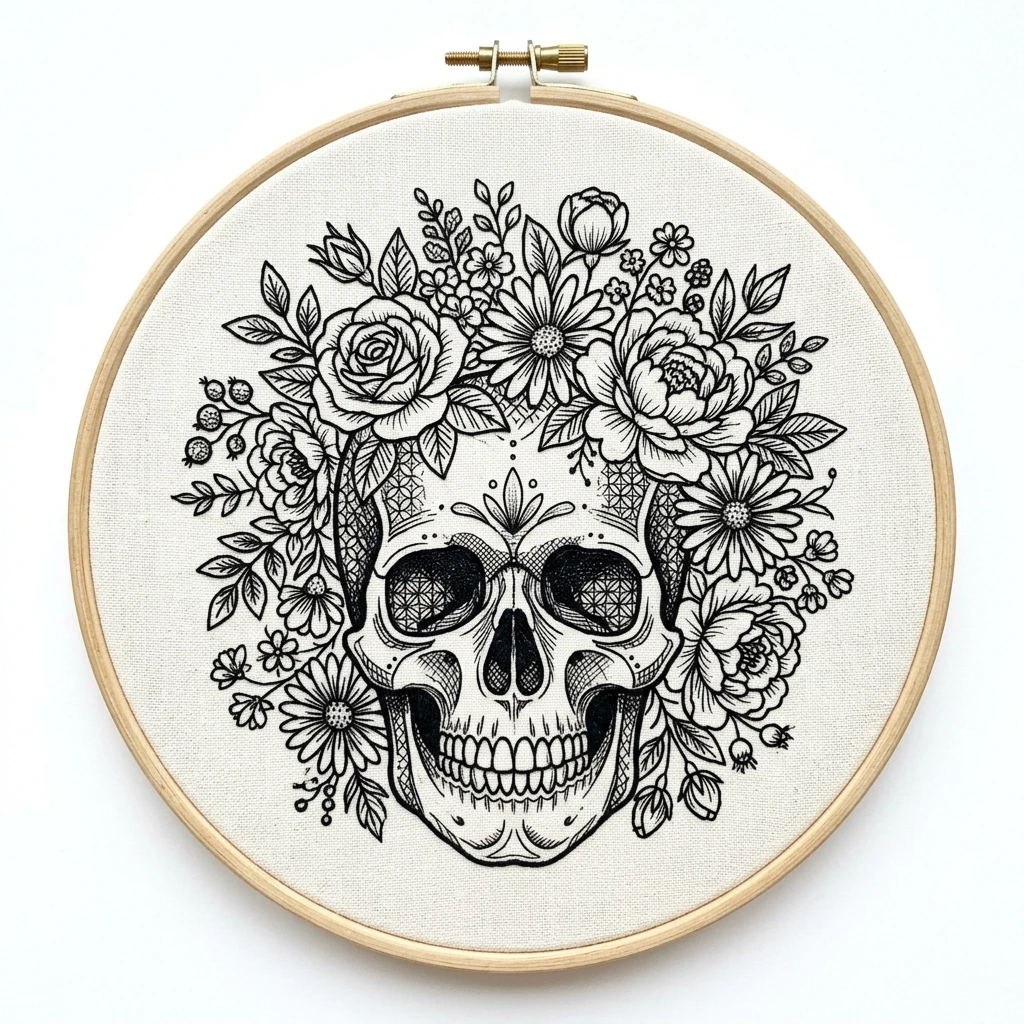
A detailed human skull sits at the center of the hoop, surrounded by roses, peony-like blooms, daisies, berries, buds, and layered leaves. The black linework gives the piece a tattoo-inspired botanical look, with dense crosshatching and geometric fills creating depth while the open linen ground keeps the design crisp.
Free Pattern Download
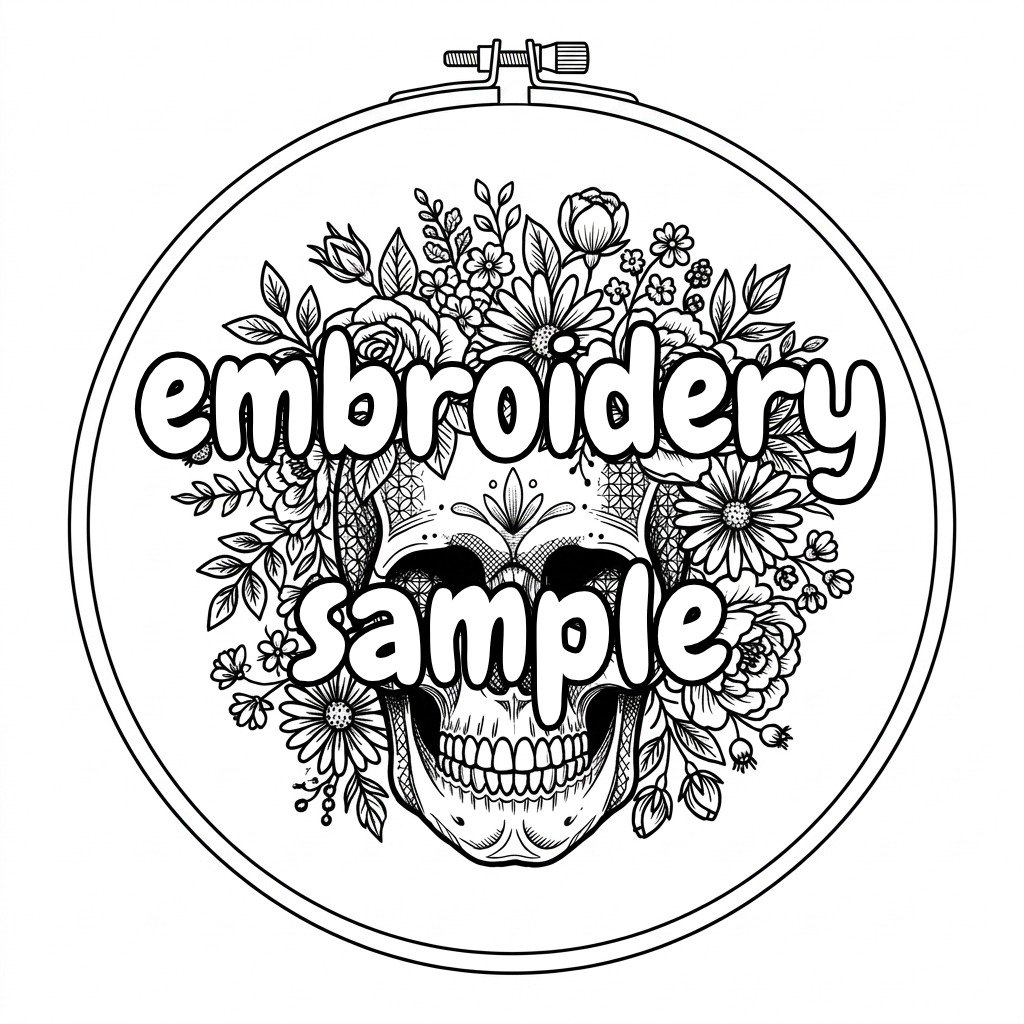
Get the printable pattern PDF and the pixelized cross-stitch chart. Click the button below to prepare your files.
Your files will be ready in 30 seconds.
Preparing your files…
This takes about 30 seconds.
Your files are ready. Happy stitching!
Design Read
The composition is built around a front-facing skull with deep eye sockets, a dark nasal cavity, exposed teeth, and delicate contour lines across the cheekbones, temples, and jaw. A generous floral crown surrounds it: a large rose on the upper left, a broad daisy near the top center, a layered blossom on the upper right, smaller daisies and clustered berries at the sides, and leafy stems filling the gaps. Repeated line patterns inside the skull and leaves add a blackwork character without turning every area into a solid fill.
The strongest contrast sits in the eye sockets, nose, and selected shadow panels. The flowers remain lighter and more open, so they frame the skull rather than compete with it.
Recommended DMC Color Palette
The reference is monochrome, so a restrained grayscale palette preserves its graphic quality. Use pure black for the main drawing and the gray shades only when you want softer depth or subtle separation between neighboring forms.
| DMC | Color | Suggested use |
|---|---|---|
| 310 | Black | Main outlines, eye sockets, nasal cavity, tooth divisions, deepest flower centers, and bold blackwork fills. |
| 3799 | Pewter Gray Very Dark | Soft secondary outlines, cheek shadows, petal folds, and dense leaf veins. |
| 413 | Pewter Gray Dark | Mid-value hatching inside the skull, flower overlap shadows, and geometric fill transitions. |
| 317 | Pewter Gray | Lighter contour shading around temples, jaw, and broad petals. |
| 318 | Steel Gray Light | Very light guide-like lines, delicate botanical stems, and subtle highlights on bone forms. |
| 762 | Pearl Gray Very Light | Optional pale shading on linen when a nearly invisible tonal layer is desired. |
| 3865 | Winter White | Optional tiny highlights on dark fabric only; unnecessary on the natural light ground shown. |
| 844 | Beaver Gray Ultra Dark | Optional warmer dark for selected leaves or flower shadows if you want separation from pure black. |
Stitch Plan by Design Area
Skull outline and bone contours
Use one- or two-strand split stitch for the outer silhouette and major facial divisions. Work the curved lines in short segments so the forehead, cheekbones, jaw, and chin stay smooth.
Eye sockets and nasal cavity
Build the darkest areas with close long-and-short stitch, seed stitch, or compact crosshatching in DMC 310. Leave tiny unstitched channels where the reference shows geometric patterning.
Teeth
Outline with one strand of 310 in back stitch. Add the vertical separations last, using a fine needle and light tension. Keep the tooth interiors mostly open so the mouth remains readable.
Roses and layered blossoms
Use whipped back stitch or split stitch around petal edges, then add short-and-long stitches only in the deepest folds. Follow the spiral direction of each bloom instead of filling petals uniformly.
Daisies and small flowers
Work petals with single straight stitches, lazy daisy, or narrow fishbone stitch. French knots or colonial knots suit the dotted centers.
Leaves and stems
Use stem stitch for branches, fishbone stitch for selected leaves, and back stitch for the many open leaves. Add one-strand veins after the outer shapes are complete.
Berries, buds, and dots
Use satin stitch or clustered French knots for berries. Tiny buds can be made with detached chain stitches and one anchoring straight stitch.
Geometric blackwork panels
Use one strand of 310 or 3799 in evenly spaced back stitch. Count spacing visually and stop before the pattern becomes denser than the reference.
Thread Count & Blending Guide
Fine details
Use 1 strand for teeth, facial hatching, flower stamens, leaf veins, berry dots, and geometric blackwork patterns.
Main outlines
Use 2 strands for the skull silhouette, prominent flower contours, major stems, and the darkest structural lines.
Dense dark areas
Use 2 strands for long-and-short fill or 3 strands only for small satin-stitched accents. Large solid areas are cleaner when built gradually with two strands rather than packed with heavy floss.
| Blend | Where to use | Effect |
|---|---|---|
| 1 strand 310 + 1 strand 3799 | Eye socket edges and cheek shadows | Deep black with a slightly softer boundary. |
| 1 strand 3799 + 1 strand 413 | Petal folds and skull hatching | Controlled charcoal transition. |
| 1 strand 413 + 1 strand 317 | Light bone contours and broad petals | Subtle mid-gray shading without losing the line-art look. |
| 1 strand 310 + 1 strand 844 | Selected leaves or warm shadow accents | A nearly black neutral with slight warmth. |
Outlining, Shading & Texture Suggestions
Keep the outline hierarchy clear
Make the skull silhouette and the largest flower contours slightly heavier than internal hatching, leaf veins, and decorative dots. This preserves the tattoo-like clarity of the reference.
Shade with direction, not blocks
Curve skull hatching around the forehead, temples, cheekbones, and jaw. On petals, aim stitches toward the flower center so the folds feel dimensional.
Use negative space deliberately
Do not fill every petal, tooth, or bone plane. The untouched linen is an active highlight and is essential to the clean monochrome appearance.
Mix line textures
Combine smooth split stitch, tiny seed stitches, crossed hatching, French knots, and occasional satin stitch. The contrast between open contours and dense micro-texture gives the design depth.
Beginner-Friendly Practical Tips
- Transfer the skull first, then the large flowers, and add the smallest leaves and dots only after checking the overall spacing.
- Use a size 7 or 8 embroidery needle for two strands and a size 9 or 10 for the one-strand teeth and blackwork details.
- Keep the fabric firm in the hoop, but release the tension between sessions to reduce hoop marks.
- Work with 35–40 cm thread lengths. Black floss shows fuzz and twisting quickly when used in long lengths.
- Test your darkest fills on a scrap first. Dense black stitching can pucker light linen if tension is too tight.
- Photograph the piece in grayscale while working. This makes uneven value distribution easy to spot.
Quick Working Recipe
Build the design from structure to detail, keeping the flowers airy and the skull shadows concentrated.
- Transfer the skull, the largest flowers, and the main leafy silhouette onto tightly hooped natural linen.
- Outline the skull, jaw, eye sockets, nose, and major flower shapes with one strand before reinforcing selected contours with a second strand.
- Complete the teeth and facial divisions early, while the surrounding area is still easy to access.
- Add skull hatching and geometric blackwork panels, moving from 3799 or 413 toward 310 in the deepest areas.
- Stitch the large rose, daisy, and layered blossoms, keeping most petals open and shading only the folded bases.
- Finish leaves, stems, berries, buds, flower centers, and decorative dots with one-strand details and small knots.
- Step back, balance any weak dark areas, remove visible transfer marks, and block the fabric lightly before final framing.


