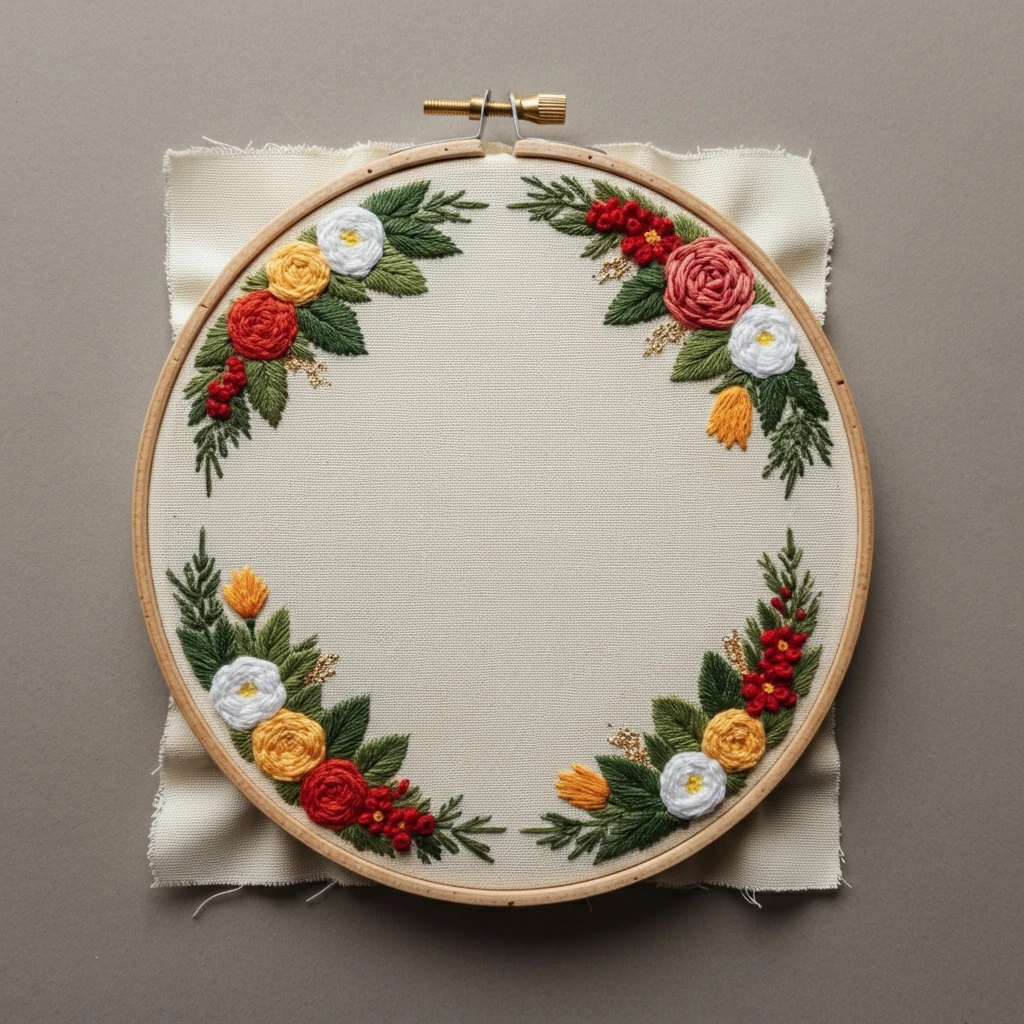


DMC color palette & hand embroidery guide
Monochrome Garden Black Rose and Tulip Mandala
A polished stitch-planning page for a dramatic blackwork garden mandala: layered roses, tulip silhouettes, petal arcs, ornamental leaves, and fine symmetrical linework worked in rich black, charcoal, pearl gray, and soft linen highlights.
Design color read
The reference design is built around a striking black rose and tulip mandala composition. The visual impact comes from clean dark outlines, repeated petals, ornamental garden curves, and subtle tonal variation rather than many colors. Keep the palette restrained so the symmetry stays elegant and the central florals remain crisp.
Use the deepest black for the main rose contours, tulip outlines, mandala rings, and key symmetry lines. Introduce charcoal and gray only where you want depth: the shadowed underside of petals, leaf veins, inner curls, and secondary decorative flourishes. A pale gray or off-white can be used sparingly for glints, tiny seed stitches, and lifted petal edges.
Monochrome stitching depends on contrast, thread weight, and negative space.
Suggested DMC floss palette
A compact grayscale palette gives the mandala a premium ink-drawing look while still allowing petal depth, leaf texture, and ornamental variation.
Stitch types by design area
| Design element | Best stitch choices | Thread guidance | Use notes |
|---|---|---|---|
| Outer mandala rings | Stem stitch, whipped back stitch, split stitch | 2 strands for clean curves; 1 strand for fine inner rings | Work slowly around the hoop and rotate the fabric often to keep curves smooth. |
| Black rose petals | Long and short stitch, fishbone stitch, satin stitch for small shapes | 2 strands for fills; blend 310 + 3799 for deepest areas | Shade from the petal base outward, leaving tiny linen gaps for a refined illustrated look. |
| Tulip silhouettes | Split stitch outline, satin stitch, contour stitch | 2 strands 310 for outline; 1 strand 413 for inner folds | Keep tulip tips sharp by ending stitches precisely at the point rather than crossing over it. |
| Leaves and fern-like curls | Fishbone stitch, fly stitch, detached chain, straight stitch veins | 1-2 strands in 3799, 413, or 414 | Alternate gray values between left and right leaves to keep the mandala dimensional. |
| Small dots and ornaments | French knots, colonial knots, seed stitch | 1 strand for tiny dots; 2 wraps for neat French knots | Use 415 or 762 sparingly for light-catching points around the floral frame. |
| Fine blackwork details | Back stitch, running stitch, couching for long arcs | 1 strand 310 or 3799 | Use shorter stitches on curves. For long straight ornamental lines, couch a single laid thread. |
Blending & shading plan
- Deepest shadows: blend one strand DMC 310 with one strand DMC 3799 for petal bases and tucked rose folds.
- Soft graphite transitions: use DMC 413 beside black outlines rather than overfilling every petal.
- Highlight restraint: add DMC 415 or 762 only along the top edge of selected petals, not throughout the whole mandala.
- Symmetry check: repeat the same shade sequence in opposite petals so the mandala feels intentional.
Thread-count guidance
- 1 strand: inner contour lines, tiny veins, blackwork scrolls, delicate dots.
- 2 strands: standard outlines, most stems, tulip shapes, medium petal fills.
- 3 strands: only for the boldest outer accents or central rose emphasis on larger hoops.
- 6 strands: avoid for this design unless couching a decorative border; it can make the mandala look heavy.
Beginner-friendly stitching sequence
Outlining, texture & finishing tips
Outlining
Use short back stitches on tight curves and split stitch for petal edges that need a smoother drawn line. A whipped back stitch in DMC 310 creates a polished cord-like ring around the mandala.
Texture
Mix smooth satin petals with tiny seed stitches and French knots so the monochrome palette still feels lively. Keep knot sizes consistent for a refined ornamental finish.
Fabric choice
Natural linen, ivory cotton, or warm oatmeal fabric supports the black rose theme beautifully. On dark fabric, reverse the highlights with 762 and 3865 for a moonlit garden effect.
Tension reminder
Monochrome work shows uneven tension easily. Keep the hoop drum-tight, avoid pulling satin stitches too firmly, and let each stitch lie flat before starting the next one.
Clean finish
Press from the back on a towel after stitching. For display, center the mandala carefully in the hoop so the floral points align with the top, bottom, left, and right edges.