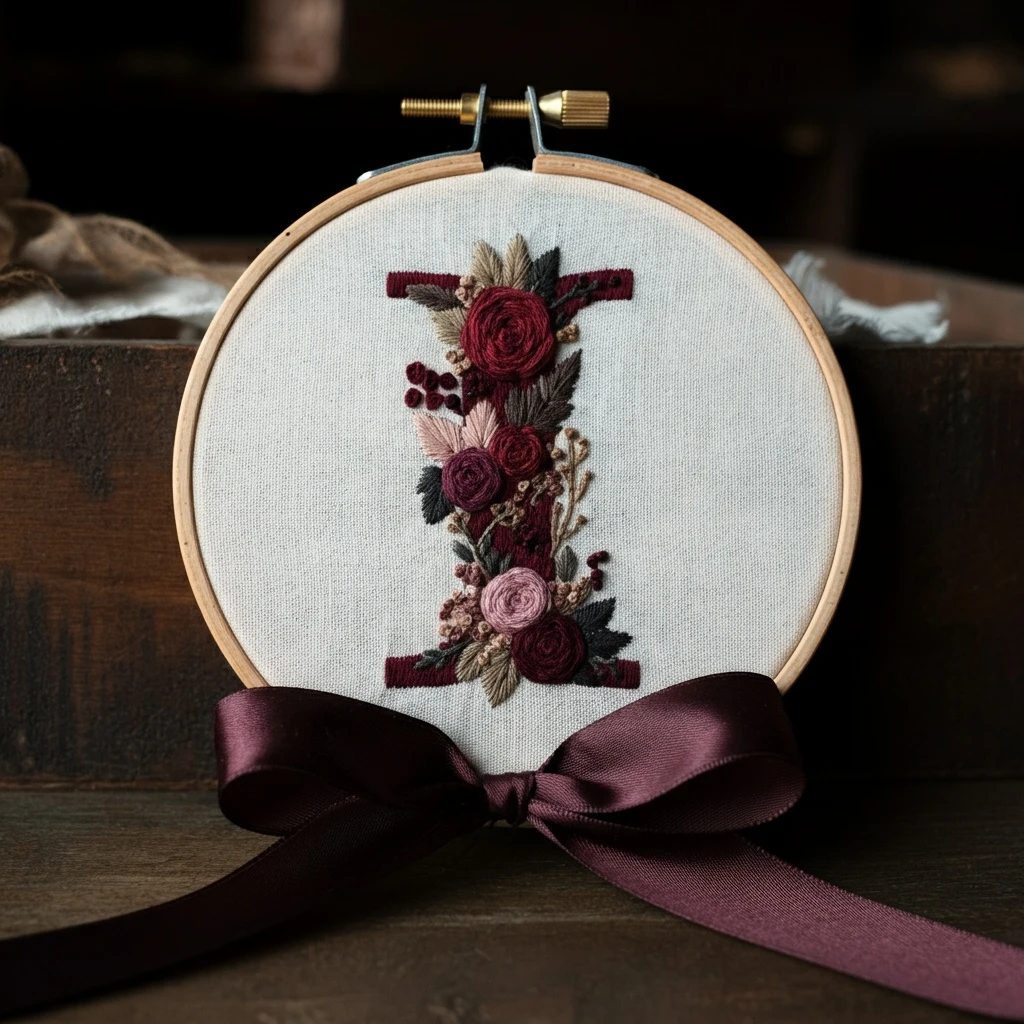

Blushing Roses Geometric Star Mandala
This design combines soft blushing roses with a structured geometric star mandala. The embroidery works best when the roses feel rounded and romantic while the star points remain crisp, symmetrical, and lightly architectural.
Use blush pinks, ivory highlights, muted greens, and warm golden-brown accents to balance floral softness with the mandala’s precise geometry.

Suggested DMC floss palette
A polished palette for soft roses, muted leaves, and warm geometric star accents.
| Swatch | DMC | Color name | Practical use notes |
|---|---|---|---|
| B5200 | Snow White | Bright highlight sparks on petal tips, star points, and small accent stitches where contrast is needed. | |
| 712 | Cream | Soft ivory petal highlights and warm light areas around the rose faces. | |
| 818 | Baby Pink | Pale blush wash for outer rose petals and gentle transition areas. | |
| 819 | Baby Pink - Light | Main blush rose tone for open petals and repeated floral forms. | |
| 3326 | Rose - Light | Medium rose shading for curled petal bases and dimensional folds. | |
| 3350 | Dusty Rose - Ultra Dark | Deepest rose creases, tiny shadow accents, and selective petal separation. | |
| 3828 | Hazelnut Brown | Warm golden-beige star accents and geometric framework highlights. | |
| 420 | Hazelnut Brown - Dark | Deeper geometric line accents, tiny separators, and warm center details. | |
| 772 | Yellow Green - Very Light | Soft leaf highlights and pale filler foliage between the rose clusters. | |
| 3012 | Khaki Green - Medium | Main leaf tone for balanced greenery around the mandala. | |
| 3011 | Khaki Green - Dark | Leaf shadows, stems, and deeper botanical details near rose bases. | |
| 844 | Beaver Gray - Ultra Dark | Subtle dark definition for the sharpest geometric points where black would look too harsh. |
Design elements to notice
Star geometry
Keep the star points sharp with consistent line thickness and a limited outline color.
Rose clusters
Use rounded petal stitches to soften the geometric framework without covering the mandala shape.
Balanced symmetry
Repeat colors evenly around the circle so no quadrant feels heavier than the others.
Warm accents
Golden-brown details add structure and warmth beside the blush-pink roses.
Stitch types
Use smooth fills for roses and precise line stitches for the mandala structure.
Thread-count guidance
- 1 strand: tiny geometric corrections, fine petal crease lines, and small leaf veins.
- 2 strands: main outlines, rose fills, star lines, leaves, and most visible stitching.
- 3 strands: fuller focal roses or slightly raised star accents in the center.
- 4-6 strands: reserve for dimensional French knots only. Too much bulk can distort the mandala symmetry.
Blending, outlining, and shading guidance
- Rose highlights: place B5200 or 712 only along the outer petal lips and the lightest lifted curls.
- Blush transition: use 818 beside 819 to soften the rose face; alternate short stitches where the shades meet.
- Petal depth: add 3326 at curled bases, then use tiny 3350 stitches only in the deepest creases.
- Needle blending: combine one strand of 818 with one strand of 819 for a gentle blush; combine 819 with 3326 for dimensional mid-shadows.
- Geometric definition: use 3828 for warm light segments, 420 for deeper separators, and 844 sparingly at the sharpest intersections.
- Leaf shading: begin with 772 at leaf tips, use 3012 through the body, and place 3011 near the base or under overlapping roses.
Texture suggestions
- Pad the central rose slightly with a few under-stitches before satin or long-and-short stitching.
- Use French knots in balanced pairs around the mandala so texture supports the symmetry.
- Keep star lines smooth and low while allowing roses to be more dimensional.
- Vary leaf angles around the roses to keep the floral sections natural.
- Leave small fabric spaces between some rose petals and star lines so the geometry stays readable.
Beginner-friendly stitch order
- Transfer the mandala carefully, marking center points and star tips first.
- Stitch the central geometric framework before filling flowers.
- Add the largest roses, working from the center of each flower outward.
- Place leaves and filler buds around the rose clusters.
- Return to the star points for final crisp outlining and small accent dots.
- Check symmetry after every quadrant so color weight remains even.
Practical finishing tips
- Use a ruler or printed transfer guide to keep star points aligned before stitching.
- Keep fabric drum-tight; loose fabric makes geometric lines wobble.
- Anchor threads away from open light areas so shadow knots do not show through pale fabric.
- Work with shorter floss lengths when stitching roses to reduce fuzz and twisting.
- Press finished embroidery face down on a towel to preserve raised rose texture.
- Ivory, pale blush, soft oatmeal, or warm white fabric will flatter this palette.