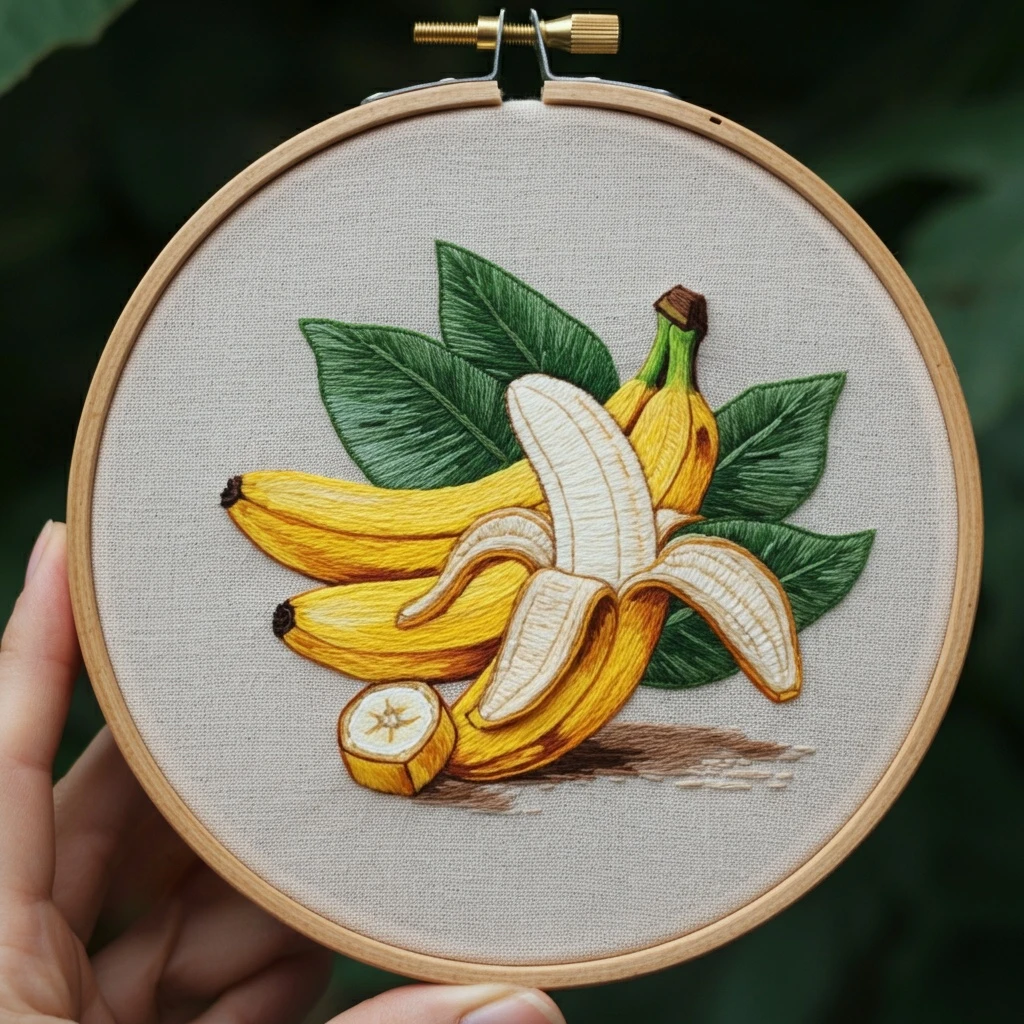


Tropical Realism Peeled Banana Palm Leaves
A polished DMC palette and stitch guide for a realistic banana arrangement with peeled creamy fruit, golden yellow skins, deep green palm leaves, warm brown stem details, and soft grounded shadows.
Preview Color Story
Colors are estimated from the visible hoop preview and matched to close DMC embroidery floss shades. The design reads as a high-contrast tropical still life: saturated banana yellows, creamy off-white peeled fruit, dimensional ochre shadows, dark leaf veins, and a natural linen background.
Likely DMC Color Palette
Use these shades as a realistic working palette. For the best result, place yellows in long directional layers, reserve the darkest browns for tiny accents, and blend greens along the leaf ribs.
Stitching Suggestions
This design benefits from realistic stitch direction. Work the bananas in curved, lengthwise strokes; work the palm leaves from the central rib outward; keep the peeled fruit smooth and slightly raised.
| Element | Stitch Type | Practical Notes |
|---|---|---|
| Banana peel bodies | Long and short stitch | Follow the banana curve from tip to stem. Blend DMC 725 and 728 through the center, then add 782 and 977 along lower edges and overlaps. |
| Peeled creamy fruit | Satin stitch with split-stitch outline | Pad lightly with one strand first if you want raised flesh. Use 3865 for the brightest center and 739 for shallow rib shadows. |
| Peel flaps | Long and short stitch plus couching | Stitch from the fold outward. Couch a fine tan or brown line along the fold to make the flap look curled and dimensional. |
| Palm leaves | Fishbone stitch and straight stitch | Use a central vein first, then angle stitches outward like feather barbs. Mix 986 near the underside, 987 through the body, and 989 sparingly as highlights. |
| Leaf veins | Stem stitch or split backstitch | One strand keeps veins crisp. Add a few lighter green stitches beside the rib instead of outlining every vein heavily. |
| Banana tips and stem cap | Tiny satin stitch and French knots | Use 938 for dark caps, then soften with 420 or 977. Keep these small so they punctuate the design without becoming bulky. |
| Cut banana slice | Satin stitch, backstitch, seed stitch | Fill the slice face with 3865 and 739. Add a small star center with 420 and tiny seed stitches for realistic fruit texture. |
| Ground shadow | Loose straight stitches | Use one strand of 648 and 420 in broken horizontal strokes. Leave fabric showing so the shadow stays soft and painterly. |
Thread Count, Blending & Shading
Thread-count guidance
Use 2 strands for most banana and leaf filling. Switch to 1 strand for outlines, leaf veins, peel ribs, cut-slice details, and the soft cast shadow. Use 3 strands only for small padded cream highlights if you want raised fruit flesh.
Blending ideas
For realistic yellow gradients, blend one strand DMC 725 with one strand DMC 728. For darker peel creases, blend 728 with 782. For natural leaves, alternate 986, 987, and 989 rather than mixing every stitch.
Outlining details
Outline major banana silhouettes with split stitch in 782 or 420, not black. Use 938 only at the banana tips, stem cap, and deepest creases. A softer outline keeps the realism warm and natural.
Shading guidance
Place the lightest floss along upper banana ridges and the front of the peeled fruit. Put darker ochres under overlaps, behind peel flaps, near the bottom banana curve, and where fruit touches the surface.
Texture suggestions
Keep banana flesh smooth, banana skins gently streaked, and palm leaves visibly fibrous. Add a few single-strand lines in 739 and 420 to mimic the tiny lengthwise threads seen in peeled banana flesh.
Beginner-friendly pace
Work one color family at a time: greens first, then yellows, then creams, then browns. This prevents the small shadow colors from spreading into the brighter banana sections too early.
Where to Start
Start with the background palm leaves so the bananas can sit cleanly on top. Next, stitch the full yellow banana shapes, then add the peeled cream sections and curled flaps. Finish with the stem caps, cut banana slice, fine vein lines, and the soft shadow beneath the arrangement.
- Transfer outlines lightly; dark transfer marks can show through cream floss.
- Anchor and bury threads on the back instead of knotting near smooth satin areas.
- Keep stitch direction consistent on each banana so the curve reads naturally.
- Use short stitches near tight tips and longer stitches through broad banana middles.
- Save the crisp brown contour lines until the filling is complete.
Encouraging Finish
The key to this piece is contrast: bright smooth banana flesh, warm golden peel, and darker textured leaves. Build the shadows gradually, keep the cream areas clean, and let the final one-strand veins and contours sharpen the realism at the very end.