
Heart Shaped Floral
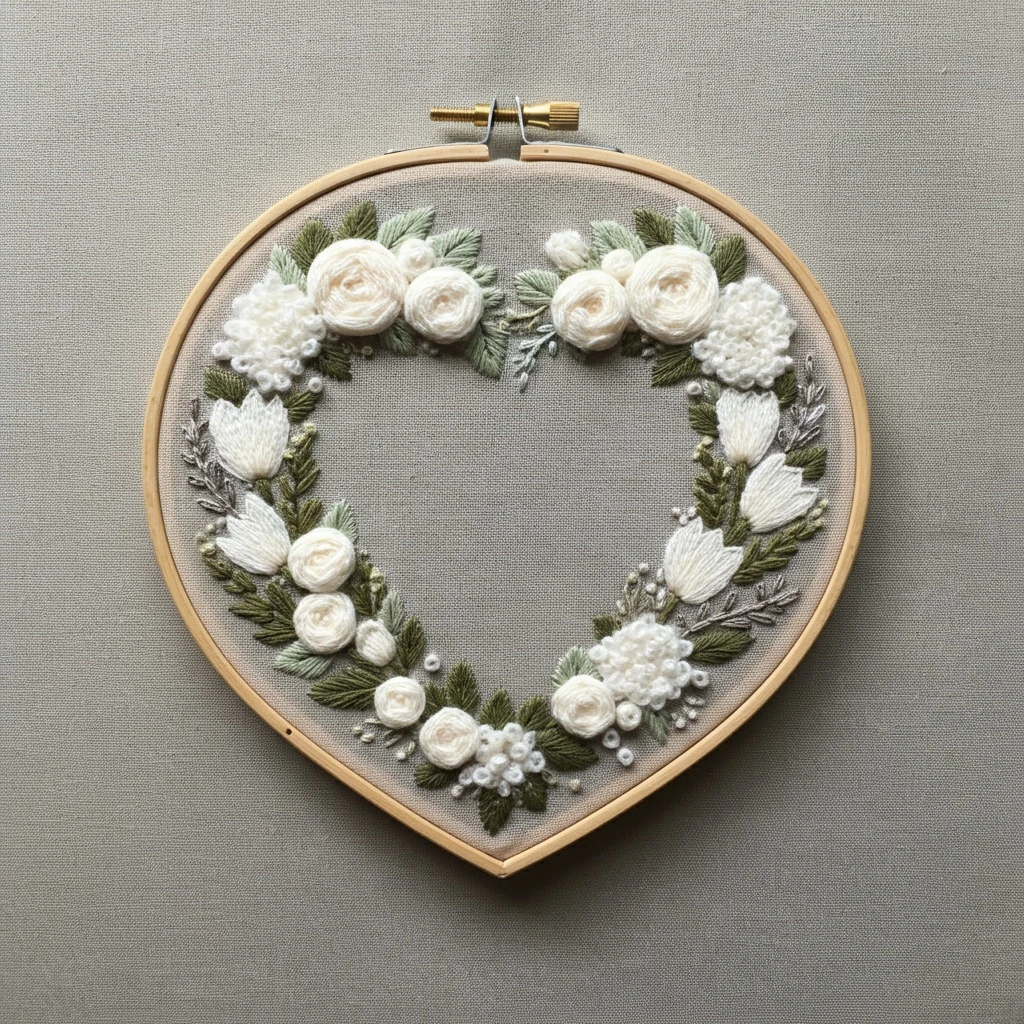
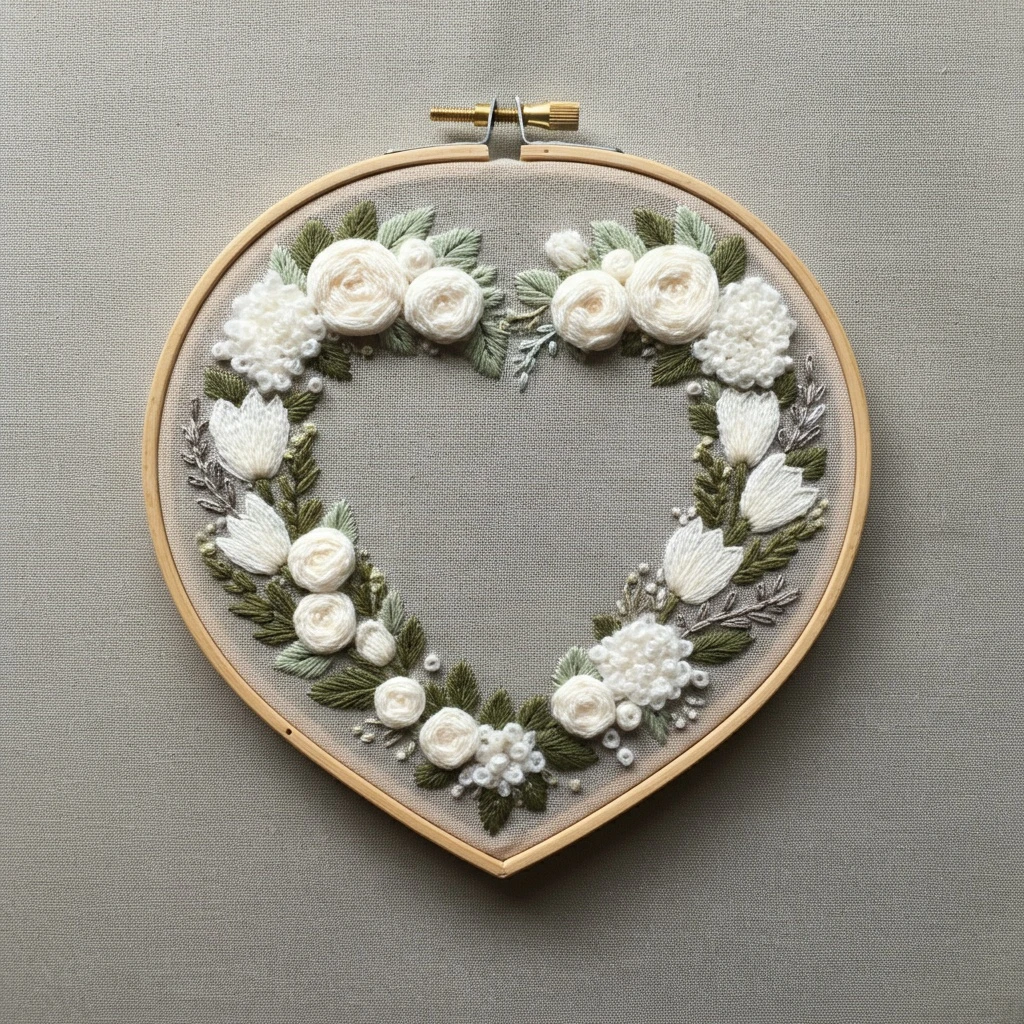
A romantic floral hoop built around a heart-shaped arrangement of clustered blossoms, leafy sprigs, tiny buds, and soft trailing details. The design works best with a balanced palette of deep rose, blush pink, creamy highlights, fresh greens, and small golden centers so the heart shape stays clear while the flowers feel lush and dimensional.
Suggested DMC Floss Palette
This palette is designed for a heart-shaped floral arrangement with enough contrast to define the outline and enough soft shades for romantic blending. Use the darkest pinks only at petal bases and shadowed overlaps, then let the pale pinks and creams carry the highlights.
DMC 902 — Garnet Very Dark
Deepest petal shadows, rose centers, and small accents that define the lower curve of the heart silhouette.
DMC 3831 — Raspberry Dark
Main saturated rose shade for statement flowers. Use at petal bases and outer blooms for rich depth.
DMC 335 — Rose
Mid-tone pink for rounded petal bodies, medium blossoms, and transitions between dark rose and blush.
DMC 3716 — Dusty Rose Very Light
Soft petal highlights, small filler blooms, and airy edge stitches where flowers need a gentle romantic feel.
DMC 761 — Salmon Light
Warm blush for small buds, petal tips, and light accents that keep the palette lively rather than flat.
DMC 3865 — Winter White
Creamy petal highlights, tiny white flowers, and soft shine on raised stitches. Warmer than bright white.
DMC 744 — Pale Yellow
Light flower centers, pollen dots, and the brightest touch on golden seed stitches.
DMC 783 — Topaz Medium
Warm golden centers, French knots, and small accent dots that add sparkle inside the floral clusters.
DMC 895 — Hunter Green Very Dark
Darkest leaf undersides, small stem shadows, and crisp areas where greenery needs to separate from petals.
DMC 730 — Olive Green Very Dark
Main leaf and stem color. Excellent for curved stem stitch and darker lazy-daisy leaves.
DMC 3012 — Khaki Green Medium
Leaf highlights and lighter sprigs. Blend with 730 to give leaves a natural, dimensional shift.
DMC 3364 — Pine Green
Pale greenery, delicate tendrils, and soft filler leaves around the outer heart edge.
DMC 801 — Coffee Brown Dark
Tiny twig details, deeper flower-center shadows, and subtle grounding lines beneath dense clusters.
DMC B5200 — Snow White
Use very sparingly for the brightest tiny dot highlights. Too much can overpower the soft floral palette.
Stitch Map by Design Area
Large roses and open blossoms
- Use woven wheel roses for rounded blooms or long-and-short stitch for open petals.
- Place 902 or 3831 at the base of petals, then blend through 335 and 3716 toward the tips.
- Add a few 3865 stitches on petal edges for lift, but keep the heart outline readable.
Small filler flowers
- Use lazy daisy, detached chain, or small satin petals in 3716, 761, and 3865.
- Work centers with French knots in 744 or 783.
- Vary flower sizes so the heart feels organic rather than evenly dotted.
Leaves and stems
- Use stem stitch for curved vines and split stitch for fine stems.
- Make leaves with lazy daisy, fishbone stitch, or simple straight stitches.
- Use 895 at leaf bases and 3012 or 3364 on the tips for natural shading.
Heart outline
- Do not draw a heavy border unless the pattern requires it; let petals and leaves build the silhouette.
- Use darker rose blooms along the lower curve and lighter blooms near the top for balance.
- Place tiny stems and buds at the inner point to keep the heart shape crisp.
Centers and texture
- French knots, colonial knots, and tiny seed stitches are ideal for pollen and floral centers.
- Use 783 under 744 for golden depth in larger flowers.
- Scatter knots unevenly so the flowers look hand-gathered and natural.
Trailing buds and airy details
- Use 1-strand straight stitches for tendrils and tiny bud stems.
- Small satin ovals in 761 or 3716 make sweet unopened buds.
- Keep outer details light so the central floral heart remains the focus.
Thread Counts, Blending & Shading Guidance
| Area | Recommended strands | Practical guidance |
|---|---|---|
| Fine stems and outlines | 1 strand | Use for delicate vines, small tendrils, and fine petal definition. One strand prevents the arrangement from looking heavy. |
| Main petals | 2 strands | Best for satin, long-and-short, and detached-chain petals. Keep stitch direction consistent within each petal. |
| Raised roses | 3–6 strands | Woven wheel roses can use more strands for volume. Use fewer strands for smaller roses so they do not crowd the design. |
| Leaf fills | 1–2 strands | Use 2 strands for larger leaves and 1 strand for fine sprigs around the heart edge. |
| Blended needle | 1 + 1 strands | Blend 3831 with 335 for rich pink transitions, 335 with 3716 for soft petals, and 730 with 3012 for natural leaves. |
Beginner-Friendly Stitching Sequence
Mark the heart shape lightly
Transfer the main heart boundary, the largest flowers, a few stems, and the central point. Keep small buds and filler stitches flexible so you can adjust spacing as you stitch.
Stitch the main flowers first
Work the largest roses and blossoms in the most visible areas. Establish dark-to-light petal shading before adding smaller filler flowers.
Add stems and leaves
Use curved stem stitch for the vines and lazy-daisy or fishbone leaves around them. Let greenery connect the flowers and reinforce the heart silhouette.
Fill gaps with buds and small blossoms
Add tiny satin buds, detached-chain flowers, and knot clusters where the composition feels sparse. Vary colors and sizes for a natural arrangement.
Finish with centers and highlights
Add golden knots, tiny white highlights, and final one-strand tendrils last. This keeps the surface texture clean and dimensional.
Texture Suggestions & Practical Tips
For dimensional flowers
- Use woven wheel roses for the largest blooms and detached chain for smaller blossoms.
- Shade petal bases darker and tips lighter to create depth.
- Avoid making every flower the same size; variety makes the heart feel fuller.
For graceful greenery
- Curve stems toward the heart center instead of stitching them straight.
- Use darker leaves underneath flowers and lighter leaves around the outer edge.
- Keep tendrils in 1 strand so they stay elegant.
For clean outlining
- Let the floral clusters define the heart rather than adding a thick outline.
- If an edge needs definition, use tiny leaf or bud stitches instead of a continuous dark line.
- Use 902 only in small shadow pockets so it adds depth without dominating.
For an easy finish
- Work with the fabric drum-tight to keep satin petals smooth.
- Trim jump threads frequently because pale fabric can show stray threads from the back.
- Press the finished hoop face-down on a towel to protect raised knots and woven roses.
Finishing Notes
The polished look comes from balancing fullness with airiness: dense blooms along the heart curve, delicate stems between them, and just enough tiny buds to soften the edges. Keep the darkest rose shades tucked into petal bases and the deepest parts of the arrangement, then finish with pale highlights and golden centers for a romantic, dimensional floral heart.