
DMC palette & hand embroidery notes
Majestic Horse
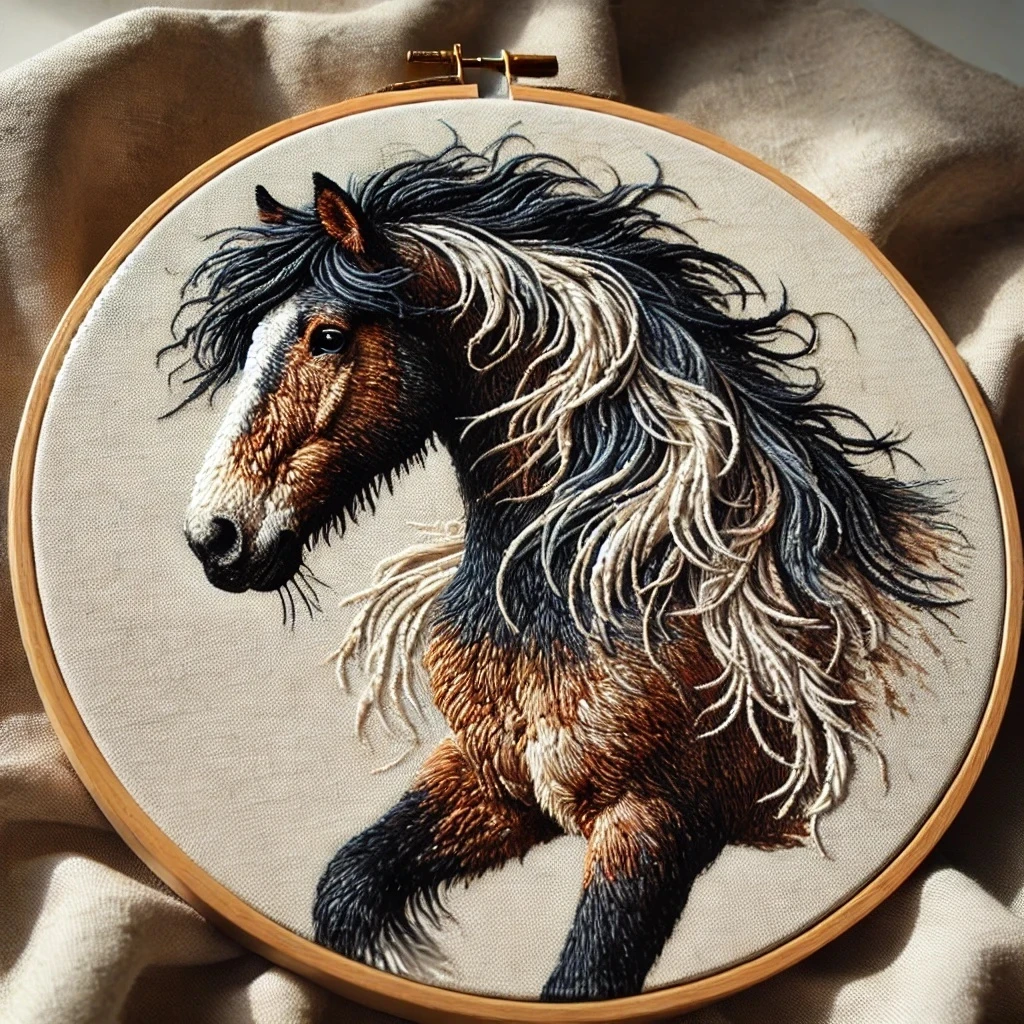
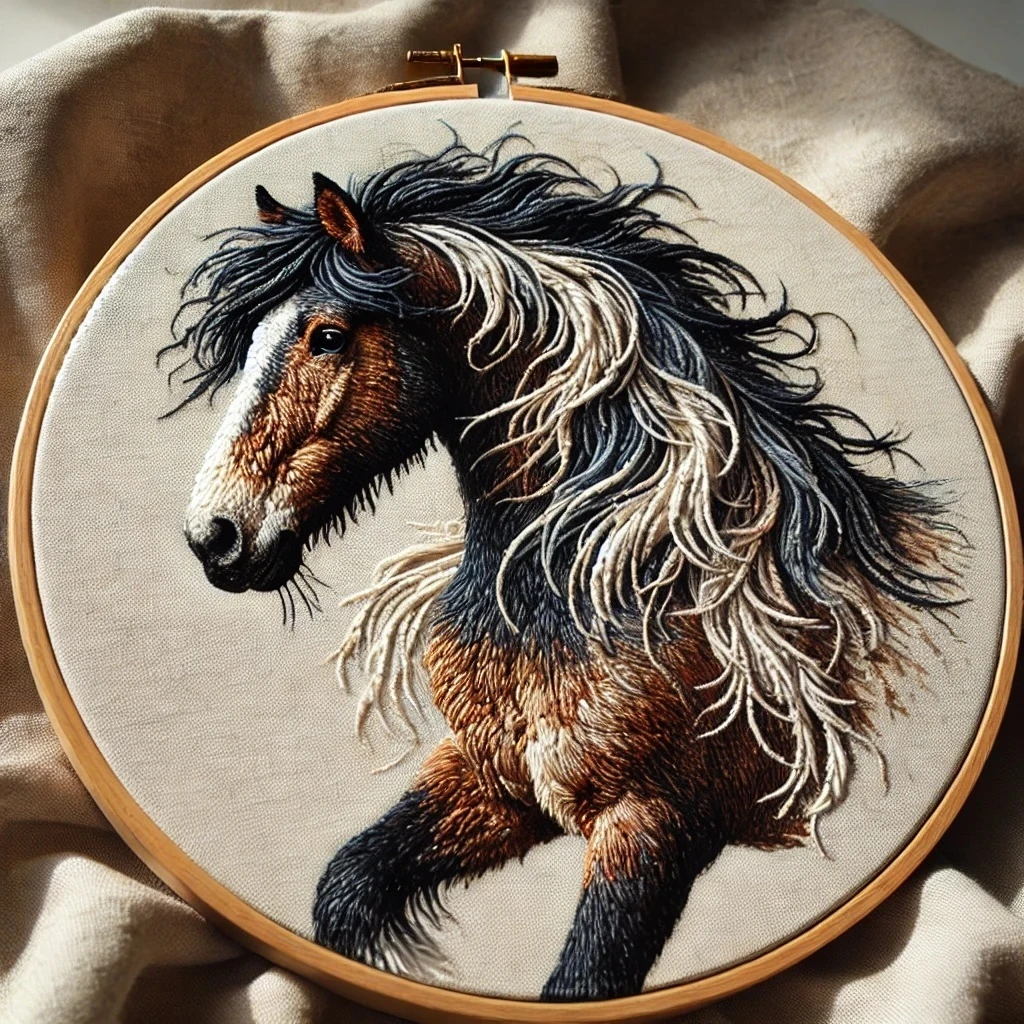
A dramatic horse portrait with a flying black-and-ivory mane, chestnut face and body, creamy white blaze, dark muzzle, glossy eye, and expressive wisps of loose hair. This guide keeps the image bold and dimensional while making the fur and mane achievable with practical hand-embroidery methods.
Suggested DMC Color Palette
The reference is built from high contrast: blue-black mane shadows, creamy white strands, warm chestnut coat, tan highlights, and a few near-black accents for the eye, nostril, muzzle, and deepest hair separations.
Stitch Map by Design Area
- Long and short stitch: Work the mane in flowing locks, following the direction of each strand rather than filling as one flat shape.
- Couching for sweep: For the longest ivory and black tendrils, couch a single strand with tiny matching stitches so curves remain graceful.
- Split stitch shadow map: Lay dark 939 and 310 lines first under the mane, then add 3799, 317, 822, and 3865 highlights on top.
- Stray hairs: Add them last with one strand and a sharp needle; let a few extend beyond the main silhouette for energy.
- Directional fur: Use short staggered straight stitches from the brow down the cheek and from the muzzle outward.
- White blaze: Fill with 3865, shade one side with 822, and blend a few 738 stitches where the blaze meets chestnut fur.
- Eye detail: Satin stitch the eye in 310, outline with 3371, then place one tiny 3865 highlight dot or short stitch.
- Muzzle texture: Use 3371 and 898 for rounded shading, then soften the nose bridge with 822 and sparse 738 stitches.
Thread Count, Blending & Shading
| Area | Strands | Guidance |
|---|---|---|
| Fine mane lines | 1 strand | Use one strand for the loose wisps and outer flyaway hairs. Keep stitches varied in length so the mane looks wind-swept. |
| Main mane locks | 2 strands | Use 2 strands for filled locks, alternating dark and light values. Avoid solid blocks by leaving narrow shadow channels between locks. |
| Chestnut coat | 1–2 strands | One strand gives the best fur texture on the face; two strands are useful for the shoulder and larger body areas. |
| Facial blaze | 1–2 strands | Use 2 strands for smooth white coverage, then add single-strand beige-gray shadows to shape the bridge of the nose. |
| Outlining | 1 strand | Use split stitch or tiny backstitch in 898, 3371, or 939. Reserve pure black for the eye, nostril, and deepest mane separations. |
Blending idea: use 801 + 975 for rich chestnut mid-tones, 975 + 434 for golden coat highlights, 939 + 3799 for blue-black mane softness, and 3865 + 822 for shaded ivory strands. Blended needles are best in transition zones, not across the entire design.
Practical Stitching Order
- Transfer the eye, blaze, nostril, ear shapes, and major mane-flow lines accurately. These landmarks keep the portrait recognizable.
- Stitch the horse’s deepest shadows first: eye, nostril, under-jaw, ear creases, and the dark channels in the mane.
- Build the chestnut face with layered short stitches, moving from dark browns to warm browns and finally light tan highlights.
- Fill the white blaze and ivory mane locks after the brown coat so the light stitches stay clean and crisp.
- Add flyaway mane strands, whisker-like muzzle texture, fine outlines, and sparkle highlights at the very end.
Beginner-Friendly Tips
- Use a firm hoop and keep the fabric drum-tight; long mane stitches look smoother when the fabric does not shift.
- Do not over-outline the horse in black. Dark brown and navy-black outlines look more natural and less cartoon-like.
- When stitching the mane, finish one lock at a time so the direction stays clear and the values do not become muddy.
- Keep the white blaze edges slightly irregular with small feathered stitches to mimic real hair.
- Start with fewer strands than you think. You can always add a second pass, but bulky thread is hard to remove from detailed facial areas.
- Use thread lengths around 14–16 inches for dark colors to reduce fuzzing and preserve crisp mane lines.
- Step back often: the mane should read as alternating dark and light ribbons from a distance, not as evenly striped rows.
- Press the finished embroidery face down on a towel so the raised hair texture and eye highlight are not flattened.