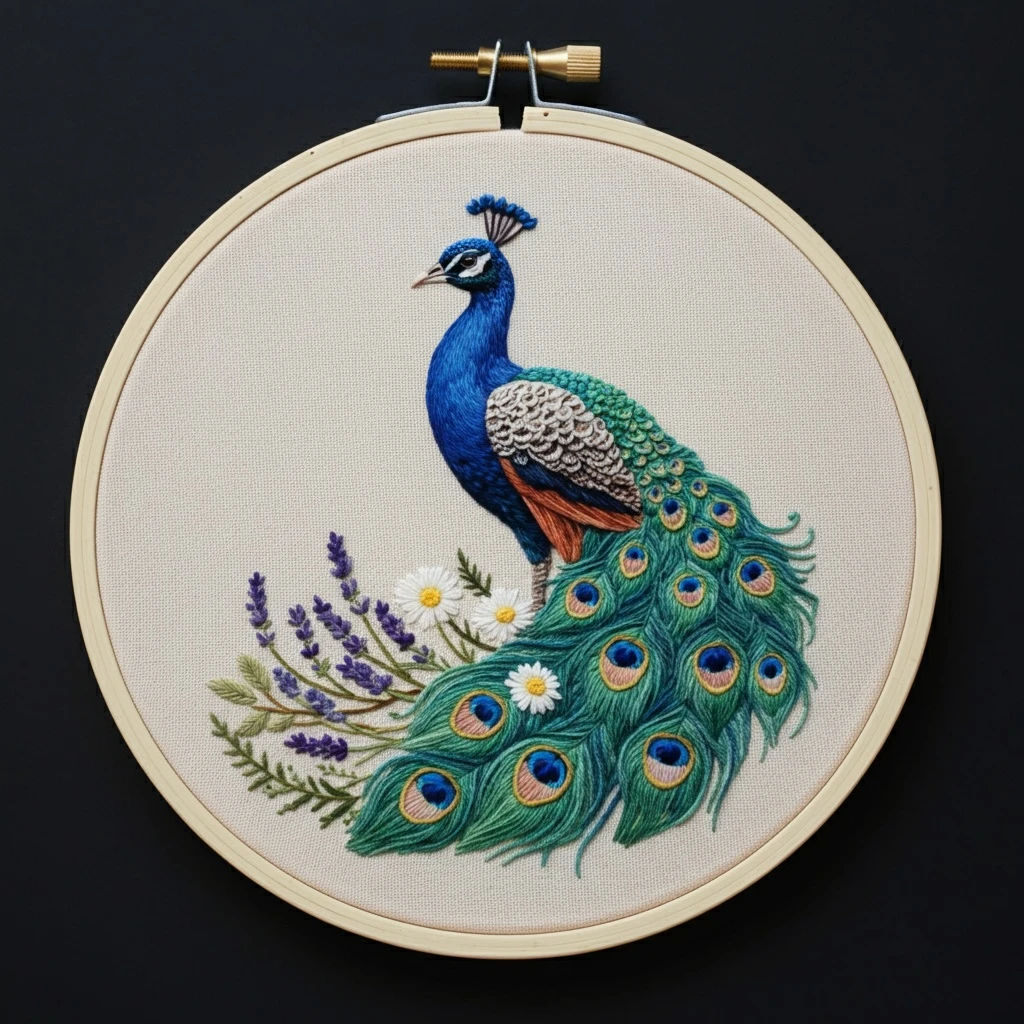

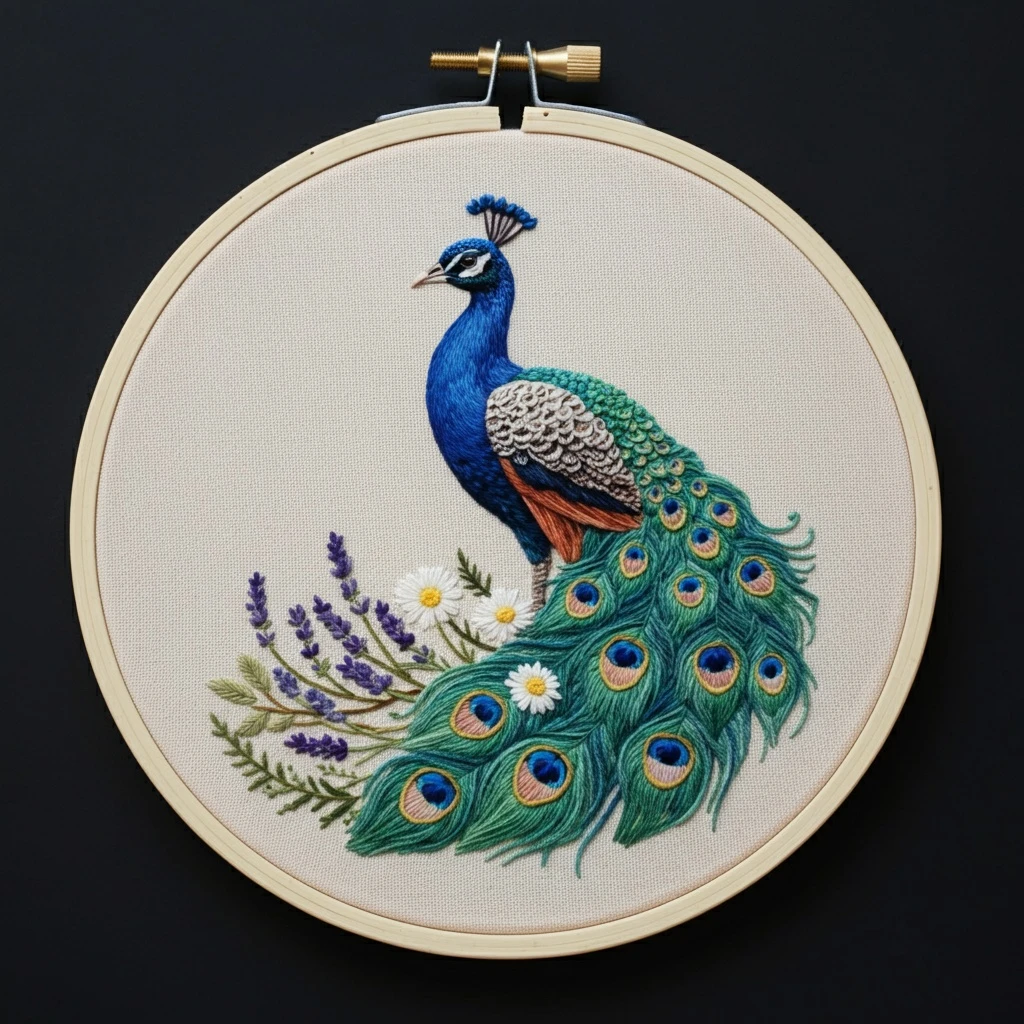
Majestic Peacock
A jewel-toned stitching plan for a proud blue peacock with layered teal tail feathers, golden eye spots, cream wing scallops, warm copper body accents, and soft lavender-and-daisy wildflowers at the base.
Color story
The design works best when the peacock reads as luminous rather than flat: keep the neck in cool blues, the tail in layered blue-greens, the eye feathers in tiny rings of gold, tan, cobalt, and black, then soften the lower edge with meadow florals.
Stitch map by design area
Use direction changes to create the peacock’s form. The head and neck need smooth curved stitches; the tail benefits from fine directional strands; flowers should stay lighter and more dimensional.
Head, crest & neck
Work long-and-short stitch in 1 strand, following the curve from beak to shoulder. Blend 995 into 820, then place 939 only at the darkest lower edge. Use detached chain or tiny satin stitches for the crest tips.
Tail plumes
Use stem stitch or split stitch for the central veins, then add long feather strokes in 3848, 3849, and 3810. Vary lengths so the plume ends look wispy rather than combed.
Feather eyes
Build each eye spot as small satin-stitch rings: old gold outer ring, hazelnut tan crescent, electric blue center, and a tiny navy pupil. Outline selectively with one strand of 3810.
Wing scallops
Use nested split stitch or small chain loops in 3865, shaded with 3828. Keep the scallops compact and raised so they contrast with the flowing tail.
Warm side feathers
Use 921 in long angled satin stitches tucked under the wing. Add a few 820 shadow strokes where the copper meets the dark body.
Wildflowers & greenery
Use lazy daisy petals in 3865, French knots in 680, lavender spikes in 333 with small detached chains, and fern stitch or fly stitch in 3012 for leaves.
Thread-count guidance
Fine detail areas
Use 1 strand for the face, eye, beak, feather-eye pupils, fine outlines, and most long-and-short shading. This prevents the small shapes from becoming bulky.
Medium fill areas
Use 2 strands for tail veins, flower stems, lavender buds, and broader body strokes. Split the floss carefully so the sheen stays even.
Raised accents
Use 2–3 strands for French knots, crest tips, daisy centers, and a few foreground leaves. Reserve thicker thread for accents only.
Blending & shading plan
For a polished result, blend by stitch direction rather than by hard color blocks. Let one shade overlap the next with staggered ends.
| Area | Suggested blend | How to use it |
|---|---|---|
| Neck shine | 1 strand 995 + nearby strokes of 820 | Place 995 on the light-facing curve and stitch 820 into the underside with uneven stitch lengths. |
| Deep blue body | 820 with minimal 939 | Use 939 sparingly at the bottom edge, around the eye, and behind the wing to avoid flattening the bird. |
| Tail movement | 3848, 3849, 3810 | Alternate shades in narrow rows. Keep 3849 near outer tips and 3810 under overlaps. |
| Eye-spot glow | 680, 3828, 995, 939 | Stitch rings from outside inward. Add the navy pupil last as one or two tiny straight stitches. |
| Wing texture | 3865 with 3828 shadow touches | Shade lower edge of each scallop with small 3828 stitches, leaving the upper edge creamy. |
Beginner-friendly stitching order
Start with the greenery
Stitch stems and fern leaves first so later tail feathers can sit visually in front of the flowers without awkward gaps.
Block the peacock body
Work the neck and body in long-and-short stitch before adding outlines. Use light pencil marks or tiny guide stitches for the feather direction.
Add wing scallops
Build the pale wing in small repeated loops or split-stitch arcs. Keep tension gentle to preserve the rounded scale texture.
Stitch tail veins, then wisps
Place main tail curves first, then fill outward with long feather strokes. Rotate the hoop so your hand follows the natural curve.
Finish with eye spots and florals
Stitch the feather eyes last so they stay crisp on top. Finish with daisies, lavender knots, and tiny highlight stitches.
Practical tips for a clean finish
Fabric & hoop
- Natural linen or cotton-linen in warm ivory suits the peacock’s jewel colors.
- Keep the fabric drum-tight; loose fabric makes long satin and feather strokes buckle.
- Use a sharp embroidery needle size 7–9 for 1–2 strand work.
Outlining choices
- Use one strand of 3810 or 820 for tail separation instead of black.
- Use 939 only for the eye, pupils, and very deep accents.
- Back stitch the beak and face with tiny stitches so expression stays delicate.
Texture control
- Do not fill every tail gap; small open fabric spaces make feathers look airy.
- Use French knots only where you want raised texture: flower centers, lavender buds, and crest tips.
- For wing scallops, repeat the same stitch size to create a tidy pattern.
Common fixes
- If the tail looks too dark, add a few 3849 strokes along the top-facing curves.
- If eye spots look crowded, remove one outline ring and rely on color contrast.
- If the neck looks stripey, stitch shorter overlap strokes with one strand to blend transitions.