
Golden Candlelight
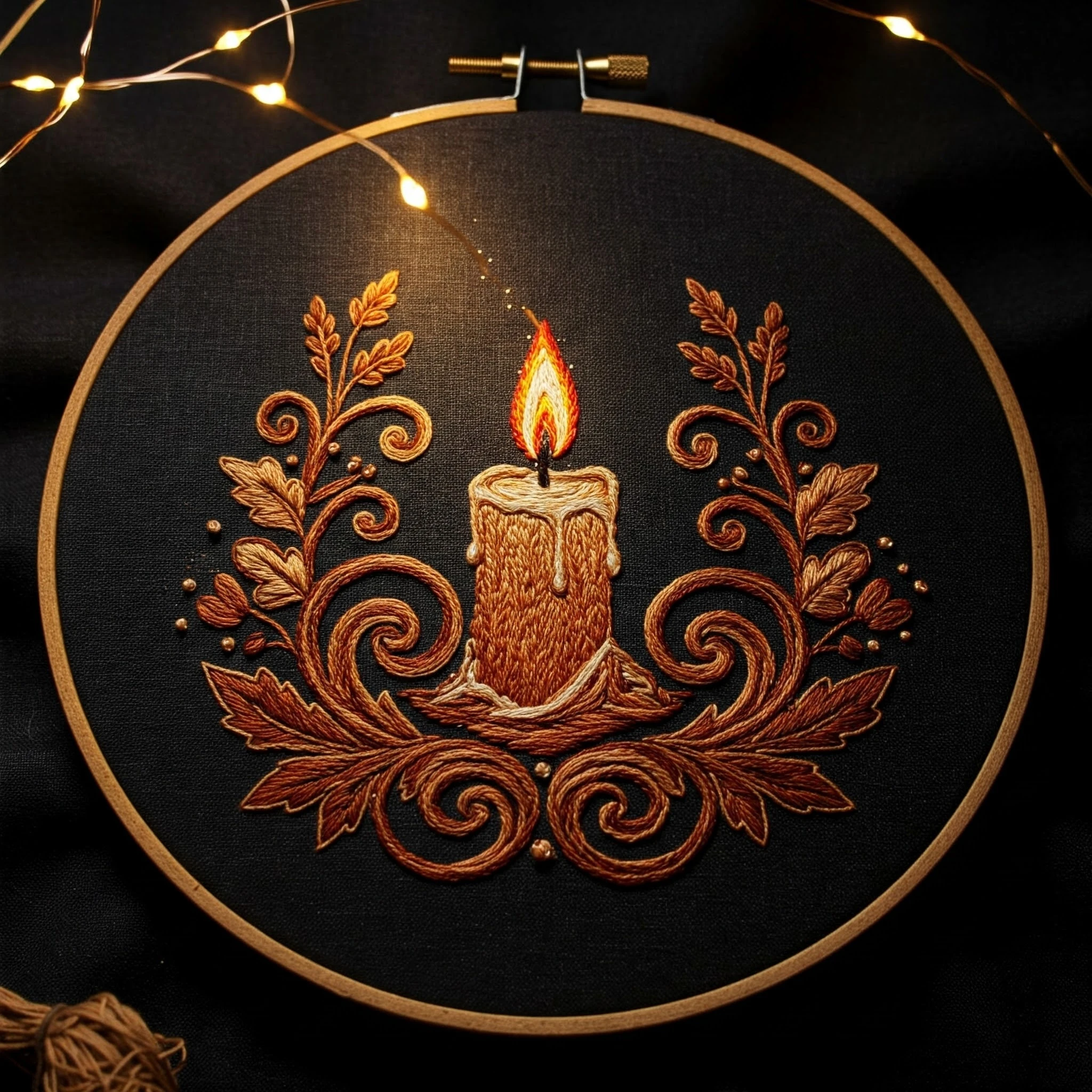
A warm, dramatic hoop design built around a glowing candle, flame, bronze acanthus scrolls, curled leaves, bead-like berries, and a deep black fabric ground. The palette leans antique gold, honey cream, copper brown, ember orange, and controlled touches of firelight.
Color read from the artwork
The reference image is dominated by a black cloth background and a centered ochre candle. Decorative scrollwork and leaves sit symmetrically around it in copper, russet, caramel, and gold. The flame adds tiny but important notes of cream, yellow, orange, and red, while the candle wax requires soft ivory shading so it stays luminous rather than flat.
Stitch map
- Candle body: work vertical long-and-short stitch in 2 strands, mixing DMC 780, 782, and 783. Keep the direction slightly uneven to mimic melted wax texture.
- Wax rim and drips: use padded satin stitch or satin over split-stitch padding with DMC 3820, 3822, and tiny DMC 746 highlights.
- Flame: layer nested satin stitches: 746/3822 center, 972 yellow-orange middle, 947 outer glow, and one fine 817 edge.
- Scrollwork: stem stitch or whipped backstitch in 2 strands. Add couching on the largest curls for a raised, gilded cord effect.
- Leaves: fishbone stitch for larger leaves; detached chain or straight stitches for small sprigs. Vein with one strand of 898 or 400.
- Berries and sparks: French knots or colonial knots in 783/3820. Wrap once for tiny sparks, twice for rounded berries.
Thread-count guidance
- 1 strand: flame edges, leaf veins, black outlines, dot trails, and final highlight marks.
- 2 strands: most candle filling, scroll stems, medium leaves, and warm outlines.
- 3 strands: lower scrolls and bold acanthus leaves when you want strong relief against black fabric.
- 6 strands or pearl cotton option: only for couching the largest scroll curls; couch with 1 strand so curves stay smooth.
On black fabric, every pale stitch shows. Start with shorter thread lengths, keep hands clean, and park light colors away from dark browns to prevent lint transfer.
Blending and shading plan
Blend one strand DMC 400 with one strand DMC 782 for a burnished copper line. Add a second pass of DMC 783 only on the upper edge of curls that face the candle.
Use DMC 780 at the outer sides, DMC 782 in the center, then DMC 783/3820 near the top rim. Stagger stitch lengths so the candle looks carved, not striped.
Keep the flame small and high-contrast. A pale 746 core framed by 972 and 947 will read brighter than using too many large red stitches.
Beginner-friendly stitching order
Transfer lightly
Use a white or pale gold transfer pencil on black fabric. Mark only the main curves, leaf centers, candle outline, and flame shape so the finished piece stays clean.
Anchor the candle first
Stitch the candle body, rim, and wax drips before the surrounding scrollwork. This establishes the brightest center and helps you judge all surrounding shadows.
Build the scroll skeleton
Outline scrolls with stem stitch in DMC 400 or 898. Then add a highlight strand along only one side of each curl for a dimensional metalwork impression.
Add leaves and berries
Fill larger leaves with fishbone stitch, then place French knots last so they remain raised and do not snag while you work nearby areas.
Finish with light
Stitch the flame, wax shine, and candle sparks at the end. These final bright marks create the golden candlelight effect and should remain crisp.
Texture suggestions
- Use split-stitch padding under the wax rim for a raised melted edge.
- Whip stem stitches on the main curls with DMC 783 to imitate gilded cord.
- Use slightly irregular long-and-short stitches on the candle to suggest ridged beeswax.
- Mix satin and fishbone stitches in the leaves so the botanical scrollwork feels ornate but still natural.
Practical tips
- Black fabric can loosen visually in the hoop; tighten gently before each stitching session.
- Use a needle minder or tray for the pale floss so it does not pick up dark fibers.
- For symmetrical scrolls, complete one small section on the left, then mirror it on the right before moving on.
- Stand back occasionally: the flame and candle rim should be the brightest points, not the berries.